
Could New Mexico Really Become “New America” After Trump’s Viral Map Posts
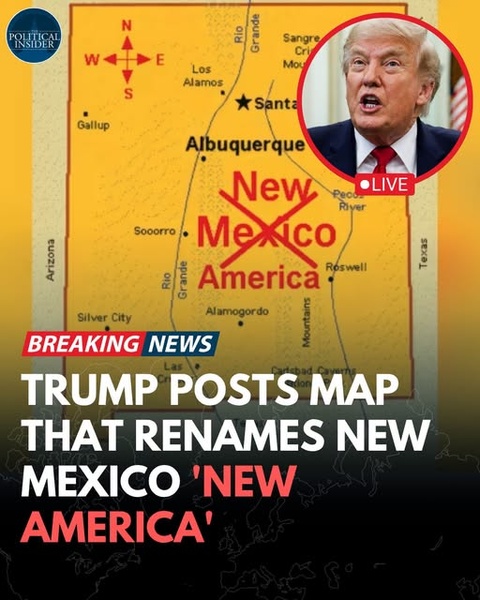
WASHINGTON — President Donald Trump has sparked a fresh political and cultural controversy by repeatedly promoting maps that relabel New Mexico as “New America,” despite lacking unilateral authority to change the state’s legal name.
The idea emerged over Labor Day weekend, when Trump shared several maps showing the southwestern state under the proposed name and said supporters had suggested the change.
Trump described “New America” as a more “prestigious and beautiful” name, while a White House account also shared one of the altered maps, giving the proposal additional national attention.


A Name Change That Is Not Actually Happening
Despite the dramatic presentation online, there has been no federal order officially renaming New Mexico. The White House has not announced a formal process to change the state’s legal identity.
That distinction separates Trump’s social-media proposal from previous federal naming actions involving geographic features such as the Gulf of Mexico and Lake Ontario.
A president can direct federal agencies to use particular names for certain geographic features, but a state’s constitutional name is governed by the state itself.
New Mexico’s Constitution explicitly states that “The name of this state is New Mexico,” placing the state’s official name inside its governing constitutional framework.
Changing that provision would require a constitutional amendment rather than a presidential proclamation or social-media announcement. New Mexico’s amendment process ultimately involves approval by state voters.
Why Trump’s Proposal Created Immediate Pushback
New Mexico Gov. Michelle Lujan Grisham rejected the proposal, saying the state’s name had existed since before the United States and was not available for unilateral change.
Members of New Mexico’s congressional delegation also opposed the idea, arguing that the state’s name belongs to its residents and is protected by the state constitution.
Sen. Ben Ray Luján and other members of the delegation subsequently asked Apple and Google to publicly commit to keeping New Mexico on their digital mapping services.
Their request reflects concerns that technology companies could potentially adopt presidentially promoted terminology, as some mapping services previously did with “Gulf of America” and “Lake America.”


The Constitution Creates a Major Barrier
Article I of New Mexico’s Constitution identifies the state as New Mexico, while Article XIX establishes procedures for changing the state constitution through amendments.
Under the current amendment process, a proposed constitutional change must be approved by the legislature before being submitted to voters for ratification.
The legislature’s official materials explain that constitutional amendments generally require legislative approval followed by a majority vote among electors voting on the proposition.
That means neither the White House nor Congress can simply issue an order replacing New Mexico’s constitutional name with “New America.”
Even if federal agencies began informally using the proposed terminology, that would not automatically alter New Mexico’s legal identity, state constitution, government documents or state law.
Why New Mexico Is Called New Mexico
The state’s name has deep historical roots stretching back centuries, long before New Mexico became part of the United States.
Reuters reported that the region was known as La Nueva Mexico in the 16th century, when Spanish explorers applied the name to territory north of the Rio Grande.
The area subsequently passed through Spanish and Mexican rule before becoming part of the United States during the 19th century, creating a complex cultural history.
New Mexico today retains strong Spanish, Mexican, Native American and Hispanic cultural influences, making the state’s name closely connected to its historical identity.
Reuters reported that residents interviewed across the state described the proposed renaming as an attempt to erase or diminish aspects of that history.


Part of Trump’s Broader Naming Campaign
The New Mexico proposal follows Trump’s earlier efforts to change the names used by the federal government for major geographic features.
In 2025, Trump directed federal agencies to use “Gulf of America” instead of Gulf of Mexico in official federal references.
In August 2026, he similarly ordered federal references to Lake Ontario to use “Lake America,” following tensions with Canada over trade and other issues.
Those cases differ legally because geographic-feature naming within federal government usage does not require rewriting a state constitution.
New Mexico therefore presents a substantially different legal question: changing its official name would require action through the state’s constitutional amendment system.
Could Trump Still Push the Name?
Trump could potentially encourage federal agencies to use “New America” in certain federal references, depending on existing administrative authority and naming procedures.
But such an administrative change would not force New Mexico’s government, residents, businesses or state institutions to recognize “New America” as the state’s legal name.
Nor would it automatically require private companies such as Apple and Google to adopt the terminology across their mapping platforms.
The companies’ decisions could nevertheless become politically significant, particularly after New Mexico lawmakers asked them to commit publicly to retaining the existing name.
As of the latest reporting, there was no announced federal process capable of immediately replacing New Mexico’s constitutional name.
A Viral Proposal, Not a Completed Renaming
Trump’s posts have nevertheless generated substantial attention because they present a visual version of a hypothetical future, with maps already displaying the proposed name.
The altered graphics can make the change appear official even though no legal renaming has occurred.
The Washington Post noted that Trump lacks authority to rename New Mexico or another state unilaterally, although federal agencies could potentially be instructed to use different terminology.
The distinction between a presidential proposal, federal administrative usage and an actual constitutional amendment is therefore central to understanding the controversy.
For now, New Mexico remains New Mexico, and changing that legal name would require a state constitutional process involving lawmakers and voters.
The episode illustrates how a presidential social-media post can trigger a national debate over history, identity and governmental authority even when the proposed change itself has no immediate legal effect.
Comments (0)
Loading comments...
May You Like

Barack Obama Draws Attention With New Literary Podcast

OBAMA STUNS ON INSTAGRAM: MESSAGE MARKING 34-YEAR MILESTONE SPARKS A BUZZ
Jack Smith Defends His Integrity as Trump Investigations Face Renewed Political Firestorm













