
Could This Lawsuit Block Trump’s New Green Card Rule Before It Takes Effect?
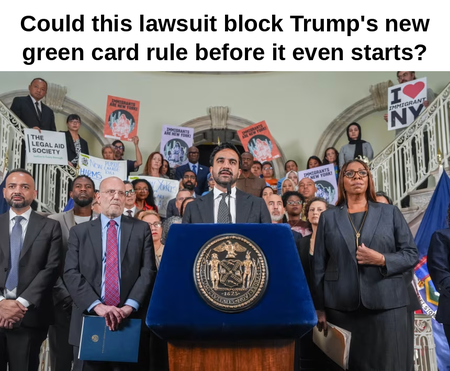
NEW YORK — September 15, 2026 — A coalition of states, cities and immigration advocates has launched a last-minute legal challenge to a new Trump administration policy that would give immigration officers significantly broader authority to consider an applicant’s use of public benefits when deciding whether to approve a green card.
The lawsuits were filed Monday, just three days before the rule is scheduled to take effect on September 18, setting up a potentially consequential court battle over one of the administration’s most significant immigration-policy changes this year.
The central question is now whether a federal judge will intervene quickly enough to prevent the policy from taking effect — and whether the courts will ultimately conclude that the Department of Homeland Security went beyond the authority Congress gave it.
A major expansion of the “public charge” test
The new policy revives and substantially broadens the Trump administration’s approach to the immigration-law concept known as “public charge.”
Under U.S. immigration law, certain people seeking admission or adjustment to permanent-resident status can be denied if immigration officials determine they are likely to become a public charge.
The Trump administration's new rule rescinds regulations adopted in 2022 and restores much broader discretion for DHS officers to evaluate an applicant's circumstances. The final rule was published July 20 and is scheduled to become effective September 18.
The administration argues that the change is necessary to ensure immigrants are financially self-sufficient and do not become dependent on taxpayer-funded assistance.
DHS said the previous 2022 regulations were too restrictive and prevented officers from making what it considers more accurate assessments of whether an applicant is likely to become a public charge.
But opponents say the new framework could make immigration decisions considerably less predictable.
What benefits could be considered?
This is where the new rule becomes especially controversial.
The administration's new framework allows immigration officers to consider means-tested public benefits much more broadly than under the current 2022 regulations.
The states challenging the rule argue that this could include benefits involving areas such as:
- Medicaid and other health coverage
- SNAP and food assistance
- Housing assistance
- School-related benefits
- Other means-tested federal, state or local programs
The Massachusetts-led complaint argues that the final rule removes previous limitations on which benefits could be considered and gives officers broad discretion without clearly explaining how individual benefits should be weighed.
That does not mean every immigrant who has ever received a government benefit will automatically lose the ability to obtain a green card.
The determination is supposed to involve an assessment of the applicant's circumstances rather than an automatic disqualification.
That distinction is important — and it is one reason the legal battle is likely to focus heavily on how much discretion immigration officers should have.
Two lawsuits were filed
The legal challenge is actually made up of two separate lawsuits.
One was brought by New York Attorney General Letitia James, joined by 21 other states and the District of Columbia. The coalition is asking the U.S. District Court for the Southern District of New York to block the rule.
A second lawsuit was filed by a coalition led by New York City, joined by Chicago, San Francisco, Santa Clara County, Seattle and King County, Washington, together with the Public Rights Project.
The two cases were filed in the same federal district on September 14.
The state case is New York v. U.S. Department of Homeland Security, while the local-government case is City of New York v. U.S. Department of Homeland Security.
The plaintiffs are seeking court intervention before Friday's implementation date.
Why are the states challenging it?
The states argue that the administration has effectively rewritten immigration law without sufficient authority from Congress.
New York Attorney General James said the rule gives individual immigration officers sweeping power to penalize immigrants for legally using public benefits.
The coalition argues that the policy conflicts with more than a century of immigration-law principles and violates the Administrative Procedure Act, which governs how federal agencies create and implement regulations.
The states also contend that the rule could create a “chilling effect.”
Immigrant families may become afraid to use healthcare, food assistance or housing programs even when they are legally entitled to those benefits.
That could affect not only immigrants applying for permanent residence but also U.S.-citizen children and other family members living in mixed-status households.
New York City officials made a similar argument, warning that families could feel forced to choose between receiving assistance and protecting an immigration pathway.
The Trump administration strongly disagrees
The federal government has defended the rule as a legitimate exercise of DHS authority.
The administration says immigration policy has long incorporated the principle that people seeking permanent residence should be capable of supporting themselves rather than relying primarily on government assistance.
The Federal Register rule states that DHS is seeking to restore broader discretion and align immigration policy with what it describes as Congress's longstanding goal of self-sufficiency.
A DHS spokesperson has also sharply criticized the lawsuits, arguing that Democratic-led states and cities are attempting to obstruct the administration's immigration policies.
The dispute therefore goes well beyond the technical details of immigration forms.
At its core is a disagreement over how much power the federal government should have to determine whether an immigrant is likely to rely on public assistance in the future.
The September 18 deadline is critical
The timing of the lawsuits is especially important.
The final rule explicitly says it applies to applications for admission made on or after September 18, 2026, and to adjustment-of-status applications postmarked or electronically submitted on or after that date. Benefits received before September 18 are treated under the previous framework.
That means the lawsuits were filed only days before implementation.
If a federal judge issues a preliminary injunction, the rule could be temporarily blocked while the litigation proceeds.
If the court declines to intervene, the regulation could take effect Friday even while the lawsuits continue.
Filing a lawsuit alone does not stop the rule. A court would need to issue an order preventing the government from enforcing it.
As of September 15, there is no reported court order blocking the rule.
This is not the first legal fight over “public charge”
The Trump administration faced a similar legal battle during its first term.
In 2019, the administration adopted a broader public-charge policy that allowed officials to consider certain benefits, including Medicaid, food assistance and housing benefits.
That policy was challenged in court and generated extensive litigation before ultimately being rescinded by the Biden administration in 2022.
The current administration is now attempting to move back toward a broader interpretation, but with an important difference: the 2026 rule explicitly rescinds the Biden-era regulatory framework and returns much greater discretion to immigration officers.
That history could become central to the new litigation.
The challengers will likely argue that the government has not adequately justified its departure from the 2022 framework and has failed to account for the reliance interests created by the earlier policy.
Who would actually be affected?
The new rule does not apply to everyone with an immigration connection to the United States.
For example, people who already hold green cards generally are not subject to a public-charge determination simply because they receive benefits while remaining in the United States.
The rule primarily matters to people whose immigration applications are subject to the public-charge ground of inadmissibility, including certain applicants seeking adjustment of status or admission to the United States. Some categories of immigrants are exempt.
That means the viral description that the rule will simply “take away green cards from immigrants who use benefits” is misleading.
The real change is that a broader range of financial and benefit-related information could become relevant when officials evaluate certain applications.
The stakes for immigrant families are significant
For immigrant families, uncertainty may be almost as important as the final legal outcome.
If applicants believe that using Medicaid, food assistance or other programs could jeopardize their immigration prospects, they may avoid programs they are legally eligible to receive.
That concern is one of the central arguments advanced by the states and cities.
California Attorney General Rob Bonta, whose state joined the lawsuit, said the new rule could force families to choose between access to healthcare or food assistance and their pathway toward permanent residency.
The administration sees the issue differently, arguing that immigration benefits should favor people who can demonstrate financial independence.
The courts will ultimately have to determine whether the government's interpretation is legally permissible.
Could a judge stop the rule before Friday?
Yes — legally, that is possible.
The plaintiffs can seek a preliminary injunction or other emergency relief preventing DHS from implementing the rule while the lawsuit proceeds.
To obtain such relief, they would generally need to persuade the court that they are likely to succeed on their claims and that allowing the rule to take effect would cause serious, potentially irreparable harm, among other considerations.
But filing on September 14 leaves very little time.
If no emergency order is issued before September 18, the regulation is scheduled to take effect according to its published terms.
Even then, the lawsuits would continue and could eventually determine whether the regulation survives.
A legal showdown with national consequences
The dispute is likely to attract attention well beyond New York.
If the challengers prevail, the decision could restrict how broadly DHS can interpret the public-charge provision nationwide.
If the administration wins, immigration officers would retain the expanded discretion outlined in the 2026 regulation, potentially making financial circumstances and use of means-tested benefits a more significant part of green-card adjudication.
The case could therefore become another major test of Trump's broader immigration agenda — particularly the administration's effort to use existing immigration statutes to impose stricter standards without waiting for Congress to enact entirely new legislation.
The bottom line
Trump's new green-card rule is not blocked yet.
The lawsuits filed Monday by New York, 21 other states, Washington, D.C., New York City and several other local governments represent a serious legal challenge, but a lawsuit by itself does not suspend a federal regulation.
The rule is currently scheduled to take effect September 18, 2026, giving the courts only a few days to consider emergency relief.
The central battle is over whether DHS has lawful authority to give immigration officers such broad discretion to consider public benefits when evaluating green-card applicants.
If a judge grants an injunction before Friday, Trump's new policy could be stopped before it begins. If no injunction is issued, the rule will take effect while the larger legal battle continues.
For thousands — potentially millions — of immigrant families watching the case, the next few days could determine whether the new public-charge system becomes reality or is halted at the courthouse door.
Comments (0)
Loading comments...
May You Like

South Korea–Ukraine Rift Deepens Over North Korean POW Transfer as PURL Draws New Scrutiny

Russian Drone Strikes Kyiv Bridge as German Chancellor Arrives in Ukraine
TRUMP HIT WITH 26 ARTICLES OF IMPEACHMENT













