Dan Sullivan Faces Viral Backlash After Appearing to Copy Mary Peltola’s Answer During Alaska Debate
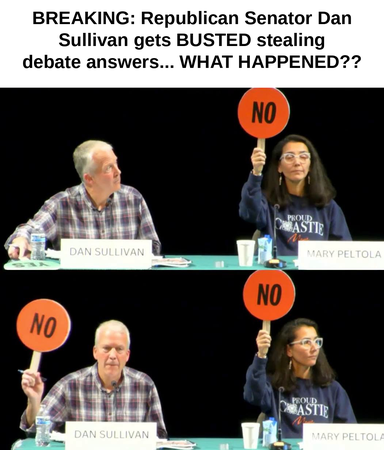
KODIAK, Alaska — September 15, 2026 — A brief moment during a U.S. Senate debate in Alaska has exploded across social media after Republican Sen. Dan Sullivan appeared to look at Democratic challenger Mary Peltola’s answer before giving his own response during a rapid-fire question round.
The incident occurred Saturday, September 12, during a fisheries-focused debate hosted by the Kodiak Chamber of Commerce. The candidates were asked a series of yes-or-no questions using paddles marked “Yes” and “No.”
What followed was an awkward exchange that quickly became one of the most talked-about moments of the debate.
The moment that went viral
The moderator asked whether the North Pacific Fishery Management Council and NOAA Fisheries adequately consider the effects of their decisions on subsistence users, salmon migration, habitat and Indigenous ways of life.
Peltola immediately raised her red “No” paddle.
Sullivan, meanwhile, appeared to be looking down at papers on the table and did not initially respond. A moderator prompted him directly: “Mr. Sullivan, sir. Yes or no?”
Sullivan then looked up and glanced sideways toward Peltola's paddle before raising his own paddle with the same “No” answer.
The audience laughed, while Sullivan smiled and apologized.
The episode was captured on video and quickly circulated online, with headlines describing it as Sullivan “cheating,” “copying” or “stealing” Peltola's answer.
However, the footage itself establishes that Sullivan looked at Peltola's paddle before displaying the same answer; it does not establish what was in his mind or whether he deliberately intended to copy her.
Peltola turns the moment into a campaign weapon
Peltola wasted little time using the incident against her Republican opponent.
After the debate, she posted the clip on social media with the caption:
“Happy to help, Dan.”
She later added that Alaskans deserve a senator who knows where he stands.
The exchange gives Peltola an unusually simple campaign message: she can portray Sullivan as a senator who was unprepared for a question about one of Alaska's most important industries.
For Sullivan, the episode is particularly unfortunate because the debate was specifically focused on fisheries — an issue central to Alaska's economy, culture and politics.
The debate was about much more than the viral clip
Despite the attention surrounding the paddle incident, the debate itself centered on serious disagreements over the future of Alaska's fishing industry.
Both candidates promised to address bycatch — particularly the capture of salmon and other species by large trawling operations.
Sullivan emphasized his legislative record, pointing to his work on seafood policy and his effort to advance a Bycatch Reduction Act through the Senate Commerce Committee. He also highlighted his efforts to restrict Russian seafood imports and pursue similar restrictions involving China.
Peltola took a different approach.
She criticized large Seattle-based pollock catcher-processors and accused Sullivan of being too close to the commercial trawling industry. She also pointed to approximately $300,000 in political contributions from the trawl industry, arguing that Alaska needed stronger action against factory trawling.
The fisheries debate therefore reflected a broader political divide over whether Alaska's seafood policy should prioritize large commercial operations or place greater emphasis on small fishermen, subsistence users and Alaska Native communities.
A critical Senate race
The controversy comes at a politically sensitive time for Sullivan.
The incumbent Republican is seeking reelection against Peltola in one of the country's closely watched Senate contests.
Reuters has identified Alaska as one of nine competitive Senate races that could help determine control of the chamber. Peltola received roughly 82,000 votes in Alaska's August nonpartisan primary, compared with about 69,000 for Sullivan. Another Republican named Dan J. Sullivan also advanced to the November election, creating an unusual three-way Republican-Democratic contest.
Alaska's ranked-choice voting system adds another layer of uncertainty to the race.
The outcome could have national consequences because Republicans currently hold the Senate majority, while Democrats need to gain four seats to take control of the chamber.
Sullivan's larger challenge
The viral debate moment is unlikely by itself to determine the election.
But it arrives as Sullivan attempts to defend his record against a challenger who is presenting herself as a more independent voice for Alaska.
Peltola has focused heavily on fisheries, subsistence communities and the influence of large out-of-state fishing companies. Sullivan, meanwhile, has emphasized his experience in Washington and legislation he says has benefited Alaska's fishermen.
That contrast could become increasingly important as the November election approaches.
The debate also demonstrated how quickly a complicated policy discussion can be overshadowed by a few seconds of television-ready political drama.
What actually happened?
The strongest version of the claim — that Sullivan was definitively “caught stealing debate answers” — goes beyond what can be established from the footage.
What is documented is straightforward:
- Peltola raised her “No” paddle.
- Sullivan initially appeared distracted and did not answer.
- A moderator prompted him.
- Sullivan looked toward Peltola's paddle.
- He then raised his own “No” paddle.
- The audience laughed.
- Peltola subsequently used the clip in her campaign messaging.
That sequence is why the moment has become such an effective viral clip — but whether it represents deliberate copying or simply Sullivan confirming an answer after missing the question remains an interpretation.
The bottom line
Dan Sullivan's brief glance at Mary Peltola's answer has become a major viral moment in one of America's most competitive Senate races.
The episode is embarrassing for the incumbent, but the larger significance lies in what the exchange reveals about the campaign: fisheries, bycatch, Indigenous interests and the influence of large commercial fishing operations are becoming defining issues in the Alaska race.
And with the Senate majority potentially at stake, a six-second moment at a Kodiak debate has suddenly become another weapon in a campaign where every advantage could matter.
Comments (0)
Loading comments...
May You Like

Russian Drone Strikes Kyiv Bridge as German Chancellor Arrives in Ukraine
Jack Smith Defends His Integrity as Trump Investigations Face Renewed Political Firestorm