
"Defensive Strikes": Inside the U.S. Attack on Iran’s Qeshm Island—and the Midterm Gamble That Could Define a Presidency
"Defensive Strikes": Inside the U.S. Attack on Iran’s Qeshm Island—and the Midterm Gamble That Could Define a Presidency
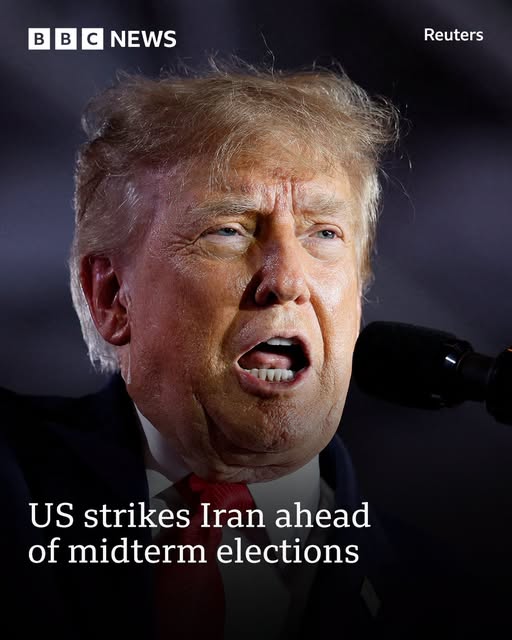
The image is a portrait of a president in the final hours of a political war: Donald Trump, mid-speech, the BBC News chyron cutting to the heart of the moment: “US strikes Iran ahead of midterm elections.”
The post, shared widely across social media on the eve of the November 3, 2026 midterms, captures a moment of extraordinary political and geopolitical tension. It was not a policy announcement or a carefully scripted address. It was a sudden, limited military strike on a strategic Iranian island, carried out just hours before Americans were set to vote in an election that could determine the future of Trump’s presidency. The White House called it “defensive.” Critics called it a reckless escalation. And the world held its breath, waiting to see if the tenuous diplomatic track that had briefly raised hopes of a settlement would survive the explosions on Qeshm.
This is the story behind the strikes, the strategic island at their center, and the high-stakes gamble that could reshape the Middle East and American politics.
The Verdict: A Real, Limited Strike, Delivered at a Delicate Moment
Unlike many viral political headlines, this one is grounded in verifiable reporting and direct quotes. On Monday, November 2, 2026—the eve of the U.S. midterm elections—U.S. forces launched limited strikes on Qeshm Island, a strategically vital Iranian territory in the Strait of Hormuz. The strikes were confirmed by multiple U.S. officials to CBS, the BBC’s U.S. partner, and other outlets. Iranian state media reported several explosions on the island.
The official justification was straightforward: the strikes were “defensive” in nature, a response to Iran’s Islamic Revolutionary Guard Corps (IRGC) firing on a U.S. aircraft. U.S. officials described the operation as “limited” and “not a full return to hostilities” , emphasizing that it was designed to prevent Iran from attacking commercial shipping in the Strait. The White House deliberately kept the operation quiet, with one official stating that the U.S. “intentionally maintained a low profile” to avoid signaling a resumption of major combat operations.
The Target: Qeshm Island and the Strait of Hormuz
The choice of target was not random. Qeshm Island sits just off the Iranian coast on the northern side of the Strait of Hormuz, the narrow waterway through which a fifth of the world’s oil and gas shipments normally pass. The island is home to a large underground missile launch site, a naval base, and a major desalination plant—making it a critical node in Iran’s ability to project power and disrupt shipping in the strait.
The U.S. had targeted Qeshm in previous phases of the conflict, and American officials had even discussed plans to seize the island. The strikes on Monday were part of a series of “undeclared, limited attacks” that the U.S. had been carrying out against Iranian targets in recent weeks, according to The Wall Street Journal. But this one was different: it came on the eve of an election, and it was impossible to separate from the political calendar.
The Timing: A Broken Promise?
The political significance of the timing cannot be overstated. President Trump had previously said the U.S. would not launch strikes on Iran before the midterms. His own vice president, JD Vance, had told reporters just hours earlier that he and Trump were optimistic about securing a negotiated settlement. And Trump himself had told Axios that he was in “no rush” to escalate the conflict.
Yet, the strikes happened. The White House’s explanation—that they were a response to an IRGC attack on a U.S. aircraft—was technically consistent with Trump’s promise not to launch a new offensive. But the distinction was lost on many. The strikes were the latest in a series of low-profile operations that had been unfolding for weeks, and they landed on the eve of an election that was already shaping up as a referendum on the war.
The War: Eight Months of Conflict, Billions in Costs
The strikes on Qeshm were the latest chapter in a war that began on February 28, 2026, when the U.S. and Israel launched massive strikes on Iran. The conflict has been devastating. By midsummer, it had killed at least 8,000 people, mostly in Iran and Lebanon. The U.S. had lost 17 service members by early October, with dozens more wounded. Iranian officials reported dozens killed and hundreds wounded in U.S. strikes.
The economic toll has been equally severe. The war has cost the U.S. at least **$47.1 billion**, according to a U.S. Central Command estimate. Oil prices surged, with Brent crude exceeding $90 a barrel and U.S. gasoline prices climbing above $4 a gallon. The war has been a persistent drag on the U.S. economy and a political liability for Republicans, who are fighting to retain control of Congress.
The Diplomacy: A Fragile Track That Survived the Explosions
What makes the strikes on Qeshm so extraordinary is that they occurred against the backdrop of an intense, ongoing diplomatic effort to end the war. Iranian Foreign Minister Abbas Araghchi confirmed that “very intensive” indirect talks with the U.S. were underway, mediated by Qatar and Pakistan. Iran had even offered a proposal to reopen the Strait of Hormuz within two days if the U.S. met a series of conditions, including lifting the naval blockade and releasing frozen Iranian assets.
Vice President Vance said he and Trump were optimistic about securing an agreement. And Iran’s chief negotiator, Mohammad Bagher Ghalibaf, declared that “the ball is now in America’s court to prevent war” .
The strikes did not end the diplomatic track. Iranian officials confirmed that talks were still ongoing even after the explosions on Qeshm. But the trust that had been slowly building was, once again, shattered. The question now is whether the diplomatic window can survive the military reality.
The Political Fallout: A War That Could Sink a Presidency
The strikes came as Trump was already facing falling poll numbers and mounting pressure from within his own party to end the war. A recent POLITICO poll found that 29 percent of Republican midterm voters would blame Trump if the party performed worse than in 2024. An increasing number of Republican lawmakers were scrambling to distance themselves from a costly, unpopular conflict.
The timing of the strikes—on the eve of the election—was seen by many as a political gamble. Some analysts suggested that if Republicans lost the midterms, Trump might feel more free to escalate the war, rather than less. Others argued that the strikes were designed to project strength and rally his base, even as the broader war remained deeply unpopular.
The Bottom Line
The viral graphic is right about one thing: the United States did strike Iran ahead of the midterm elections. But the story is not just about a single military operation. It is a story about a president who is trapped between a war he cannot end and a diplomatic track he cannot fully trust. It is a story about a strategic island in a vital waterway, and a conflict that has cost thousands of lives and billions of dollars. And it is a story about an election that will determine whether the American people endorse the path Trump has chosen—or demand a different one.
For now, the explosions on Qeshm have faded, but the questions they raised have not. As voters head to the polls, the world is watching to see whether the United States will choose the “wise path” of negotiation that Iran has offered, or the “mistake of military aggression” that has already defined so much of this conflict.
📸 Suggested Images
-
The Strike: A photo of Qeshm Island or the Strait of Hormuz, with a caption noting the strategic importance of the waterway and the location of the strikes.
The President: A photo of Donald Trump at a rally or speaking to reporters, with a quote overlay of “No rush” and the BBC chyron.
The War: A photo of U.S. military personnel or a map of the Middle East highlighting the conflict zone, with a caption noting the $47.1 billion cost and the casualties.
The Diplomacy: A photo of Iranian Foreign Minister Abbas Araghchi or Qatari mediators, with a quote overlay of “The ball is now in America’s court.”
The Election: A photo of Americans voting, with a caption noting that the midterms could determine the next phase of the war.
Comments (0)
Loading comments...
May You Like

TRUMP CALLS GDP FIGURE “FAKE” AFTER GOVERNMENT’S SCHEDULED REVISION


FCC CLEARS SPACEX FOR ONE MILLION AI SATELLITES AS ASTRONOMERS SOUND ALARM

Latest Posts








Popular Posts




