Democrats Propose Banning AI Data Centers on Federal Lands — And Tearing Down Existing Ones
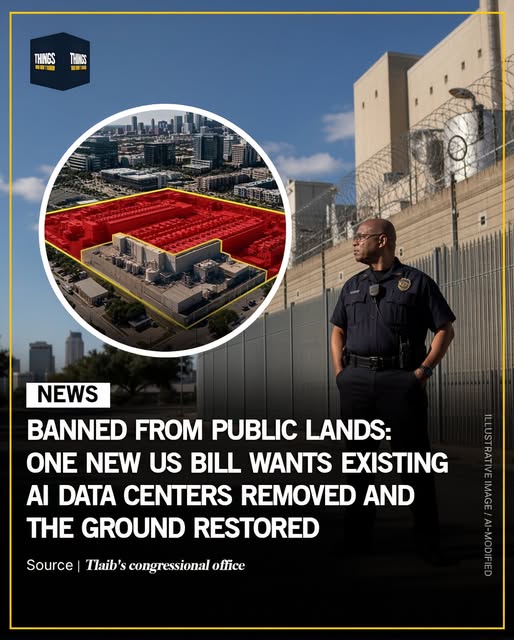
A new bill introduced by U.S. Representative Rashida Tlaib would permanently prohibit AI data centers from federal lands, including military bases — and go even further by requiring existing facilities to be removed and the land restored. The proposal comes as a growing grassroots backlash against data centers sweeps across the country, with nearly 70% of Americans opposing such facilities in their communities.
WASHINGTON – The image circulating online is real: Rep. Rashida Tlaib (D-MI) has introduced the "No AI Data Centers on Federal Lands Act" in the U.S. House of Representatives . The bill, introduced on July 23, 2026, would permanently ban large-scale AI data centers and their supporting infrastructure from land owned or managed by the federal government — including military bases .
But the legislation goes further than simply blocking new projects. Existing facilities that qualify under the bill could be required to close, be dismantled, and have the surrounding land environmentally restored . The bill has been referred to committee, where it faces an uncertain future in the Republican-controlled House .
What the Bill Would Do
The "No AI Data Centers on Federal Lands Act" includes three key provisions :
| Provision | Details |
|---|---|
| Permanent prohibition | Bans new AI data centers and associated infrastructure on federal land, including military bases |
| Removal mandate | Requires existing qualifying facilities to be removed |
| Land restoration | Mandates environmental restoration of affected land |
The bill is backed by environmental and anti-war organizations who argue that public lands should not subsidize a highly resource-intensive AI construction boom that consumes massive amounts of electricity and water while producing noise and emissions .
Why Now? The Growing Backlash Against Data Centers
Tlaib's bill comes amid a national wave of opposition to data centers that has been building for months. Communities across the United States are confronting the physical footprint of the AI boom — and they're pushing back .
The Numbers Tell the Story
-
71% of Americans oppose building an AI data center in their local area, according to a recent Gallup poll .
48% are "strongly opposed" .
75 data center projects worth roughly $130 billion have been blocked or delayed in the first three months of 2026 alone .
At least 37 people have been detained during AI data center protests this year .
14 states have considered or are considering moratoriums on data centers .
Monterey Park: A Case Study
The city of Monterey Park, California, became a flashpoint in June 2026 when residents voted overwhelmingly — by an 88.3% margin — to permanently ban large-scale data centers citywide . It was the first U.S. city to enact such a ban through a citizen referendum .
The conflict began when an Australian developer (DigiCo Infrastructure, through its subsidiary HMC Capital) proposed building a 50-megawatt AI data center less than 500 feet from the nearest homes — about three times the city's entire power demand . Residents packed city council meetings, with nearly 100 people submitting speaking cards to voice concerns about electricity consumption, noise, and declining property values . When the developer repeatedly failed to hold public information sessions, the controversy escalated . The project was eventually withdrawn, and the city council passed a ban .
The Resource Reality: Why Communities Are Fighting Back
Data centers, which house the computing systems needed to train and run AI models, require enormous amounts of resources . The concerns cited by opponents are grounded in hard numbers:
Water and Energy Consumption
A study by Ceres, a nonprofit focused on water sustainability, quantified the problem: power plants supplying data centers in seven high-density states (Virginia, Texas, California, Illinois, Georgia, Ohio, and Arizona) withdraw approximately 3.4 trillion gallons of freshwater annually — more than California's average annual urban water demand . 66% of those plants face medium-to-high water stress .
The U.S. Department of Energy estimates that data centers consumed about 4.4% of total U.S. electricity in 2023, with the share projected to rise to 6.7-12% by 2028 . Goldman Sachs Research projects U.S. data center power demand could rise from about 31 gigawatts in 2025 to 66 gigawatts in 2027 .
Cost to Consumers
In Arizona, the state's largest utility proposed a 45% rate increase on "extra-large energy users" — a category made up primarily of data centers — while also proposing a roughly 14.5% increase for residential customers . Lawmakers have since moved to suspend a sales tax exemption for data centers .
The Federal Push vs. Local Resistance
Tlaib's bill directly challenges a broader push by federal agencies to fast-track AI development on public lands . In April 2025, the Department of Energy identified 16 federal sites that could host data centers and new energy infrastructure . Some projects are already advancing:
-
The Bureau of Land Management approved a data center on 88.5 acres of public land near Henderson, Nevada .
The Army has selected developers for major projects at Fort Bliss in Texas and Dugway Proving Ground in Utah .
The Air Force has offered unused land across five bases for potential AI data centers .
Supporters argue that utilizing government-controlled land is crucial to accelerate construction, strengthen national security, and ensure the United States remains competitive in the global AI race . They also point to economic benefits: construction jobs, tax revenue, and support for cloud computing, scientific research, and AI development .
However, the industry's environmental lobby points out that data centers do not necessarily raise residential electricity bills . A report by the consulting firm Energy and Environmental Economics (E3), commissioned by the industry's Data Center Coalition, found no evidence that data centers had historically pushed up household electricity rates .
The Politics of the Bill
The bill has been introduced but has not yet become law . Even if it fails to pass, experts say it has already changed the diligence question for AI procurement in the United States: siting risk is now a live variable .
The legislation comes amid a broader election-year debate over AI regulation. Polling suggests that data centers could become a campaign issue in local and state elections . As Brookings researchers have noted, local opposition is likely to soon become the leading constraint on data centers .
What the Viral Graphic Gets Right
| What the Image Suggests | What's Actually Happening |
|---|---|
| Tlaib introduced a bill banning AI data centers on federal lands | Yes — the "No AI Data Centers on Federal Lands Act" was introduced July 23, 2026 |
| Existing facilities would be removed | Yes — the bill mandates removal and land restoration |
| The bill is law | No — it has been introduced and referred to committee; it has not passed |
The Bigger Picture
The debate over Tlaib's bill reflects a deeper tension in American politics: the conflict between the national imperative for AI competitiveness and local communities' concerns about the tangible costs of the AI revolution .
As the AI boom accelerates, communities are asking tough questions:
-
Who benefits from the AI economy?
Who pays for the electricity, water, and land?
How much should society give up to power the AI revolution?
The answers to those questions will shape not only the future of AI infrastructure in America, but also the political landscape for years to come. As one expert put it: "How much land, water, and electricity should society give up to power the AI revolution?"
For now, Tlaib's bill is a long shot. But the grassroots movement behind it shows no signs of slowing down.
Comments (0)
Loading comments...
May You Like
OBAMA STUNS ON INSTAGRAM: MESSAGE MARKING 34-YEAR MILESTONE SPARKS A BUZZ

South Korea–Ukraine Rift Deepens Over North Korean POW Transfer as PURL Draws New Scrutiny
TRUMP’S OHIO WARNING UNDER THE SPOTLIGHT