
"Dems in Panic": The Real Story Behind the Viral Midterm Poll Graphic—and the Data It Doesn't Show
"Dems in Panic": The Real Story Behind the Viral Midterm Poll Graphic—and the Data It Doesn't Show
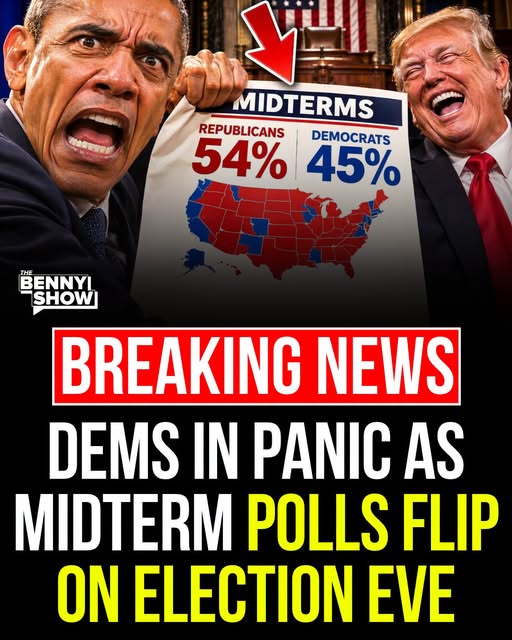
The image is designed to be a political lightning bolt: a furious Barack Obama, mouth open in a scream, clutching a map of the United States. Beside him, Donald Trump is doubled over in laughter. Between them, a mock poll graphic shows Republicans leading Democrats 54% to 45%. The text below, in bold red and white, delivers the punchline: "BREAKING NEWS: DEMS IN PANIC AS MIDTERM POLLS FLIP ON ELECTION EVE."
The post, shared widely across social media, is a masterpiece of political propaganda. It combines the most recognizable faces of the two parties, a stark visual contrast of emotion, and a simple, dramatic claim: the election is breaking late, and it is breaking toward the Republicans.
But here is the truth: The graphic is not a real poll. The numbers 54% and 45% do not come from a credible survey, a reputable polling firm, or an official election forecast. They appear to be a fictional composite, designed to produce a specific emotional response. And the broader narrative it pushes—that Democrats are in a state of panic as polls "flip" on the eve of the election—is a partisan talking point, not a factual description of the state of the race.
This is the story behind the viral graphic, the real polling data that complicates its claim, and the information war that has come to define the final hours of the 2026 midterms.
The Verdict: A Fabricated Graphic, a Familiar Strategy
Unlike many viral political headlines, this one cannot be traced to a specific, verifiable source. The image bears the logo of "The Benny Show," a conservative media outlet, and the style is consistent with the hyper-partisan content that floods social media during election season.
The poll numbers themselves—54% Republican, 45% Democrat—are not reflected in any of the major public polling averages in the final days of the campaign. The graphic appears to be a fabrication, designed to create a false impression of momentum and to demoralize Democratic voters in the final hours before they cast their ballots.
This is not to say that the midterms were not close or that Republicans were not positioned to make gains. The race for Congress was, by all accounts, extraordinarily tight. But the specific claim that "polls flip on election eve" and that Democrats are in "panic" is a narrative device, not a data-driven conclusion.
The Real Polling: A Race That Was Always Close
The actual polling in the final days of the 2026 midterms painted a picture of a race that was, if anything, tilting slightly toward Democrats in some key contests—not toward Republicans.
According to the New York Times/Siena poll conducted between October 27 and November 1, Democrat Troy Jackson led Republican incumbent Susan Collins by 6 points in Maine, 51% to 45% . In Michigan, Democrat Abdul El-Sayed led Republican Mike Rogers by 7 points, according to a CNN poll . The Detroit News/WDIV poll showed El-Sayed leading by 6 points, 51.4% to 45.1% .
On the generic ballot, the picture was more mixed. RealClearPolitics' average of generic congressional ballot polls showed Democrats with a narrow lead, but the margin was within the historical error range. The polling was not showing a Republican "flip." It was showing a race that had been remarkably stable for months.
The "Hidden Vote" Argument: A Real Phenomenon, But Not a Guarantee
The viral graphic's implicit argument is one that has become a staple of conservative media: the polls are wrong because they undercount Trump supporters. This argument has some basis in history. In 2016, 2020, and 2024, polls underestimated Trump's support, leading to widespread skepticism of polling among his base .
Conservative commentators like Benny Johnson have argued that this pattern would repeat in 2026, pointing to the New York Times' own admission that its polling was struggling to reach Trump supporters . They also cited data showing that late-deciding voters favored Republicans by 9 points in the final month .
But there is a critical flaw in this argument: midterm elections are not presidential elections. The "hidden Trump voter" phenomenon is specific to Trump's unique coalition, which turns out disproportionately in presidential years. In midterms, the electorate is smaller, older, and more likely to be composed of habitual voters—a demographic that tends to be more favorable to Democrats in swing districts. In 2018 and 2022, the polls were actually quite accurate in midterm races, and they tended to underestimate Democrats, not Republicans .
The "Panic" Narrative: A Psychological Operation
The claim that "Dems in panic" is not a news report. It is a psychological operation. The goal is to create a sense of inevitability around a Republican victory, to discourage Democratic voters from turning out, and to provide a ready-made excuse if the results do not match the narrative.
This strategy is not unique to the right. Both parties engage in spin and narrative construction in the final days of a campaign. But the viral graphic is a particularly vivid example of how a fabricated image can shape perceptions of an election. By pairing Obama's anguished face with Trump's gleeful laughter, it tells a story that is emotionally powerful but factually hollow.
The Bottom Line
The viral graphic is right about one thing: the 2026 midterms were close, and the outcome was uncertain until the final votes were counted. But the specific claim that "polls flip on election eve" and that Democrats are in a state of panic is not supported by the available data.
The graphic is a fabricated piece of political propaganda, designed to create a false sense of momentum and to manipulate voters in the final hours of the campaign. The real polling showed a race that was tight but trending slightly toward Democrats in key Senate contests. The "hidden vote" argument has some historical basis, but it is not a guarantee, and it ignores the differences between presidential and midterm electorates.
In the end, the only poll that mattered was the one conducted at the ballot box. And the voters—not the memes—had the final say.
📸 Suggested Images
-
The Viral Graphic: The original image featuring Obama, Trump, and the mock poll numbers, with the "Dems in Panic" headline.
The Real Polling: A chart comparing the actual final polls in key Senate races (Maine, Michigan) with the fabricated 54-45 numbers in the graphic.
The Pollster's Warning: A screenshot of the New York Times' acknowledgment that its polling was struggling to reach Trump supporters, illustrating the basis of the "hidden vote" argument.
The Contrast: A split image of the 2016/2020/2024 polling errors (which underestimated Trump) and the 2018/2022 midterm polling (which underestimated Democrats), showing why the "hidden vote" argument is more complicated than it seems.
The Ballot Box: A photo of Americans voting, with a caption noting that the final verdict belongs to the voters, not the viral graphics.
Comments (0)
Loading comments...
May You Like

BANGCHAK REFINERY IN THAILAND SHUT DOWN, U.S. OIL PRICES JUMP 10%!

THANKSGIVING NIGHTMARE: OVER 1M BLACKOUTS, NEARLY 2M WATER ALERTS!
Latest Posts









Popular Posts





