DeSantis Calls for Impeachment of Florida Judge After Convicted Sex Offender Was Released Before Girl’s Death
TALLAHASSEE, Fla. — Florida Gov. Ron DeSantis has called on lawmakers to impeach a state judge whose decision to release a convicted sex offender on bond preceded the death of a 5-year-old girl, intensifying a political and legal fight over judicial accountability in the state.
The controversy centers on Judge Tiffany Baker-Carper and the death of Melissa “Missy” Mogle, a 5-year-old Tallahassee girl who died in May 2025. Her stepfather, Daniel Spencer, had been convicted weeks earlier of traveling to meet a minor for sex and was awaiting sentencing when Baker-Carper allowed him to remain out on bond.
DeSantis and Florida Attorney General James Uthmeier have argued that Spencer should have been taken into custody after his conviction and that the judge's decision deserves impeachment proceedings.
But the case has also raised questions about what information was available to the judge at the time and how far elected officials should go in disciplining members of the judiciary.
The Decision That Sparked the Controversy
Spencer was arrested in February 2024 after investigators accused him of traveling to meet someone he believed was a 15-year-old girl for sex. The person was actually an undercover officer.
He initially remained free on a $3,000 bond. On April 15, 2025, Spencer was convicted of traveling to meet a minor for unlawful sexual conduct.
The state attorney's office asked Baker-Carper to take Spencer into custody following the conviction.
Instead, the judge allowed him to remain free while awaiting sentencing.
During the hearing, Baker-Carper cited the fact that Spencer had been out of custody for roughly a year without violations and that she did not see a violent criminal history in the information before her.
About a month later, on May 19, 2025, 5-year-old Missy Mogle was found unresponsive at her Tallahassee home.
Spencer and Missy's mother, Chloe Spencer, were subsequently charged in connection with the girl's death. Prosecutors later brought first-degree murder charges against both.
DeSantis Demands Accountability
The tragedy prompted an immediate political response.
In March 2026, DeSantis signed Missy's Law, legislation named after the child that changes Florida's rules for defendants convicted of specified dangerous crimes.
Under the new law, a person who pleads guilty or is found guilty of a qualifying dangerous crime must be remanded into custody and remain there while awaiting sentencing, without the possibility of release on bond.
At the bill-signing ceremony, DeSantis went further, calling on the Florida House to impeach Baker-Carper.
The governor argued that the judge had the opportunity to keep Spencer behind bars but instead allowed him to remain free, with catastrophic consequences.
Attorney General James Uthmeier has made the same argument. In a letter to House Speaker Daniel Perez, Uthmeier urged lawmakers to begin impeachment proceedings, arguing that Baker-Carper's decision could constitute a “misdemeanor in office” under the Florida Constitution.
The Judge Later Recused Herself
The controversy followed Baker-Carper into the murder case itself.
In April 2026, attorneys for Daniel Spencer sought to have Baker-Carper removed from the case, arguing that the governor's and attorney general's calls for her impeachment had made her involvement politically controversial.
Baker-Carper ultimately recused herself from the murder proceedings. Chief Circuit Judge Frank Allman later took over the case.
That development did not end the political dispute.
Florida House Has Not Impeached the Judge
Despite repeated calls from DeSantis and Uthmeier, Florida lawmakers have not pursued Baker-Carper's impeachment.
As of September 2026, Republicans still control the Florida Legislature, and reporting from WUSF found that the House had not initiated impeachment proceedings against Baker-Carper. Former House Speaker Daniel Perez previously indicated that a future legislature could make that decision.
Supporters of the impeachment effort argue that judges must be held accountable when their decisions put the public at risk.
Critics, however, warn that removing a judge because of a controversial judicial decision could undermine judicial independence. Some advocates have also questioned whether Baker-Carper had been given complete information about the risks posed by Spencer at the time she made her decision.
Missy's Law Changes the Rules
Whatever happens to the impeachment effort, the case has already changed Florida law.
Missy's Law was designed specifically to prevent defendants convicted of certain dangerous crimes from remaining free while awaiting sentencing.
The legislation requires immediate remand to custody after conviction and also expands the state's definition of dangerous crimes to include certain child-exploitation and pornography offenses.
The law does not retroactively determine whether Baker-Carper violated the law in 2025. Instead, it changes the rules governing similar cases going forward.
The Murder Case Is Still Pending
Meanwhile, the criminal case surrounding Missy's death remains unresolved.
Daniel Spencer is charged with murder and other offenses, and prosecutors are seeking the death penalty. His trial, originally scheduled for September 2026, was delayed in August and is now scheduled for February 2027.
His wife, Chloe Spencer, also faces murder charges, although a trial date for her has not been set.
Because the criminal proceedings are still pending, allegations surrounding Missy's death should not be presented as established facts until they are proven in court.
What the Graphic Gets Right — and What It Leaves Out
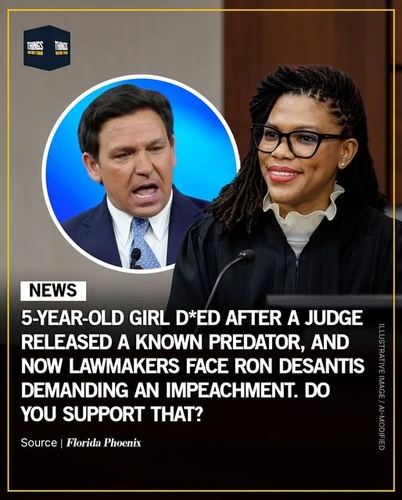
The graphic's central claim is based on a real controversy: a Florida judge allowed a man who had just been convicted of a sex offense to remain free pending sentencing, and that man was later accused of killing his 5-year-old stepdaughter.
However, the wording “released a known predator” is highly charged. A more precise description is that Spencer had been convicted of traveling to meet a minor for unlawful sexual conduct and was awaiting sentencing when the judge allowed him to remain on bond.
The image also suggests that lawmakers are currently facing an imminent impeachment vote. That is not accurate as of September 11, 2026. DeSantis and Uthmeier have called for impeachment, but the Florida House has not initiated proceedings.
Bottom Line
The Missy Mogle case has become a major test of how Florida balances judicial discretion, public safety and judicial independence.
DeSantis and his allies say the judge's decision was an unacceptable failure that warrants removal from office. Critics argue that judicial accountability should not become political punishment for controversial rulings, particularly when questions remain about what information the judge had at the time.
For now, Missy's Law is in effect, the impeachment push has not produced formal House proceedings, and the criminal case against Daniel Spencer remains pending.
Comments (0)
Loading comments...
May You Like

Russian Drone Strikes Kyiv Bridge as German Chancellor Arrives in Ukraine

Barack Obama Draws Attention With New Literary Podcast