
DeSantis Warns Trump’s $5,000 Dividend Could Fuel Inflation and Increase U.S. Debt
September 13, 2026 — Washington, D.C.
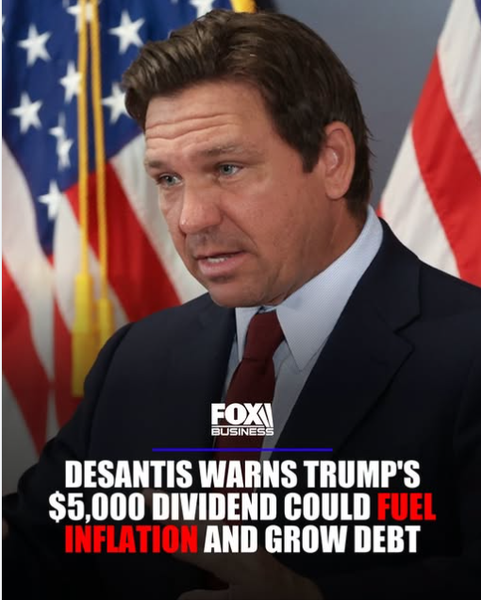
President Donald Trump’s proposal to distribute a $5,000 “dividend” to American adults has sparked criticism within the Republican Party, with Florida Gov. Ron DeSantis warning that the plan could worsen inflation and increase federal debt.
Trump unveiled the proposal during a Republican midterm convention in Dallas, promising $5,000 payments to adult U.S. citizens if Republicans retain control of Congress after November’s elections.
Trump described the payment as a “dividend” generated by economic gains and tariff revenue, arguing that Americans should directly benefit from policies he says have strengthened the country’s finances.


DeSantis, however, has expressed strong reservations about the proposal, arguing that government should use genuine surplus revenue to reduce taxes rather than borrow additional money for large direct payments.
The Florida governor warned that borrowing to finance the checks could inject substantial new spending into an economy already facing persistent inflationary pressures and elevated government borrowing costs.
His criticism is significant because DeSantis remains one of the most prominent Republican figures to publicly challenge Trump’s proposal, highlighting an ongoing debate inside the party over fiscal policy.
The proposed payments would be extraordinarily expensive. With roughly 240 million adult American citizens, a $5,000 payment could cost approximately $1.2 trillion before administrative expenses.
Economists have questioned whether tariff revenue could realistically cover such a massive program. Current tariff collections remain far below the amount required to finance one year of payments.
According to estimates cited by CBS News, tariff revenue is generating roughly $125 billion annually, approximately one-tenth of the estimated amount needed for $5,000 payments.
FactCheck.org similarly reported that tariff revenue would require several years to cover the estimated cost of a single round of payments, raising questions about the proposal’s financial sustainability.
That funding gap has prompted fiscal analysts to warn that the government could ultimately need additional borrowing, potentially pushing the federal deficit significantly higher than current levels.


Inflation represents another major concern. Economists argue that putting more than a trillion dollars into consumers’ hands could increase demand for goods and services, placing additional upward pressure on prices.
Analysts have compared the potential effects with pandemic-era stimulus payments, which increased household spending while the economy faced supply constraints and subsequently experienced sharply higher inflation.
The Committee for a Responsible Federal Budget has estimated that large direct payments could increase inflationary pressures while adding substantially to government borrowing and potentially affecting interest rates.
Higher Treasury borrowing costs could also affect households indirectly. Increased government borrowing can place upward pressure on rates for mortgages, automobile loans, credit and other consumer financing.
The proposal comes as the federal government faces an enormous debt burden. Analysts have warned that additional borrowing could complicate efforts to stabilize the nation’s long-term fiscal position.
Trump has defended the concept by emphasizing tariff collections and other potential government revenues. Administration officials have also discussed alternative funding mechanisms rather than relying exclusively on new borrowing.
Commerce Secretary Howard Lutnick has suggested that the administration could explore additional revenue sources, although significant questions remain about whether those sources could finance payments of this size.
Another obstacle is congressional approval. Legal and constitutional experts have said Congress would generally need to authorize federal spending, making implementation considerably more complicated than a presidential announcement alone.
Some Republican lawmakers have embraced the idea, while others have expressed skepticism. The debate highlights tensions between calls for immediate financial relief and concerns about long-term fiscal sustainability.
For DeSantis, the central issue is whether Americans would ultimately benefit from the payments after accounting for higher inflation, borrowing costs and national debt. His warning adds another Republican challenge to Trump’s proposal.
Comments (0)
Loading comments...
May You Like

South Korea–Ukraine Rift Deepens Over North Korean POW Transfer as PURL Draws New Scrutiny

South Korea–Ukraine Rift Deepens Over North Korean POW Transfer as PURL Draws New Scrutiny

Shocking news from Ohio: an unexpected development ahead of Trump's rally












