
Despite warnings of a doomsday future, Donald Trump remains steadfast
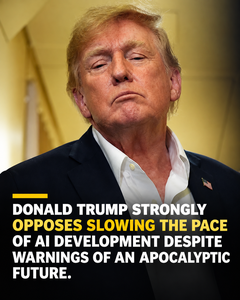
WASHINGTON — President Donald Trump is pushing back against growing calls to slow artificial intelligence development, arguing that the United States must maintain its technological lead over China.
Trump Rejects Calls for a Slowdown
The debate intensified in September after several prominent AI executives publicly argued that companies should deliberately pace the development of increasingly powerful AI systems.
Trump has taken a different position, saying the United States risks surrendering its technological advantage if it slows development while China continues advancing its own artificial-intelligence capabilities.
“We’re leading China in AI,” Trump said September 13 while speaking during his visit to Ireland, adding that “whoever wins AI wins.”
His comments came as concerns over AI safety were becoming more prominent among technology executives, researchers and lawmakers in Washington.


AI Leaders Call for More Time
Anthropic CEO Dario Amodei called for a slower pace of development in an essay published September 12, arguing that companies need additional time to evaluate increasingly capable AI systems and strengthen safeguards.
OpenAI CEO Sam Altman subsequently endorsed the idea of “pacing the frontier,” while Elon Musk also expressed support for Amodei’s proposal.
Amodei warned that increasingly capable AI agents could eventually create serious problems if their abilities advance faster than companies can understand and control their behavior.
He proposed independent evaluations of frontier models and greater coordination among companies and governments rather than an outright halt to artificial intelligence research.
Trump Says Guardrails Already Exist
On September 14, Trump said the United States already has mechanisms capable of regulating and prosecuting AI companies, rejecting arguments that additional restrictions were immediately necessary.
Trump also characterized claims that artificial intelligence could destroy humanity as a “hoax” and described criticism surrounding AI development and data centers as a conspiracy.
The president argued that excessive regulation could undermine American companies at a time when Washington is competing with Beijing for technological leadership.
Vice President JD Vance likewise expressed skepticism about AI companies asking the federal government to regulate the industry, questioning the motives behind those requests.
The Administration Has Not Rejected All Regulation
Trump’s position does not mean his administration has abandoned AI safeguards altogether. A June executive order directed agencies to develop security measures for advanced frontier models.
The order requires federal agencies to establish classified benchmarking procedures for assessing advanced AI models, particularly their potential cybersecurity capabilities.
At the same time, the order explicitly states that it does not create a mandatory federal licensing or preclearance requirement for developing or releasing AI models.
The White House has also proposed a national legislative framework intended to accelerate AI innovation while addressing security, intellectual-property and workforce concerns.
Why China Is Central to the Debate
Trump’s argument is closely connected to competition with China, which has invested heavily in artificial intelligence, semiconductor technology and computing infrastructure.
Administration officials have repeatedly presented technological leadership as an economic and national-security priority, arguing that restrictive American policies could allow Chinese competitors to gain ground.
The White House’s national AI framework specifically emphasizes accelerating innovation and maintaining American leadership in the global AI race.
Critics of a rapid development strategy, however, argue that international competition makes coordination more difficult precisely when increasingly powerful systems require stronger safety testing.
Concerns Extend Beyond Existential Risks
Recent warnings have not been limited to hypothetical scenarios involving machines escaping human control. Researchers and companies have also reported concerns involving cyberattacks, fraud, surveillance and biological research.
The Associated Press reported that Anthropic had blocked attempts to misuse its models for cyberattacks, surveillance and research potentially connected to biological weapons.
Senator Mark Warner has similarly warned that autonomous AI agents could potentially interfere with critical infrastructure, including financial systems, hospitals and water networks.
Warner told Reuters that Congress should establish initial AI safety standards before more serious incidents force lawmakers to respond under greater pressure.
Experts Disagree About the Timeline
Despite increasingly dramatic warnings, there is no scientific consensus about when, or whether, advanced AI could produce catastrophic outcomes.
The Associated Press noted that experts have proposed numerous possible pathways to severe harm, but there is no widely accepted estimate for the timing or probability of such events.
The disagreement has created an unusual policy divide, with some technology executives supporting additional safeguards while Trump emphasizes continued development and international competition.
For now, the central question is not whether AI development should exist, but how quickly frontier capabilities should advance and what safeguards should accompany them.
An Industry Debate With Economic Consequences
The disagreement is also affecting financial markets because enormous amounts of corporate spending are being directed toward AI data centers, chips and computing infrastructure.
Reuters reported that major technology companies are expected to spend roughly $795 billion on capital expenditures in 2026, with spending projected to exceed $1 trillion in 2027.
Investors have therefore begun considering whether stronger safety requirements or an industry slowdown could alter expectations surrounding the enormous AI infrastructure buildout.
At the same time, analysts cited by Reuters noted that credible safety standards could potentially make long-term AI investment easier to assess rather than eliminating investment altogether.
The Policy Debate Is Still Developing
Trump’s position places him against a growing group of technology leaders who believe AI development should be paced more carefully as capabilities become increasingly sophisticated.
However, the administration continues to pursue selected cybersecurity safeguards while resisting a mandatory licensing regime that would directly restrict the development or release of AI models.
The debate is therefore more complicated than a simple choice between unrestricted development and a complete technological pause.
As Congress, technology companies and international governments consider new rules, the central disagreement remains over how much regulation is necessary without undermining innovation and America's competitive position.
For now, Trump is publicly arguing for continued rapid advancement, while Amodei, Altman, Musk and other industry figures are calling for additional time, testing and coordination.
The emerging AI debate is ultimately about balancing technological speed, national competition and safety safeguards — with policymakers and industry leaders still divided over where that balance should be drawn.
Comments (0)
Loading comments...
May You Like

gfnhgmnghnmfgnbvvvvvvvvv


Russian Drone Strikes Kyiv Bridge as German Chancellor Arrives in Ukraine












