
James Talarico Says Billionaires Are “Destroying America,” Challenging the Influence of Wealth in U.S. Politics
October 15, 2026 | Fort Worth, Texas, United States | Politics & Economy
A Sharp Message About Wealth and Political Power
Texas Democratic Senate candidate James Talarico has renewed his criticism of America’s wealthiest individuals, arguing that billionaires exploit cultural divisions to distract the public from corruption and economic inequality. His remarks have drawn attention during a closely watched election campaign in Texas.
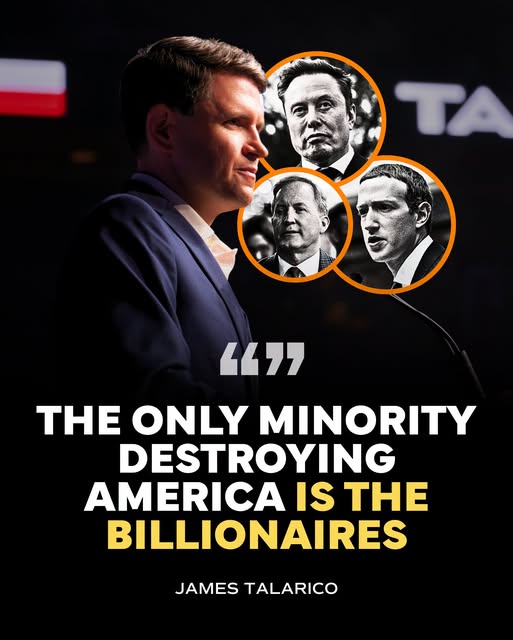
During a televised town hall in Fort Worth on October 14, Talarico told an audience that powerful figures use disagreements involving minority communities to divert attention from their own interests. He then delivered the line that became the defining moment of the exchange: “The only minority destroying America is the billionaires.”
The statement reflected a central theme of Talarico’s political message: that the country’s deepest divisions are not simply between Democrats and Republicans, but between ordinary citizens and wealthy individuals with disproportionate influence over politics, media, and public policy.
Talarico’s criticism is part of a broader debate about economic inequality, campaign financing, and the power of major donors. Supporters say his message highlights structural problems in American democracy, while critics may view his rhetoric as an oversimplification of the role wealthy people play in the economy.
Illustrative image of a political speaker addressing an audience; this is not a photograph of Talarico at the October town hall.
Who Is James Talarico?
Talarico is a Texas state representative and Democratic candidate for the U.S. Senate. A former public school teacher and seminarian, he has built his political identity around public education, economic fairness, religious values, and opposition to what he describes as excessive corporate influence.
His message seeks to reach voters beyond the traditional Democratic base. He has emphasized that working people face common pressures, including housing costs, healthcare expenses, childcare, and the difficulty of saving for retirement, regardless of their political affiliation.
Rather than presenting every political disagreement as a conflict between left and right, Talarico argues that wealthy donors and powerful institutions can benefit when voters remain divided over cultural issues. In his view, this division can prevent broader coalitions from forming around economic concerns.
The approach is particularly significant in Texas, a state where Republicans have dominated statewide elections for decades. Talarico’s campaign is attempting to challenge that political landscape by combining progressive economic themes with language rooted in his Christian faith and an appeal to shared community values.
Billionaires and the Politics of Influence
The debate over billionaire influence has intensified as wealthy individuals increasingly finance political campaigns, support advocacy groups, and invest in media and technology platforms. Critics argue that large fortunes can translate into political access that ordinary citizens cannot easily match.
Talarico has specifically criticized the role of major technology and business figures in shaping public debate. He argues that concentrated ownership of digital platforms can influence which stories people see, how political arguments spread, and whether public discussion becomes more polarized.
Illustrative business portrait; not a verified photograph of the individuals shown in the uploaded graphic.
The image accompanying the claim includes portraits of prominent technology figures, but it does not independently establish that any individual has engaged in corruption or deliberately attempted to divide Americans. Such allegations require specific evidence and should be assessed separately from political rhetoric.
Wealthy donors also argue that investment, entrepreneurship, and political participation are legitimate activities. The central policy question is not simply whether billionaires should participate in public life, but how campaign-finance rules, transparency requirements, and institutional safeguards should limit the risk that financial power overwhelms broader democratic participation.
The Texas Senate Race Raises the Stakes
Talarico’s message comes as he competes in a high-profile Texas Senate race against Republican Ken Paxton. The contest has attracted national attention because its outcome could affect the balance of power in the U.S. Senate.
Financial resources have become a major point of contention. Talarico has criticized spending by wealthy donors and outside political groups, arguing that candidates should be accountable to voters rather than to a small number of powerful contributors.
The campaign has also emphasized its fundraising success, presenting broad-based financial support as evidence that ordinary voters can compete with large donors. However, campaign fundraising totals alone do not determine electoral outcomes; candidates must also persuade voters on issues ranging from the economy and immigration to education, healthcare, and national security.
The contest therefore provides a test of whether an economic-populist message can attract voters in a state with a strong Republican tradition. It also illustrates how the influence of wealthy political donors has become a prominent issue in campaigns across the country.
Cultural Divisions and Economic Concerns
Talarico’s argument links economic inequality with the country’s continuing cultural conflicts. He contends that disputes involving minority groups can dominate political discussion while issues such as wages, public schools, healthcare costs, and housing affordability receive less attention.
That argument has gained visibility amid growing concern about the cost of living. Many American households continue to face difficult choices over rent, homeownership, childcare, medical expenses, and retirement savings. These pressures have encouraged politicians from different ideological backgrounds to focus more heavily on economic security.
Nevertheless, cultural and social issues remain important to many voters for reasons that cannot be reduced to economic distraction. Questions involving religion, immigration, identity, education, and civil rights often reflect deeply held beliefs and practical concerns within local communities.
The challenge for candidates is to address these issues without dismissing voters’ experiences or treating political opponents as acting in bad faith. Talarico’s message attempts to redirect attention toward concentrated wealth, but its effectiveness will depend on whether voters see his proposed solutions as credible and relevant to their lives.
What His Message Means for American Politics
Talarico’s statement is a political argument, not an independently established finding that billionaires as a group are destroying the country. Its significance lies in the broader debate it represents over wealth concentration, political donations, and democratic accountability.
Supporters of stronger campaign-finance restrictions argue that limits on undisclosed spending and greater transparency could reduce the influence of wealthy interests. Opponents of some proposed restrictions warn that political spending can constitute protected expression and that reforms must respect constitutional rights.
The debate also raises questions about how technology companies shape public discourse. Algorithms designed to maximize engagement can amplify provocative material, although the effects vary by platform and cannot be attributed to every wealthy owner or business leader in the same way.
Ultimately, Talarico is trying to make economic inequality a central issue in the Texas Senate contest. His argument asks voters to look beyond partisan labels and consider who benefits from existing political and economic arrangements.
Whether that message can reshape the state’s political landscape remains uncertain. What is clear is that the influence of billionaires, campaign financing, and the growing concentration of wealth have become important subjects in the national debate over the future of American democracy.
Comments (0)
Loading comments...
May You Like

WWE BRONSON REED DEAD AT 38, STIMULANTS DETECTED, $10M INSURANCE PAYOUT FROZEN!

MINNESOTA NIGHTMARE—UNDERGROUND GAS LEAK, HUNDREDS OF HOMES AT RISK, $300M DAMAGE!

EAST COAST DISASTER—179 THOUSANDS OF HOMES AT RISK, CAUSING $50 BILLION IN DAMAGE!









Popular Posts




