Did Elon Musk Call for the United Nations to Be Defunded? The Viral Claim Needs Context
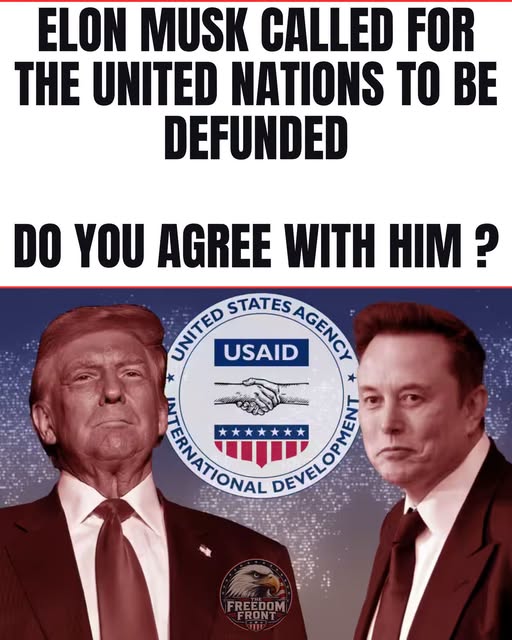
A viral graphic asks:
“Elon Musk called for the United Nations to be defunded. Do you agree with him?”
The claim is partly accurate but overstated.
Elon Musk did publicly criticize the amount of U.S. funding going to the United Nations and related organizations. But the evidence I found does not support the broad claim that Musk explicitly called for the entire United Nations to be completely “defunded.”
The distinction matters — especially because the Trump administration has since taken major steps to withdraw from and cut funding to numerous UN bodies.
What Elon Musk Actually Said
In February 2025, Musk posted on X that:
“America provides way too much funding to the U.N. and associated entities.”
That statement was reported by Reuters during the Trump administration's broader campaign to cut federal spending and reassess U.S. support for international organizations.
Musk's position was therefore clearly critical of U.S. financial support for the UN system.
However, saying that the United States provides “way too much funding” is not exactly the same as publicly issuing a blanket demand to eliminate every dollar of U.S. funding to the entire United Nations.
The most accurate description is:
Musk argued that the United States gives too much money to the UN and associated entities and supported dramatically reducing government spending.
The viral graphic simplifies that position into the stronger phrase:
“Musk called for the United Nations to be defunded.”
Musk Was Already Calling for Entire U.S. Agencies to Be Eliminated
The broader context helps explain why the claim spread so widely.
During his involvement in the Trump administration's government-efficiency effort, Musk advocated eliminating entire federal agencies rather than merely reducing their budgets.
In February 2025, he said the government needed to “delete entire agencies” as part of a broader effort to shrink the federal bureaucracy.
Musk also played a prominent role in the administration's effort to dismantle the U.S. Agency for International Development, or USAID.
He described USAID as “beyond repair” and said President Donald Trump had agreed that it should be shut down.
Those statements make it understandable why critics and supporters alike interpreted Musk's UN comments as part of a much broader push to cut international spending.
But USAID and the United Nations are not the same institution.
The Trump Administration Did Take Major Action Against UN Bodies
While the viral graphic focuses on Musk, the more consequential story involves official U.S. government policy.
In February 2025, Trump ordered the United States to withdraw from the UN Human Rights Council and halt funding to the UN Relief and Works Agency for Palestine Refugees, known as UNRWA. He also ordered a broad review of U.S. participation in international organizations.
The administration argued that some UN bodies had acted against U.S. interests and that certain institutions required major scrutiny or reform.
That review eventually produced an even broader move.
Trump Ordered Withdrawal From 31 UN Entities in 2026
In January 2026, Trump signed a presidential memorandum directing U.S. agencies to withdraw from 31 UN entities, along with 35 non-UN international organizations.
The White House said the organizations identified in the review did not sufficiently serve American interests.
The list included entities and programs connected to areas such as:
- economic and social development;
- climate policy;
- gender equality;
- population programs;
- urban development;
- international trade;
- and UN-affiliated research and training.
This is a crucial distinction:
The United States did not simply withdraw from the entire United Nations.
Instead, the administration targeted specific UN entities and programs while continuing to deal with the broader UN system.
The U.S. Is Still Dealing With the United Nations
The strongest evidence that the viral claim is too simplistic comes from what happened next.
In August 2026, Reuters reported that the Trump administration had informed Congress of plans to transfer $725 million toward dues owed to the UN's regular budget.
The planned payment was significantly smaller than the amount the UN says the United States owes overall, and the administration has continued to push for reforms and cut funding to many UN agencies.
But the planned payment demonstrates something important:
The United States has not completely “defunded” the United Nations.
Instead, Washington's policy has involved a mixture of:
- withdrawing from specific organizations;
- ending funding for selected UN bodies;
- reducing broader international spending;
- withholding some payments;
- and continuing financial engagement with parts of the UN system.
Why Would Anyone Want to Defund or Dramatically Cut the UN?
Supporters of Musk's position generally make several arguments.
1. The United States Pays Too Much
The U.S. has historically been the UN's largest financial contributor.
Critics argue that American taxpayers carry a disproportionate share of the financial burden while other wealthy countries contribute comparatively less.
Musk's public statement focused directly on this issue, arguing that America provides too much funding to the UN and associated entities.
2. Critics Question the UN's Effectiveness
Some conservatives argue that the UN:
- spends money inefficiently;
- creates excessive bureaucracy;
- fails to prevent major wars;
- and sometimes adopts positions that conflict with U.S. interests.
The Trump administration made similar arguments when ordering its review and withdrawal from specific international organizations.
Supporters of major cuts believe the United States should stop funding organizations they view as ineffective or hostile to American interests.
3. Sovereignty Is a Major Concern
Another argument is that international institutions should not influence U.S. policy in ways that undermine national sovereignty.
The Trump administration explicitly framed its 2026 withdrawals as part of an effort to prioritize U.S. national interests, security and sovereignty.
For many supporters of the “America First” approach, this is the central issue.
Critics Warn That Cutting the UN Could Have Serious Consequences
Opponents see the issue very differently.
The UN Is Not Just One Organization
The phrase “defund the UN” can create the impression that the United Nations is a single office performing one function.
In reality, the UN system includes numerous agencies and programs dealing with:
- humanitarian relief;
- refugees;
- food security;
- disease;
- peacekeeping;
- children;
- international aviation and shipping;
- nuclear monitoring;
- and diplomatic conflict resolution.
A broad funding withdrawal can therefore affect very different programs in very different ways.
UN Agencies Have Already Faced Major Budget Pressure
The consequences of reduced international funding are already being felt.
Reuters reported in late August that the UN refugee agency, UNHCR, was planning substantial budget and staffing reductions after major declines in global aid, particularly from the United States.
UN Secretary-General António Guterres has also warned about a serious financial crisis caused by unpaid member contributions, with U.S. funding playing a major role in the organization's financial situation.
Critics of the cuts argue that weakening UN institutions could:
- reduce humanitarian assistance;
- limit refugee support;
- weaken peacekeeping operations;
- and leave crises to become more expensive for individual countries to manage later.
The Real Question: Reform, Reduce, or Defund?
The viral image presents only two apparent choices:
Support Musk or oppose him.
But the real policy debate is more complicated.
There are at least three distinct positions.
Option 1: Keep U.S. funding largely intact
Supporters argue that the UN remains essential to diplomacy, humanitarian aid and international stability.
Option 2: Reduce funding and demand reform
This position argues that the U.S. should remain engaged but contribute less and pressure the UN to become more efficient.
This is broadly consistent with the direction the Trump administration has taken: cutting some programs, withdrawing from selected entities and demanding reforms while continuing some engagement.
Option 3: End U.S. funding entirely
This is the most sweeping version of the “defund the UN” argument.
But based on the evidence available, the viral graphic goes further than Musk's clearly documented statement by presenting a blanket call to defund the entire United Nations as an established fact.
What the Viral Graphic Gets Right — and What It Leaves Out
✓ What it gets right
Elon Musk publicly criticized U.S. funding of the UN.
He said America provides “way too much funding” to the UN and associated entities.
Musk supported radical reductions in government spending.
He also advocated eliminating entire U.S. federal agencies rather than simply trimming their budgets.
The Trump administration has dramatically reduced U.S. involvement in numerous international and UN-related organizations.
The administration ordered withdrawal from 31 UN entities in January 2026.
✗ What it leaves out
There is an important difference between saying the U.S. funds the UN too heavily and explicitly demanding that the entire United Nations receive zero funding.
The U.S. has not completely withdrawn from the UN.
The administration has continued to engage with the organization and, as recently as August 2026, began the process for a planned $725 million contribution toward the UN's regular budget.
The UN is a broad system containing many separate agencies and programs.
Cutting one UN entity does not automatically mean ending all relations with the entire organization.
The Bottom Line
The viral claim should be treated as an oversimplification rather than a precise quotation of Musk's documented position.
The strongest verified version is:
Elon Musk said the United States provides too much funding to the United Nations and associated entities, while supporting broad reductions in government spending.
At the same time, the Trump administration has moved far beyond rhetoric by withdrawing from dozens of international organizations — including 31 UN entities — and cutting or withholding funding from several parts of the UN system.
Yet the United States is still engaged with the broader United Nations and has recently moved toward making a $725 million payment toward its UN budget obligations.
So the debate is not simply:
“Should the UN exist?”
The more accurate question is:
How much should the United States fund the UN, which UN institutions should receive American money, and what reforms should Washington demand in return?
Comments (0)
Loading comments...
May You Like
Obama Steps Back Into the Political Spotlight as Democrats Target Trump’s

Russian Drone Strikes Kyiv Bridge as German Chancellor Arrives in Ukraine

Russian Drone Strikes Kyiv Bridge as German Chancellor Arrives in Ukraine