Diesel Prices Hit Record High, Surpassing Biden-Era Peak as Fuel Costs Become Political Flashpoint
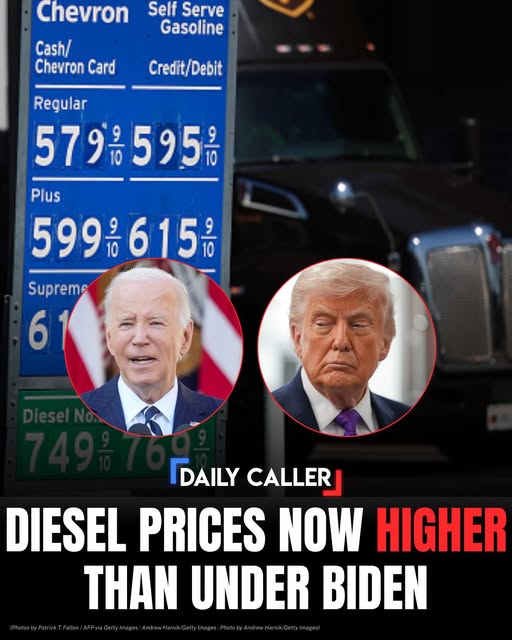
A political graphic circulating online claims that diesel prices are now higher than they were under President Joe Biden, pairing images of Biden and President Donald Trump with a Chevron price sign and the headline: “DIESEL PRICES NOW HIGHER THAN UNDER BIDEN.”
The broad claim is accurate as of September 2026, although the image needs important context. The national diesel average has just moved above the previous record reached during Biden's presidency—but the price spike is being driven by an unusually severe global supply shock, including the war involving Iran and disruptions to Russian refining.
Diesel has broken the previous U.S. record
U.S. diesel prices have surged to roughly $5.85 per gallon nationally, according to recent reporting, establishing a new record. Reuters reported a $5.82 average on September 3, above the previous June 2022 peak during Biden's presidency. By September 4, Reuters and other outlets were reporting an average around $5.85.
The Energy Information Administration's historical data show just how extraordinary the increase has been. During the Biden administration's 2022 fuel-price shock, the national weekly diesel average reached $5.810 per gallon for the week of June 20, 2022.
The latest national price is therefore only modestly above the previous record—roughly 4 cents per gallon higher than the 2022 EIA peak.
That distinction matters: the graphic's message is directionally correct, but this isn't a situation in which today's national diesel price is dramatically above the Biden-era record.
The price at the pump can be much higher locally
The Chevron sign shown in the graphic displays diesel at approximately $7.49 per gallon for cash and $7.69 for credit/debit, illustrating how much local prices can diverge from the national average.
That sign should not be interpreted as evidence that the national diesel average is $7.49.
Prices vary substantially by state, region, taxes, transportation costs and local supply. EIA data, for example, showed the national weekly average at $5.599 on August 31, while several regions were considerably higher.
The national average subsequently jumped as the global oil market deteriorated.
What is driving the surge?
This is where the political graphic leaves out some important context.
The latest spike isn't simply the result of a change in presidential administration. Several international supply disruptions have converged.
The continuing U.S.-Iran conflict has disrupted petroleum flows through the Middle East, while Ukrainian attacks on Russian refineries have further constrained global diesel supplies. Reuters reported that the Gulf previously supplied roughly 900,000 barrels a day of diesel, about 10% of global supply.
At the same time, U.S. diesel inventories are exceptionally tight. Reuters reported that East Coast diesel inventories had fallen to about 19.3 million barrels, a record low for the region.
The result is an unusually tight global diesel market precisely as seasonal demand begins increasing for agriculture, freight and heating.
Diesel matters far beyond the gas station
Diesel is particularly important to the broader economy because it powers much of the nation's freight and industrial infrastructure.
Trucks, farm machinery, construction equipment, trains and other heavy-duty vehicles depend heavily on diesel. When the fuel becomes more expensive, transportation companies face higher operating costs, which can eventually feed into the prices of food and other consumer goods.
The Associated Press reported that higher diesel costs are already putting pressure on transportation and delivery networks, with potential consequences for products ranging from produce and meat to other everyday goods.
That makes the current spike politically significant heading into the 2026 midterm elections.
Biden's 2022 fuel crisis remains an important comparison
The comparison with Biden is not invented.
Diesel prices exploded during the second year of Biden's presidency following Russia's invasion of Ukraine and the resulting disruption to global energy markets. EIA records show the national diesel average climbed from $4.104 in late February 2022 to $5.810 by June 20.
Prices subsequently fell, although they remained elevated for much of 2022 and again experienced significant increases in 2023.
EIA's annual data show the national average for on-highway diesel was:
| Year | Average diesel price |
|---|---|
| 2021 | $3.287 |
| 2022 | $4.989 |
| 2023 | $4.214 |
| 2024 | $3.760 |
| 2025 | $3.660 |
The current 2026 surge has now pushed the weekly national price above the highest point recorded during that 2022 shock.
But does that mean Trump “caused” the higher price?
The price comparison itself doesn't establish causation.
It is fair to say that diesel is currently more expensive than during Biden's presidency at the previous national record. It would be misleading, however, to imply that the comparison alone proves that Trump's policies are responsible for the entire increase.
The current market is being affected by war, refinery disruptions, international shipping constraints, inventories and seasonal demand.
There is also a political complication for Trump: the administration has been dealing directly with the consequences of the fuel spike. Recent reporting says Trump convened major U.S. oil refiners, including Chevron, Marathon Petroleum and Valero, as his administration looked for ways to increase fuel supplies and contain prices.
So the strongest factual framing is:
Diesel has now reached a new U.S. record under Trump, slightly exceeding the previous record from the Biden era, but the immediate price shock is being driven heavily by global energy disruptions rather than a single domestic policy.
What the viral graphic gets right — and what it leaves out
What it gets right:
- U.S. diesel prices have reached a new record.
- The current national average has surpassed the previous Biden-era peak.
- Diesel prices are putting substantial pressure on transportation and other businesses.
- Some individual gas stations are charging considerably more than the national average.
What it leaves out:
- The national average is around $5.85, not the roughly $7.49 shown on the particular Chevron sign.
- The difference from the Biden-era national record is relatively small—only a few cents.
- The current surge is closely tied to the Iran conflict, Russian refinery disruptions and exceptionally tight inventories.
- Biden-era diesel prices also reached extraordinary levels during the 2022 global energy shock.
- A price comparison between administrations does not by itself prove which president is responsible for a particular market move.
Bottom line
The headline is essentially true, but the picture is more complicated than the meme suggests. America's national diesel average has just broken the previous record set during Biden's presidency. The difference is real, but the current record is being produced amid a major international energy and supply crisis, making presidential blame a much more complicated question than the graphic implies.
Comments (0)
Loading comments...
May You Like

Shocking news from Ohio: an unexpected development ahead of Trump's rally

Shocking news from Ohio: an unexpected development ahead of Trump's rally

Barack Obama Draws Attention With New Literary Podcast