
Do You Trust Karoline Leavitt and Marco Rubio? The Viral Question Has a Major Problem
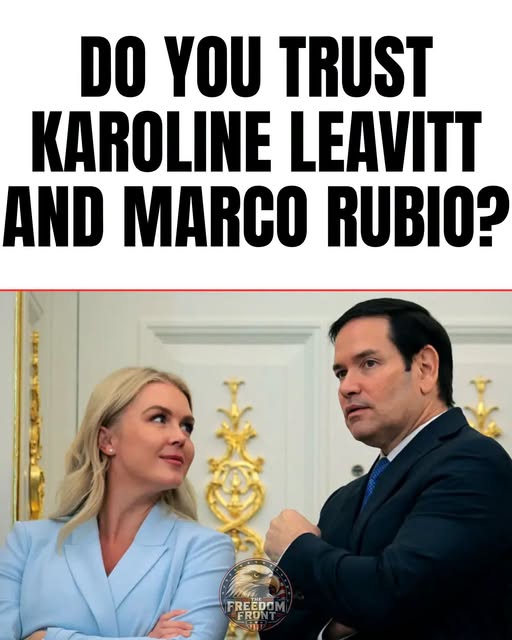
A viral graphic asks:
“Do you trust Karoline Leavitt and Marco Rubio?”
At first glance, it appears to be a simple political opinion question.
But there is an important issue with the image's framing: as of September 3, 2026, Karoline Leavitt is no longer serving as White House press secretary. She completed her tenure on August 27 and left the administration to focus on family and continue supporting President Donald Trump's political efforts from outside the White House.
Marco Rubio, meanwhile, remains Secretary of State, a position he has held since January 21, 2025.
So the viral image brings together two prominent Trump allies — but it presents them in a way that does not fully reflect their current official status.
Who Is Karoline Leavitt?
Karoline Leavitt became the 36th White House press secretary and the youngest person ever to hold the position.
She was one of President Trump's most visible defenders during his second administration, frequently engaging in combative exchanges with reporters and promoting the administration's America First agenda. The White House praised her tenure when she departed on August 27.
However, she is no longer the sitting White House press secretary.
Reuters and the Associated Press reported that Leavitt stepped down at the end of August, citing the difficulty of balancing the demands of the job with raising her young children. Trump said she would remain involved as an outside adviser to his political movement.
That means any article describing her today should use a title such as:
Former White House Press Secretary Karoline Leavitt
rather than simply implying that she still holds the position.
Marco Rubio Remains Secretary of State
Rubio occupies a very different role.
As Secretary of State, he is one of the most senior officials in the Trump administration and is responsible for leading U.S. diplomacy and the State Department.
The State Department's historical records list Rubio as Secretary of State beginning in 2025.
Unlike Leavitt, whose role centered on communicating and defending the White House's positions to the media and public, Rubio's portfolio includes:
- U.S. foreign policy;
- diplomatic relations;
- international negotiations;
- relations with allies and adversaries;
- and the management of the State Department.
That distinction is important when asking whether the public “trusts” the two figures.
They do not have the same job or the same institutional responsibilities.
Why Are They Being Grouped Together?
The image appears designed as a political engagement question, rather than a report about a specific event involving both people.
There is no claim in the graphic that Leavitt and Rubio jointly made a particular decision, announced a policy together or are involved in a specific controversy.
They are, however, both well-known figures associated with Trump's political operation.
Official White House material has previously shown both Rubio and Leavitt participating in administration events alongside other senior officials.
But that does not mean they should automatically be treated as a political pair with identical responsibilities.
Trust Is Not a Fact-Check Question
The word “trust” makes this viral graphic different from many political claims.
Whether someone trusts Karoline Leavitt or Marco Rubio is ultimately an opinion.
People may evaluate them based on:
Supporters' perspective
Supporters may say they trust both because:
- both have strongly supported Trump's agenda;
- Leavitt was an aggressive and consistent defender of the administration;
- Rubio has extensive experience in national politics and foreign policy;
- and both have occupied highly visible positions in Republican politics.
Critics' perspective
Critics may point to:
- disagreements over administration policies;
- concerns about transparency and media access;
- controversial foreign-policy decisions;
- or broader objections to Trump's political agenda.
Those are political judgments, not questions with one objectively correct answer.
Karoline Leavitt's Record Became a Source of Sharp Debate
Leavitt's tenure as press secretary made her one of the administration's most recognizable figures.
Her supporters praised her willingness to confront reporters and challenge media organizations they believed were biased against Trump.
The White House itself characterized her tenure as one defined by a strong defense of Trump and his agenda.
But her approach also generated criticism from journalists and political opponents, particularly over the administration's relationship with the press.
Reuters reported that her tenure included significant changes to media access and press practices that were welcomed by some Trump allies but criticized by press-freedom advocates.
That makes Leavitt a deeply polarizing figure.
For supporters, that may increase trust.
For critics, it may do the opposite.
Rubio Faces a Different Test: Foreign Policy
Rubio's position puts him at the center of some of the administration's most consequential international decisions.
Trust in a secretary of state is often judged differently from trust in a press secretary.
The questions surrounding Rubio are more likely to involve:
- America's role in global conflicts;
- relations with China and Russia;
- policy toward Latin America;
- sanctions and economic diplomacy;
- alliances;
- and the broader direction of U.S. foreign policy.
That means someone could strongly approve of Rubio's handling of foreign policy while disagreeing with Leavitt's approach to the media — or vice versa.
The viral image's simple yes-or-no framing does not capture those distinctions.
What the Viral Graphic Gets Right — and What It Leaves Out
✓ What it gets right
Both Karoline Leavitt and Marco Rubio are prominent figures associated with Donald Trump's political movement and administration.
Leavitt was one of the administration's most visible spokespeople during her time as White House press secretary, while Rubio remains Secretary of State.
Both have played major public-facing roles.
Their visibility makes them natural subjects for a political opinion question.
✗ What it leaves out
Karoline Leavitt is no longer White House press secretary.
She completed her tenure on August 27, 2026.
The image does not identify a specific issue.
“Do you trust them?” could mean trust on:
- immigration,
- foreign policy,
- national security,
- the economy,
- media communications,
- or general political leadership.
Those are very different questions.
Trust is subjective.
There is no factual evidence that can establish a universal answer to whether the public should trust either person.
The More Meaningful Question May Be: Trust Them to Do What?
A stronger version of the viral question would be:
Do you trust Marco Rubio to handle U.S. foreign policy?
And separately:
Do you trust former White House press secretary Karoline Leavitt as a political communicator and adviser?
Those questions would more accurately reflect their different roles.
Rubio's performance can be evaluated through diplomatic and policy outcomes.
Leavitt's can be evaluated through her public communications, defense of administration policy and political influence.
Combining them into one question creates a powerful social-media prompt — but it sacrifices a great deal of context.
The Bottom Line
The graphic is best understood as a political opinion poll, not a factual news claim.
Marco Rubio remains Secretary of State.
Karoline Leavitt, however, is no longer serving as White House press secretary as of September 2026.
Whether Americans trust either of them depends heavily on political beliefs and on which responsibilities they are being judged for.
Comments (0)
Loading comments...
May You Like

Shocking news from Ohio: an unexpected development ahead of Trump's rally

gfnhgmnghnmfgnbvvvvvvvvv













