
DOJ Orders States to Report Known Undocumented Immigrants or Risk Federal Welfare Funding
WASHINGTON — The U.S. Department of Justice has issued a new legal opinion saying that states participating in certain federal welfare programs must ensure that all state agencies report people they know to be unlawfully present in the United States to federal immigration authorities.
The Sept. 1 opinion from the Justice Department's Office of Legal Counsel (OLC) represents a significant expansion of the federal government's interpretation of a reporting requirement contained in the 1996 welfare-reform law. The DOJ said states that fail to comply could face serious consequences, including the loss of federal funding tied to the affected programs.
The development comes as President Donald Trump's administration continues to make immigration enforcement a central policy priority.
What the New DOJ Opinion Says
The opinion concerns states that participate in the Temporary Assistance for Needy Families (TANF) program and certain arrangements involving Supplemental Security Income (SSI).
Under the Justice Department's new interpretation, the reporting requirement applies not only to state agencies that administer welfare programs but to the state government as a whole.
That means agencies such as motor-vehicle departments, universities and other state entities could fall within the reporting framework if they know that an individual is unlawfully present in the country. The information would be provided to the Department of Homeland Security (DHS).
Assistant Attorney General T. Elliot Gaiser said the administration believes Congress imposed the requirement when it enacted the Personal Responsibility and Work Opportunity Reconciliation Act of 1996.
Deputy Assistant Attorney General Joshua Craddock, who authored the opinion, said the Justice Department considers the move a clarification of existing law rather than the creation of a new statutory obligation.
States Could Risk Federal Funding
The most consequential part of the policy is the potential funding penalty.
According to the DOJ, states that accept TANF funding must comply with the federal reporting requirement. Failure to do so could result in consequences including the loss of program funding.
All 50 states, the District of Columbia and several U.S. territories participate in TANF and SSI, according to the Justice Department. Federal TANF grants exceed $16.4 billion annually.
Reuters reported that the administration's interpretation could put billions of dollars in federal assistance at issue, significantly raising the stakes for states that resist the policy.
However, the threat should not be interpreted as meaning that every federal welfare program would automatically be terminated for a state that fails to report an undocumented immigrant. The DOJ's announcement specifically links the potential consequences to the federal programs covered by the legal opinion.
The 1996 Law Is at the Center of the Dispute
The Justice Department's position is based on language in the Personal Responsibility and Work Opportunity Reconciliation Act of 1996, the major welfare-reform law signed by President Bill Clinton.
The law contains a reporting provision concerning people known to be unlawfully present in the United States.
For decades, however, the Justice Department operated under a narrower 1998 OLC interpretation. That earlier opinion concluded that the reporting requirement applied primarily to the state agencies administering TANF or SSI.
The Trump administration has now withdrawn that interpretation.
The new OLC opinion takes a broader view of the word “State” in the 1996 statute, concluding that it encompasses the entire state government rather than only the agencies directly responsible for welfare administration.
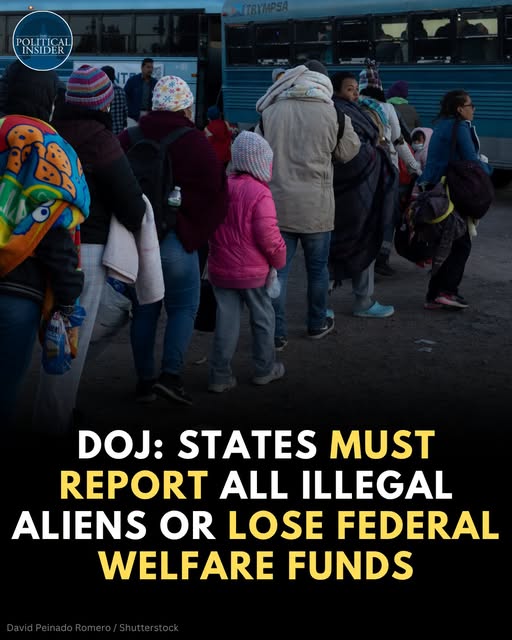
The Viral Graphic Is Broadly Based on a Real Policy — But Oversimplifies It
The image circulating online says:
“DOJ: States must report all illegal aliens or lose federal welfare funds.”
That headline captures the basic direction of the Justice Department's announcement, but it leaves out several important qualifications.
First, the DOJ does not say that every person who might be undocumented must automatically be reported regardless of circumstances. The legal opinion concerns people whom state officials know to be unlawfully present.
Second, the requirement is connected to states' participation in specific federal welfare programs, particularly TANF and SSI. It is not a blanket declaration that states will lose every category of federal assistance if they do not report immigrants.
Third, the policy is primarily about information sharing with DHS, not about changing eligibility rules for welfare programs.
These distinctions are important because undocumented immigrants are generally already excluded from major federal means-tested benefit programs. The new policy is instead aimed at giving federal immigration authorities more information about people encountered by state governments.
Why the Administration Is Pursuing the Change
The Justice Department argues that federal welfare programs should not create incentives for unlawful immigration and that states accepting federal money must follow federal immigration-related requirements.
The policy fits into the Trump administration's broader effort to increase cooperation between federal immigration authorities and state and local governments.
In recent months, the Justice Department has also taken legal action against states over benefits and policies affecting undocumented immigrants.
For example, the department has filed lawsuits challenging state laws that provide in-state tuition and financial assistance to undocumented students, arguing that those policies conflict with federal law. By late August, DOJ said it had brought 21 such lawsuits.
The administration has also pursued access to state data involving public-benefit programs. In June, DOJ sued Kentucky, Pennsylvania, Michigan and Minnesota after those states declined to provide five years of SNAP applicant data to the U.S. Department of Agriculture.
The latest welfare-reporting opinion therefore represents part of a much broader federal effort to increase oversight of immigration status and public benefits.
States May Challenge the Policy
The new interpretation is likely to generate legal and political resistance, particularly in states governed by Democrats that have opposed expanded cooperation with federal immigration enforcement.
The central question is whether the Justice Department's interpretation of the 1996 law is legally correct and whether the federal government can condition welfare funding on compliance with the expanded reporting requirement.
The administration maintains that it is simply restoring the original meaning of the statute after the narrower 1998 interpretation.
Critics are likely to argue that expanding reporting responsibilities to every state agency could interfere with state privacy rules, discourage immigrants from interacting with public institutions and place additional administrative burdens on state governments.
The ultimate resolution could therefore depend on litigation and potentially federal courts.
The Policy Does Not Mean Undocumented Immigrants Are Newly Eligible for Welfare
Another important distinction is between reporting immigration status and eligibility for benefits.
The DOJ announcement does not create a new welfare program for undocumented immigrants. Nor does it make undocumented immigrants eligible for TANF or SSI.
Instead, the administration is asserting that state governments have an obligation to report known unlawful presence when they participate in the specified federal programs.
This is why the image's wording can be misleading if interpreted as saying that the government has discovered large numbers of undocumented immigrants receiving TANF or SSI legally.
The policy is fundamentally about data sharing and immigration enforcement, rather than expanding welfare eligibility.
The Bottom Line
The Trump administration has taken a significant new step toward linking federal welfare funding with state cooperation on immigration enforcement.
The Justice Department's September 2026 legal opinion says that states participating in TANF and SSI must require all components of state government to report individuals they know to be unlawfully present to DHS. States that refuse to comply could face serious consequences, including the potential loss of funding associated with the programs.
But the viral graphic's phrase “report all illegal aliens or lose federal welfare funds” is an abbreviated description of a more complicated legal position.
The policy applies to known unlawful presence, involves specific federal welfare programs, and represents a new, broader interpretation of a reporting requirement that the Justice Department had interpreted more narrowly since 1998.
The coming legal and political battles will determine whether that interpretation survives challenges from states and immigrant-rights advocates.
Comments (0)
Loading comments...
May You Like

Barack Obama Draws Attention With New Literary Podcast

OBAMA STUNS ON INSTAGRAM: MESSAGE MARKING 34-YEAR MILESTONE SPARKS A BUZZ
Jack Smith Defends His Integrity as Trump Investigations Face Renewed Political Firestorm













