
$15B IOWA STEEL PLANT PUTS TRUM
$15B IOWA STEEL PLANT PUTS TRUMP TARIFF STRATEGY IN THE SPOTLIGHT
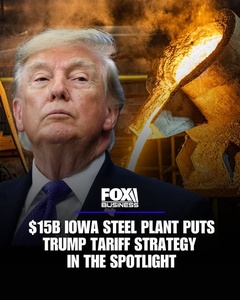
President Donald Trump has announced plans for a $15 billion steel plant in Iowa, presenting the project as a major investment in American manufacturing and evidence of renewed domestic industrial activity.
The facility, planned by Mesabi Metallics, is expected to become the largest steel plant in the United States once fully developed, with production projected to eventually reach 10 million tons annually.
Trump announced the project September 28 at the White House, surrounded by Iowa officials, Republican lawmakers and executives connected to the steel company.
The president directly connected the investment to his tariff policy, arguing that high duties on imported steel encourage companies to establish production facilities inside the United States.
Trump has imposed a 50% tariff on foreign steel and has repeatedly argued that such measures protect American producers from overseas competition while encouraging investment in domestic manufacturing.
The Iowa project therefore offers a prominent real-world test of one part of Trump's economic strategy: whether trade barriers can encourage companies to commit substantial private capital to American industrial capacity.
The planned facility will be located in Lee County in southeastern Iowa, an area where state and local officials have promoted manufacturing investment as a way to strengthen regional employment.
According to the White House, the project is expected to create approximately 1,750 permanent jobs and support as many as 6,000 construction positions during development.
Mesabi Metallics expects the first phase to produce approximately 7.5 million tons of steel annually, with capacity eventually increasing to 10 million tons after additional development.
Production is currently expected to begin in 2030, meaning the project's full economic effects will extend well beyond the 2026 midterm elections and depend on successful construction and financing.
The project is designed as part of an integrated supply chain. Iron ore from Mesabi Metallics' Minnesota operation would be transported to Iowa for processing into finished steel.
The company's Minnesota mine, which recently opened after decades of limited new domestic iron-ore development, represents another major investment connected to the planned Iowa operation.
Mesabi Metallics is owned by India-based Essar Group, making the project an example of foreign-owned capital investing in production located inside the United States.
Federal financing is also involved. The Export-Import Bank has committed up to $10 billion in financing for the company's broader expansion, according to reporting surrounding the announcement.
Supporters of Trump's tariff approach point to projects like this as evidence that stronger protection from foreign competition can give companies greater confidence to build expensive manufacturing facilities domestically.
American Iron and Steel Institute chief executive Kevin Dempsey said Trump's steel tariffs have encouraged new investment and argued that additional domestic capacity could help satisfy growing demand.
Critics, however, emphasize another side of the tariff debate: manufacturers that depend on steel can face higher costs when imported products become more expensive because of tariffs.
That tension creates a central economic question surrounding the Iowa project: whether the benefits of additional domestic steel production will ultimately outweigh higher input costs for industries that consume steel.
The project's location has also given it political significance, arriving weeks before the November 3 midterm elections and during competitive races involving several Iowa Republicans.
The announcement featured candidates and elected officials, including Rep. Ashley Hinson, who is running for the Senate, and Rep. Mariannette Miller-Meeks, who is seeking reelection.
For the Trump administration, the Iowa steel investment provides a highly visible example of its broader effort to expand domestic manufacturing, strengthen supply chains and reduce reliance on foreign production.
Whether the project ultimately validates Trump's tariff strategy will depend on factors including construction progress, operating costs, steel demand, financing, employment and the prices paid by American businesses.
For now, the $15 billion proposal has placed Iowa at the center of America's continuing debate over tariffs, industrial policy and the future direction of domestic steel manufacturing.


Comments (0)
Loading comments...
May You Like

South Korea–Ukraine Rift Deepens Over North Korean POW Transfer as PURL Draws New Scrutiny

Obama Steps Back Into the Political Spotlight as Democrats Target Trump’s Senate Majority

South Korea–Ukraine Rift Deepens Over North Korean POW Transfer as PURL Draws New Scrutiny












