Don Lemon claims his arrest was racially motivated
Don Lemon Says His Arrest Was Racially Charged as Federal Case Raises New Press-Freedom Questions
MINNEAPOLIS — Former CNN anchor and independent journalist Don Lemon is again at the center of a fierce national debate over race, press freedom and the limits of protest coverage after his arrest over a demonstration inside a Minnesota church.
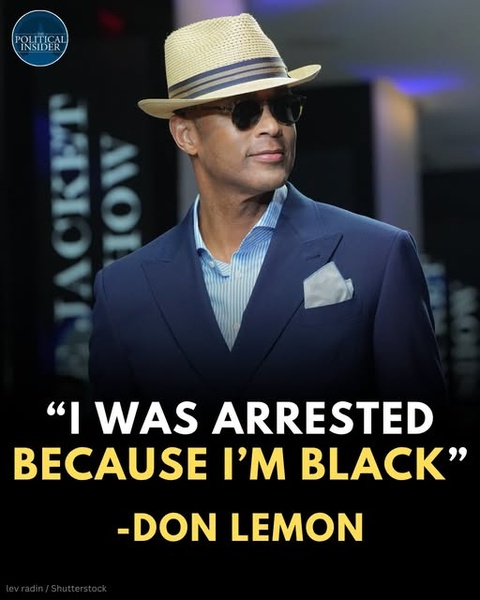
A viral graphic circulating online attributes the statement “I was arrested because I’m Black” to Lemon. However, the exact wording of that quotation could not be independently confirmed in major news reports. What is documented is that Lemon has repeatedly argued that race played a role in how he was treated and has described his arrest as part of a broader effort to intimidate him as a prominent Black journalist.
The controversy has taken on new significance as Lemon's federal case continues. In September, his lawyers challenged the government's use of an unusual administrative summons to obtain his phone records, while nearly all defendants in the broader case have sought dismissal of the charges.
How Don Lemon Was Arrested
Lemon was arrested by federal authorities in California on Jan. 29, 2026, following his coverage of an anti-Immigration and Customs Enforcement protest at Cities Church in St. Paul, Minnesota, earlier that month.
The Jan. 18 protest took place during a church service and involved activists protesting the role of a church pastor who was also associated with ICE.
Lemon livestreamed the demonstration and interviewed people at the scene.
Federal prosecutors subsequently accused him and others of conspiring to interfere with the civil rights of worshippers and violating federal law protecting access to houses of worship.
Lemon has denied wrongdoing and said he was present as a journalist, not as a participant in the protest. Reuters reported at the time that he intended to plead not guilty.
Lemon Says Race Was Part of the Story
The racial dimension became a major part of Lemon's response.
During a later appearance on The View, Lemon recalled that federal agents suddenly grabbed him at his hotel and said they were there to arrest him. He said he initially thought he was being mugged.
Lemon also said an attorney friend characterized the manner of his arrest as the “N-word treatment,” a description that Lemon agreed with.
In another interview, Lemon argued that people at the Minnesota church may have viewed him as a protester rather than a journalist partly because he is Black and because many of the protesters were Black.
That is consistent with the broader argument represented by the viral graphic, although the precise sentence “I was arrested because I'm Black” should not be presented as a verified verbatim quotation without a primary recording or transcript.
The Government's Case Is More Complicated
The federal government maintains that the case concerns conduct at a church, not Lemon's race or political views.
Prosecutors allege that Lemon and other defendants were involved in a protest that disrupted a religious service. Lemon's defense, meanwhile, argues that his actions were protected journalistic activity and that the prosecution threatens First Amendment freedoms.
The dispute is therefore not simply about whether Lemon was arrested because he is Black.
It is also about a fundamental legal question:
When does covering a protest remain journalism, and when can a journalist's conduct become participation in the underlying demonstration?
That distinction could prove critical as the case moves forward.
A Judge Previously Rejected the Government's Initial Attempt
The controversy intensified because the government's initial attempt to bring charges against Lemon did not proceed smoothly.
A federal magistrate judge initially declined to approve prosecutors' proposed charges against Lemon, finding insufficient probable cause at that stage.
Rather than ending the matter, prosecutors subsequently obtained an indictment from a grand jury.
Lemon was later arrested and released, and he has pleaded not guilty.
The unusual path to the indictment has become part of the larger debate over whether federal prosecutors are applying criminal laws aggressively against journalists and political opponents of the administration.
The Case Has Become a Press-Freedom Test
Press-freedom organizations have expressed serious concerns about the prosecution.
The Reporters Committee for Freedom of the Press has argued that the federal court should dismiss the charges against Lemon and fellow journalist Georgia Fort, framing the case as a significant First Amendment issue.
The Knight First Amendment Institute at Columbia University is also tracking United States v. Lemon as a criminal case involving Lemon and Fort.
The legal organizations' involvement demonstrates that the case has grown beyond the individual circumstances of Lemon's arrest.
It has become part of a much wider argument about the relationship between journalism, protest movements and government power.
New Controversy Over Lemon's Phone Records
The case took another unexpected turn in September.
Federal prosecutors have declined to clarify whether they secretly obtained Lemon's phone records through an administrative summons issued to Verizon.
According to documents described by The Guardian, the Department of Homeland Security sought records covering a period surrounding the Minnesota protest using 19 U.S.C. §1509, an administrative authority traditionally associated with customs investigations.
Lemon's lawyers say it remains unclear whether Verizon complied with the demand.
The issue is particularly significant because the government reportedly used similar summonses involving another journalist, Georgia Fort.
Defendants Seek to Have the Case Dismissed
The phone-record dispute is part of a broader legal challenge.
Nearly all defendants in the case have asked the court to dismiss the prosecution, arguing that the government improperly used more than 90 administrative summonses to obtain information including telephone, travel, social-media, vehicle-rental and employment records.
Defense lawyers contend that DHS exceeded the authority granted by Congress.
Prosecutors have defended the use of the summonses, arguing that DHS inherited the relevant authority after the Customs Service became part of the department.
The court has yet to resolve the broader constitutional questions.
Supporters See a Threat to Journalists
Lemon's supporters argue that the case could have consequences far beyond one reporter.
If journalists can be criminally prosecuted for covering controversial demonstrations, they say, reporters may become reluctant to document protests involving politically sensitive issues.
The concern is especially pronounced because Lemon and Fort were both journalists covering the same demonstration.
Press-freedom advocates have therefore argued that the prosecution risks creating a chilling effect on reporters who cover immigration enforcement, civil-rights protests and other contentious political events.
Critics Say Journalism Does Not Provide Immunity
Critics of Lemon's position make a different argument.
Being a journalist does not automatically exempt someone from laws governing conduct at a religious service or other restricted location.
The central factual dispute is therefore what Lemon actually did inside the church and whether his actions amounted to participation in conduct prohibited by federal law.
The government says the charges concern alleged conduct, not Lemon's profession.
Lemon says his presence and reporting were protected by the First Amendment.
That question will ultimately be decided in court, not by viral social-media graphics.
The Viral Quote Needs Context
The image circulating online presents a simple narrative:
“I WAS ARRESTED BECAUSE I'M BLACK.”
But the underlying story is considerably more complicated.
There is credible evidence that Lemon has described his arrest as racially charged and has explicitly discussed his race when explaining why he believes he was targeted.
There is also a documented federal prosecution arising from his coverage of the Minnesota church protest.
But there is no judicial finding that Lemon was arrested because he is Black, and the exact wording displayed in the viral graphic should be treated as an attributed social-media claim rather than an independently verified direct quotation.
The federal government maintains that Lemon was arrested because of alleged conduct connected to the protest.
A Bigger Battle Over Journalism and Government Power
The case now sits at the intersection of three highly sensitive issues in American politics: race, press freedom and the power of the federal government to prosecute political dissent.
For Lemon, the case is personal.
For press-freedom organizations, it could establish an important precedent.
And for the Trump administration, the prosecution is another test of whether its aggressive approach to protests and federal law enforcement will withstand constitutional scrutiny.
As the court considers motions to dismiss and disputes over government surveillance powers, the most important question may no longer be simply why Don Lemon was arrested.
It may be whether the government can criminally prosecute a journalist for conduct that the journalist says was part of his reporting — and where the constitutional line between covering a protest and participating in one should be drawn.
Comments (0)
Loading comments...
May You Like
South Korea–Ukraine Rift Deepens Over North Korean POW Transfer as PURL Draws New Scrutiny
TRUMP HIT WITH 26 ARTICLES OF IMPEACHMENT