
“Either They’ll Make a Deal, or We’ll Just End It”: Inside Trump’s Ultimatum to Iran—and the “Hammer” Waiting Behind It
“Either They’ll Make a Deal, or We’ll Just End It”: Inside Trump’s Ultimatum to Iran—and the “Hammer” Waiting Behind It
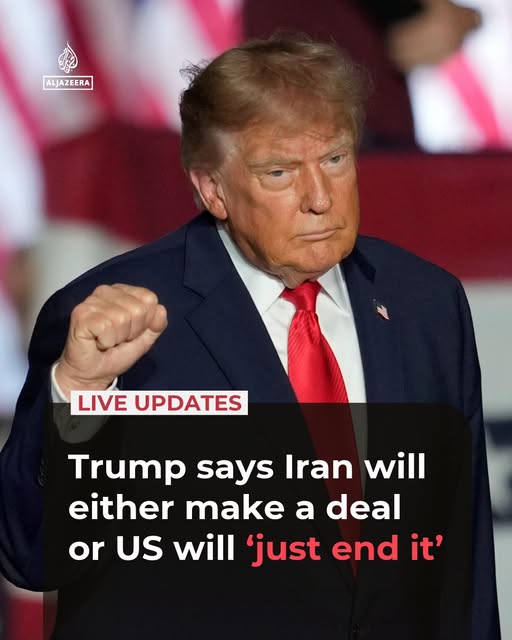
The image is vintage Trump: a clenched fist, a stern expression, and a message that leaves no room for ambiguity. The Al Jazeera chyron cuts to the heart of the matter: “Trump says Iran will either make a deal or US will ‘just end it’.”
The post, which has circulated widely across social media in the final hours before the November 3 midterms, captures a president who is simultaneously threatening war and promising peace—sometimes in the same breath. It is a strategy of maximum pressure, delivered with the blunt force that has become his trademark. But behind the bravado lies a complex reality: a war that has dragged on for months, a diplomatic track that is showing fragile signs of life, and a region bracing for what could come next.
This is the story behind the quote, the dual-track strategy it represents, and the high-stakes gamble Trump is making as Americans head to the polls.
The Verdict: A Real Ultimatum, Delivered at a Critical Moment
Unlike many viral political headlines, this one is grounded in verifiable reporting and direct quotes. On November 1, 2026—just two days before the midterm elections—Trump sat down with Right Side Broadcasting Network (RSBN) and delivered the ultimatum that would dominate the news cycle.
“We’ve had such a victory, and we’ll put it away very soon, one way or the other,” Trump said. “Either they’ll make a deal, or we’ll just end it. End it — I guess you could say maybe the easy way”.
He repeated the line at a campaign rally in Salina, Kansas, telling the crowd: “Either they’ll make a deal, or we just end it. I guess you could say maybe the easy way”. And he made clear that the “easy way” was not a diplomatic breakthrough, but a military one—a new offensive that he suggested would be more successful than the previous ones.
The “Hammer”: A Warning Disguised as Mercy
If the RSBN interview was the ultimatum, the rally was the escalation. Speaking to supporters in Iowa, Trump framed his restraint as an act of mercy—and warned that it would not last forever.
“The only reason I’m not finished with Iran is I want to be nice. I want to try and save all those lives if I can,” he said. “But at some point, we’re going to have to give them the hammer”.
He did not leave the target to the imagination. Trump named Pickaxe Mountain, a suspected underground nuclear installation, as a planned objective. “We can do that in 10 minutes. We have that planned,” he said. “We need to take care of that. We can do that very quickly”.
He also told reporters that the U.S. still had to “take care of, I would say one or two sites, but we can do that in 10 minutes”. The message was unmistakable: the military option is not a bluff. It is a loaded weapon, waiting for a presidential order.
The Diplomacy: “Going Fine,” But Not to Be Trusted
For all the martial rhetoric, Trump has also kept a diplomatic channel open. He described negotiations with Iran as “going fine” but questioned Tehran’s reliability. “They make a deal, and then they back out,” he said.
The talks, mediated by Qatar, have produced a tentative breakthrough. Iran’s Foreign Minister, Abbas Araghchi, told Al Jazeera that a plan to reopen the Strait of Hormuz—a vital waterway that has been disrupted by the conflict—could be implemented within two days if the U.S. meets Tehran’s conditions. Those conditions include lifting sanctions, reducing U.S. military forces in the region, restoring oil waivers, and releasing frozen Iranian funds.
But the sequencing remains a sticking point. The U.S. insists on progress on Iran’s nuclear program before concessions are made, while Iran wants the U.S. to act first. As one analyst told Al Jazeera, “the central difficulty is sequencing and leverage”.
The Regional Powder Keg: “The Second Round Will Be More Dangerous”
Trump’s threats have not gone unanswered. An Iranian army spokesman warned that “a potential future war could last longer than previous conflict, and the American president would not be in a position to dictate the timing or the conditions of its conclusion”. A Revolutionary Guards spokesman added that “in a conflict with America, there are no geographical limitations”.
The region is already feeling the strain. Two crude oil tankers caught fire after hitting mines in the Strait of Hormuz, according to Iran’s Revolutionary Guard. Gulf states are bracing for the worst. “The second round will be more dangerous, more destructive, and it will lead to nowhere,” Egyptian Foreign Minister Badr Abdelatty warned. A UAE presidential adviser said, “If these positions are not bridged, then we have to worry about the worst”.
The Political Stakes: A War Before the Midterms
The timing of Trump’s ultimatum is not accidental. It came just two days before the November 3 midterms, as voters prepared to decide control of Congress. The war with Iran has been deeply unpopular, driving up oil prices and contributing to inflation that has squeezed American families. Trump defended the cost as necessary. “When that war is over, it’s going to come plunging,” he said of oil prices. “It’s a very small price to pay for the security of this country and for the world”.
He also confirmed that he had spoken with Israeli Prime Minister Benjamin Netanyahu, describing the call as “a very good talk”. But Axios reported that the conversation was tense, with Netanyahu pushing for an imminent military strike while Trump preferred to give diplomacy a chance. A senior Israeli official said Israel was preparing for renewed fighting that could begin “right after the vote”.
The Bottom Line
The viral graphic is right about one thing: Trump has told Iran that it can either make a deal or face being “just ended.” But the story is not as simple as a single threat. It is a story about a president who is trying to have it both ways—keeping the door open to diplomacy while keeping his finger on the trigger. It is a story about a region on the brink, a war that has already cost billions, and a political calendar that may be driving the decision-making as much as strategy.
Whether Trump’s ultimatum will produce a deal or a new offensive remains to be seen. But as voters head to the polls and the world watches the Strait of Hormuz, one thing is certain: the next move is Trump’s—and he has made clear that he is ready to “give them the hammer” if they don’t give him what he wants.
📸 Suggested Images
-
The Ultimatum: A photo of Trump at the Salina, Kansas rally, with a quote overlay of “Either they’ll make a deal, or we just end it.”
The Target: A satellite image or map of Pickaxe Mountain, the suspected underground nuclear site Trump named as a planned target.
The Strait: A photo of an oil tanker in the Strait of Hormuz, with a caption noting the mines that have disrupted shipping and the strategic importance of the waterway.
The Diplomacy: A photo of Qatari mediators or Iranian Foreign Minister Abbas Araghchi, with a caption noting the two-day proposal to reopen the Strait of Hormuz.
The Warning: A photo of Egyptian Foreign Minister Badr Abdelatty or a Gulf state official, with a quote overlay of “The second round will be more dangerous, more destructive.”
Comments (0)
Loading comments...
May You Like

THANKSGIVING NIGHTMARE: OVER 1M BLACKOUTS, NEARLY 2M WATER ALERTS!


BANGCHAK REFINERY IN THAILAND SHUT DOWN, U.S. OIL PRICES JUMP 10%!

Latest Posts









Popular Posts



