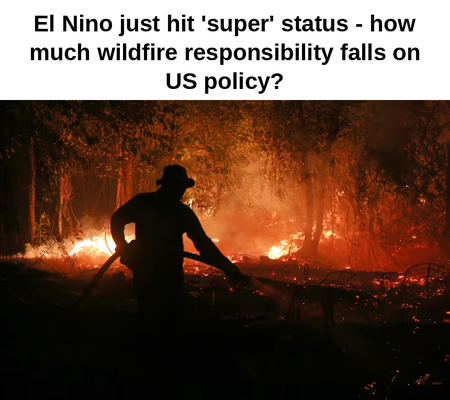
El Niño Just Hit “Super” Status — How Much Wildfire Responsibility Falls on U.S. Policy?
WASHINGTON — September 15, 2026 — A powerful El Niño is rapidly strengthening over the Pacific, with U.S. forecasters warning that the 2026–27 event could rank among the strongest ever observed.
The National Oceanic and Atmospheric Administration’s Climate Prediction Center said on September 10 that there is more than a 90% chance of a very strong El Niño during the Northern Hemisphere fall and winter. NOAA also put the probability of a historic-strength event during October–December at 69%, based on its threshold for events exceeding previous El Niños dating to 1950.
That has renewed a contentious question in the United States: If wildfire conditions worsen, how much can be blamed on El Niño and climate—and how much reflects decisions made by governments over forests, fuels and development?
The answer is considerably more complicated than either side of the political debate often suggests.


Caption: Firefighters battle a wildfire in the western United States. Weather, fuel conditions, ignition sources and land-use decisions all influence how fires develop.
El Niño Really Is Entering Exceptional Territory
El Niño occurs when unusually warm ocean water develops across the central and eastern tropical Pacific, disrupting atmospheric circulation around the world.
This year's event is already unusually intense.
NOAA reported eastern equatorial Pacific sea-surface temperature anomalies exceeding 3°C, while the Niño-3.4 region reached +1.8°C and the Niño-1+2 region reached +3.4°C in August.
That is why the term “super El Niño” has increasingly appeared in media coverage.
Strictly speaking, however, “super El Niño” is not the formal NOAA classification. The agency officially describes the developing event as very strong, while its forecasts indicate a significant possibility of historic intensity.
The distinction matters because a powerful El Niño does not produce the same effect everywhere.
In some parts of the United States, it can mean increased precipitation. In others, it can create conditions that increase wildfire potential months later.
El Niño Does Not Automatically Mean More Wildfires Everywhere
This is one of the biggest misconceptions surrounding the current debate.
A new NOAA-backed study examining wildfire patterns from 1984 through 2022 found that El Niño and La Niña can substantially alter the probability of extensive wildfire activity—but the effects differ by region and season.
For example, autumn El Niño conditions can increase the likelihood of extensive fire in parts of the Northern Rockies and Eastern United States during the following spring.
At the same time, El Niño generally reduces the likelihood of extensive wildfire in portions of the Southern United States, the Great Basin and some other western regions during certain periods.
Southern California is particularly notable: the NOAA research found that El Niño is associated with a decrease in the chances of extensive wildfire there.
So the headline “El Niño equals bigger U.S. wildfires” is simply too broad.
What matters is what El Niño does to a particular region's precipitation, temperature, humidity and vegetation.


Caption: NOAA’s September 2026 outlook shows a rapidly strengthening El Niño across the tropical Pacific, with unusually warm waters driving major shifts in atmospheric circulation.
Some Western Areas Are Still Facing Elevated Fire Risk
The immediate U.S. fire picture is more complicated than the El Niño headline suggests.
A recent drought assessment for California and Nevada identified above-normal significant wildfire potential in northern Nevada and northeastern California for September, along with elevated potential in parts of Washington, Oregon, Idaho and northern California.
That does not mean El Niño is directly responsible for every fire burning in those areas.
Wildfire risk is produced by an interaction between:
- temperature;
- precipitation;
- drought;
- humidity;
- wind;
- vegetation and fuel loads;
- ignition sources;
- topography; and
- human development.
El Niño changes the atmospheric background conditions. It does not strike a match.
So Where Does U.S. Policy Enter the Equation?
This is where the political argument becomes more serious.
For decades, U.S. land managers have wrestled with how aggressively to reduce accumulated vegetation and fuel in forests.
The U.S. Forest Service says fuel-reduction treatments—including prescribed burning, mechanical thinning, chipping and combinations of these approaches—are designed to reduce surface and ladder fuels and alter wildfire behavior.
The underlying argument is straightforward:
If a landscape contains less continuous combustible material, a fire may have fewer opportunities to become exceptionally large or intense.
But that does not mean forest management can eliminate extreme wildfire.
A 2026 Forest Service study examining wildfire risk assessments found that changing fire behavior, ignition rates, vegetation data and development patterns make wildfire-risk planning increasingly complicated.
In other words, there is no single switch that policymakers can flip to “solve” wildfire.


Caption: Prescribed fire and other fuel-reduction treatments are among the tools U.S. land managers use to reduce hazardous vegetation and modify future wildfire behavior.
Climate Change Adds Another Layer
The policy debate also cannot be separated from long-term climate trends.
The Forest Service says climate change and increasing disturbance are placing additional pressure on U.S. forests. A 2026 Forest Service synthesis notes that drought and climate-driven disturbances can reduce the ability of forests to maintain their current carbon-storage role.
Other Forest Service research has found that climate warming, changing vegetation and altered fuel conditions are affecting fire risk across western drylands.
That means today's wildfire environment is not simply the product of one year's weather.
A powerful El Niño can temporarily alter the atmospheric pattern.
Climate change can alter the baseline conditions on which that weather operates.
And land management can influence how much combustible material is available when extreme weather arrives.
Development Is Part of the Problem, Too
There is another factor frequently missing from political arguments over wildfire: where people build.
More homes and infrastructure have expanded into the wildland-urban interface—the zone where communities meet fire-prone vegetation.
A Forest Service study published in 2026 noted that climate change and housing development appear to be altering wildfire regimes in portions of the western Pacific Northwest while placing more people near fire-prone forests.
That creates a difficult policy equation.
Even if the probability of a major fire remains unchanged, the consequences can become dramatically larger when more homes, roads and utilities are located directly in its path.


Caption: Development in the wildland-urban interface can increase the number of homes and communities exposed when extreme wildfire conditions occur.
The Trump Administration Has Put Forest Management at the Center of Its Response
The issue has also become politically charged under President Donald Trump.
In a January 2026 executive order addressing the rebuilding of Los Angeles after devastating fires, the White House blamed state and local governments for what it described as failures in forest management, water infrastructure and emergency response. The administration argued that environmental and climate policies had contributed to the severity of the disaster.
That position reflects a broader Republican argument that federal, state and local governments should accelerate forest thinning, prescribed burning and other fuel-management projects.
Critics counter that blaming wildfire disasters primarily on forest management understates the roles of extreme weather, climate change, human ignition and development.
The scientific evidence supports a more complicated picture.
Fuel management can reduce risk in appropriate landscapes, but it cannot eliminate the influence of weather or climate.
El Niño Could Actually Reduce Fire Risk in Parts of the South
One of the most interesting consequences of this year's event is that some regions may receive a break from fire danger.
The U.S. Geological Survey says the exceptionally strong 2026–27 El Niño is expected to push the jet stream farther south over the southern United States during much of the cool season.
For drought-stricken areas of Texas, New Mexico and Oklahoma, that could bring above-normal precipitation and potentially improve water conditions. But heavy rainfall could also create flooding, erosion and landslide risks, particularly in areas recently burned by wildfire.
So even when El Niño delivers more rain, the consequences are not necessarily simple.
More rain can reduce immediate fire danger while simultaneously increasing flood and erosion hazards after a major burn.
The Real Question Is Not “El Niño or U.S. Policy?”
The evidence increasingly suggests that the better question is:
How do natural climate cycles, long-term warming and human decisions interact?
A major wildfire might begin with a lightning strike or human ignition.
Whether that small fire becomes a disaster can depend on wind, humidity and temperature.
How intensely it burns can depend partly on accumulated fuels.
And how many people are affected can depend on where communities were built and how well they prepared.
Federal and state land-management policies therefore matter—but they are only one part of the equation.
A 2026 Forest Service study projecting wildfire and suppression costs through 2100 found that projected wildfire activity and suppression spending increased across all of the climate scenarios examined, although the magnitude varied substantially between scenarios.
That suggests the policy challenge is not simply suppressing more fires.
It is reducing exposure and vulnerability before extreme fire weather arrives.


Caption: Wildfire preparedness increasingly combines fuel management, evacuation planning, emergency response and community-level resilience.
What Comes Next?
The current El Niño is expected to strengthen further through late 2026.
NOAA currently gives a greater than 90% probability of a very strong El Niño during the Northern Hemisphere fall and winter, while its latest outlook puts the chance of a historic-strength event during October–December at 69%.
That makes the coming months a major test for U.S. climate and wildfire preparedness.
For fire managers, El Niño provides valuable advance information about how precipitation and atmospheric circulation could evolve.
For policymakers, the challenge is converting that information into action: preparing firefighting resources, managing hazardous fuels where treatments are appropriate, protecting communities in fire-prone areas and improving evacuation systems.
And for the public, perhaps the most important takeaway is that there is no single culprit.
THE BOTTOM LINE
El Niño is becoming exceptionally strong—but it cannot by itself explain America's wildfire problem.
The 2026 event will reshape weather patterns across the United States, but its wildfire effects will vary dramatically by region. NOAA research shows that El Niño can increase wildfire risk in some areas while reducing it in others.
U.S. policy nevertheless matters.
Forest fuel management, prescribed burning, development in fire-prone areas, emergency preparedness and climate policy can all influence how vulnerable communities are when extreme conditions arrive.
The most accurate conclusion is therefore neither “El Niño caused the fires” nor “government forest policy caused the fires.”
It is an interaction:
Extreme weather sets the stage. Climate change can shift the baseline. Fuels and land management influence fire behavior. And development determines how much is ultimately at risk.
With a potentially historic El Niño now developing, the United States is about to find out how well those systems work together.
Comments (0)
Loading comments...
May You Like
gfnhgmnghnmfgnbvvvvvvvvv