
Epstein Files Controversy Intensifies as Lawmakers Challenge DOJ Transparency and Midterm Ads Fuel a Political Showdown
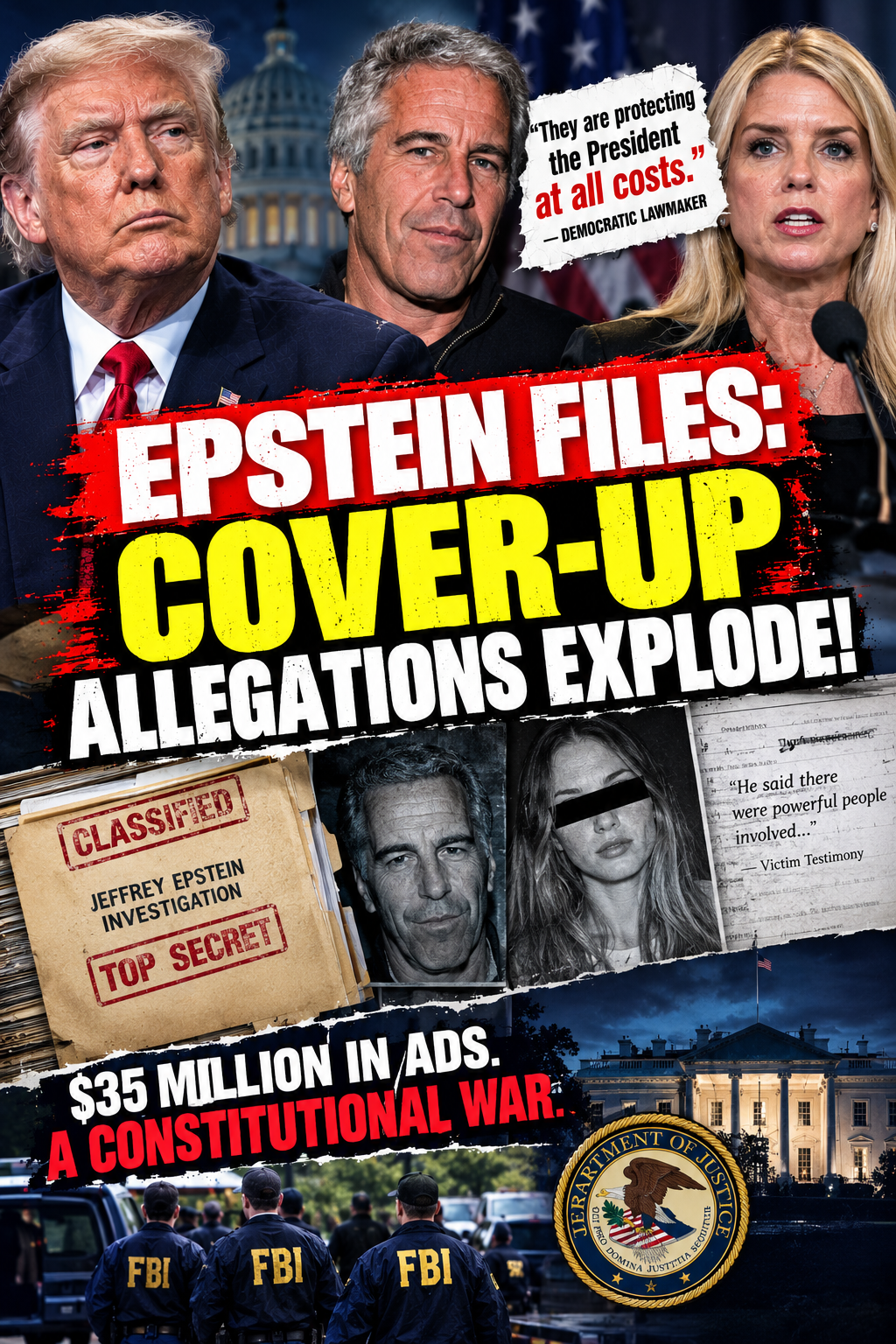
The fight over the federal government’s handling of records connected to Jeffrey Epstein has escalated into a major political confrontation, with congressional Democrats demanding greater transparency, Republicans pushing back against what they describe as politically motivated attacks, and the Justice Department facing renewed questions about how investigative material has been reviewed, withheld and released. As the 2026 midterm elections approach, the controversy has become more than a dispute over old investigative files: it is increasingly a test of public trust, government accountability and the ability of political institutions to investigate allegations involving powerful people without compromising victims’ privacy or due process.
Recent reporting shows that the controversy is not simply an online rumor. The Justice Department has published millions of pages of Epstein-related records, but lawmakers and survivors’ advocates have continued to challenge the completeness of the releases, the handling of redactions and the department’s decisions about which documents should remain confidential. Those disputes have fueled accusations of a cover-up. However, accusations that officials are deliberately protecting President Donald Trump or suppressing evidence must be distinguished from documented problems with the disclosure process. The existence of a disputed or withheld record does not, by itself, establish a coordinated effort to conceal criminal conduct.
A massive document release has not ended the transparency dispute

On January 30, 2026, the Justice Department announced that it had published more than three million additional pages in response to the Epstein Files Transparency Act, bringing the total released material to nearly 3.5 million pages. The release also included more than 2,000 videos and 180,000 images, according to the department. The records were drawn from multiple investigations, including federal cases involving Epstein and Ghislaine Maxwell, investigations into Epstein’s death in federal custody, and other related inquiries.
The scale of the release is significant, but the volume of material has not resolved the central question facing investigators and lawmakers: whether the public has received the records required by law, with only legally justified exceptions.
The department has said that certain material was withheld because it was duplicative, privileged, unrelated to the investigations or subject to restrictions designed to protect victims and prevent the release of illegal sexual-abuse material. It has also warned that the public production may contain false or fabricated submissions that were sent to the FBI. That warning matters because investigative files can include raw tips, unverified allegations, interview summaries and material collected from third parties—not simply findings that prosecutors have established as true.
The distinction is essential. A name appearing in an FBI document does not automatically indicate that the person committed a crime, was accused by a credible witness, or was the target of a formal investigation. Nor does a document’s presence in a government archive mean that its contents have been independently corroborated.
Congressional scrutiny grows over missing records and redactions

Concerns about the release process have continued despite the publication of millions of pages. In March, the Justice Department disclosed that 15 documents had been incorrectly coded as duplicates and subsequently released additional records, including FBI interview material containing allegations against Trump. The Washington Post reported that the allegations described in those records had not been independently corroborated by the newspaper; the White House rejected them as baseless. The allegations should therefore not be presented as established facts.
The episode intensified scrutiny because it raised a practical question about the review process: if records were mistakenly classified and left out of an earlier release, what safeguards exist to identify similar errors?
There have also been disputes over the opposite problem—information released with inadequate redactions. The department has acknowledged that some documents may have inadvertently included identifying information about victims and has provided a process for survivors and their representatives to flag records that require further review. That creates a difficult balance: the public has a legitimate interest in understanding how authorities handled Epstein’s crimes and potential accomplices, while survivors should not be exposed to additional harm through careless disclosure.
More recently, Rep. Jamie Raskin, the top Democrat on the House Judiciary Committee, pressed the Justice Department to explain its refusal to assist certain state and foreign investigations into potential crimes connected to Epstein. The Washington Post reported on October 22 that Raskin sought records concerning requests for international legal assistance and cooperation with state and local law enforcement. The department confirmed it was reviewing his request, but had not publicly explained all the refusals described in the report.
Those questions are serious and deserve evidence-based answers. Yet a disagreement over investigative cooperation, redaction policy or the interpretation of disclosure requirements is not, by itself, proof that the attorney general or the president directed an illegal cover-up.
The midterm elections turn the Epstein scandal into a campaign weapon

The political consequences are becoming increasingly visible in the run-up to November’s midterm elections. According to an October 22 Washington Post report citing AdImpact, Democrats had spent approximately $53 million on ads mentioning Epstein in competitive races, compared with about $3 million spent by Republicans. That is roughly $56 million combined—not the $35 million figure stated in the supplied graphic. The figures cover the report’s specified campaign-ad category and should not be interpreted as a total of all spending related to Epstein across every political contest.
Democratic campaigns have used the controversy to question Republican candidates’ votes on releasing the files, their relationships with donors who had connections to Epstein, and their willingness to scrutinize the administration. The argument is politically potent because it connects the scandal to a broader concern about whether wealth and influence allow some people to avoid the consequences that ordinary citizens would face.
Republicans have countered that Democrats are using Epstein’s crimes to damage political opponents, including through advertisements that connect candidates to people mentioned in the records without demonstrating wrongdoing. That concern is not hypothetical: reporting on the campaign ads has documented cases in which the presence of a donor’s name in the files was used to imply a more consequential relationship than the available evidence established.
The controversy has therefore created a political dilemma for both parties. Republicans face pressure to demonstrate that they support full, lawful disclosure, while Democrats must show that their demands for accountability are grounded in evidence rather than guilt by association.
For voters, the most important distinction is between criticizing a politician’s position on transparency and alleging that the politician participated in Epstein’s crimes or helped conceal them. The first can be assessed through public records and voting histories. The second requires specific, credible evidence.
What do the records and victims’ accounts actually establish?

The Epstein investigation encompasses a wide range of material: court filings, law-enforcement records, correspondence, interview summaries, photographs and submissions from members of the public. These categories carry different evidentiary weight.
A sworn statement or FBI interview record may document what a witness told investigators. It does not automatically prove every assertion in that account. Investigators may need to compare it with other testimony, travel records, communications, financial documents and physical evidence. Likewise, a person’s appearance in correspondence or a contact list does not, on its own, establish involvement in sexual abuse or trafficking.
That caution does not mean every allegation should be dismissed. It means allegations should be investigated, corroborated where possible and described accurately. The public also has a legitimate interest in knowing whether authorities overlooked evidence, made improper decisions or failed to pursue potential accomplices.
The Justice Department’s own disclosure notice acknowledges that its online archive may include material that was submitted to investigators but is false, fabricated or otherwise unreliable. The department has also warned that some files may inadvertently contain sensitive information and says it is working to address inadequate redactions.
For journalists and lawmakers, this creates a responsibility to examine documents in context rather than treating every newly released page as a revelation. A credible account should identify what the document says, who created it, whether it reflects an allegation or a verified finding, and whether independent evidence supports the claim.
Is there proof of a government cover-up?

The image accompanying this story uses the phrase “They are protecting the President at all costs” and presents the dispute as an established cover-up. That wording should be treated as a claim in an editorial graphic, not as a verified quotation or a proven conclusion. The image does not identify the Democratic lawmaker allegedly making the statement, provide a date or link to a transcript, or supply documentation establishing the accusation.
There is, however, documented grounds for continued scrutiny of the disclosure process. The Justice Department has acknowledged the mistaken classification of some records, faced criticism over redactions and been asked to explain decisions affecting access to investigative material. Those matters warrant answers from officials and, where appropriate, independent review.
Proving a deliberate cover-up would require more than demonstrating that records were missing, delayed or redacted. Investigators would need evidence that officials intentionally concealed relevant information for an improper purpose, rather than making a mistake or applying a lawful restriction. Evidence might include internal communications, documented instructions, inconsistent explanations or other records showing deliberate misconduct. The material cited here does not, by itself, establish that the attorney general is leading a coordinated effort to protect Trump.
The same standard applies to claims that the president personally directed the suppression of evidence. Political relationships, past associations and a name appearing in investigative records cannot substitute for proof of a specific act.
A constitutional and institutional test

The wider stakes extend beyond any single administration. The credibility of federal law enforcement depends on the public’s ability to believe that investigative decisions are made according to evidence and law—not political loyalty. That requires transparency where disclosure is legally required, clear explanations when information is withheld, safeguards for victims and meaningful oversight when officials’ decisions are challenged.
Congress has a role in scrutinizing the executive branch, and the Justice Department should be prepared to explain its handling of records under the Epstein Files Transparency Act. If officials failed to comply with the law or deliberately obstructed a legitimate investigation, those allegations should be examined through appropriate legal and oversight mechanisms. If accusations are unsupported, they should not be amplified as established fact simply because they are politically explosive.
The political timing makes this especially consequential. With campaigns using the Epstein scandal to define their opponents, the public could see more advertisements, hearings and competing interpretations of the same documents before Election Day. The risk is that a genuine demand for accountability becomes buried beneath claims that are difficult to verify and designed primarily to provoke outrage.
Ultimately, the central question is not which party can produce the most damaging slogan. It is whether the government has disclosed the records required by law, protected survivors from further harm, explained questionable decisions and investigated credible evidence without fear or favor.
The Epstein case remains a legitimate subject of public scrutiny. But the strongest route to accountability is a careful examination of the documentary record—not an assumption that every allegation is true, or that every procedural failure proves a conspiracy.
Comments (0)
Loading comments...
May You Like


EAST COAST STORM CRISIS—5 MILLION AT RISK OF BLACKOUTS, WATER, AND HEATING FAILURES!

WEYMOUTH HORROR — FIRE TRUCK BRAKES TO SAVE DOG, ONE FIREFIGHTER DEAD, TWO CRITICAL!









Popular Posts





