
Epstein Files Fight Intensifies as Federal Court Presses DOJ for Greater Transparency
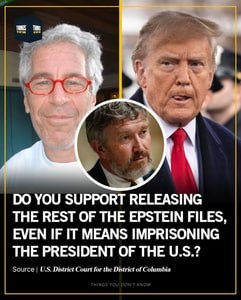
Renewed debate over Jeffrey Epstein-related records has intensified in Washington as a federal court presses the Justice Department to explain redactions, produce specific materials, and comply with disclosure requirements enacted by Congress.
The viral graphic frames the issue as though releasing additional records could automatically lead to President Donald Trump’s imprisonment, but no court order cited in the current litigation makes such a finding or prediction.
Congress passed the Epstein Files Transparency Act in November 2025, and Trump signed it into law, requiring the Justice Department to publish broad categories of unclassified Epstein-related records, subject to limited legal protections.
In January 2026, the Justice Department said it had released nearly 3.5 million pages, alongside more than 2,000 videos and 180,000 images collected from multiple Epstein-related investigations and court proceedings.
The department’s online Epstein Library remains active and was last updated on September 11, 2026, with records divided among Justice Department disclosures, congressional releases, court documents, and other responsive materials.
Some information remains redacted because existing laws and court rules protect victims, personal identifiers, grand-jury material, and other sensitive information that cannot simply be published without additional legal review.
Questions about whether additional material was improperly withheld have nevertheless continued, producing lawsuits challenging the Justice Department’s implementation of the transparency law rather than determining whether any individual committed a crime.
One major case, Phang v. Blanche, is pending in the U.S. District Court for the District of Columbia and concerns journalist Katie Phang’s effort to obtain additional records and explanations for redactions.
On September 16, Judge Emmet Sullivan addressed unresolved disclosure issues involving handwritten FBI interview notes, foreign-language documents, and the detailed redaction information that the Epstein Files Transparency Act requires the government to provide.
The judge directed the Justice Department to submit certain unredacted handwritten notes for private judicial review, allowing the court to examine the government’s objections before deciding whether further public disclosure is appropriate.
That order is a transparency ruling, not a criminal judgment against Trump or another person. It does not declare that the records prove an offense, nor does it order anyone arrested or imprisoned.
Earlier releases included FBI interview summaries containing uncorroborated allegations involving Trump. The Associated Press reported that the woman making those claims later stopped cooperating with investigators, while Trump has denied wrongdoing.
The Justice Department separately characterized allegations against Trump contained in some submitted materials as false and unfounded, while acknowledging that its massive disclosure included information submitted to investigators from many different sources.
That distinction is crucial because an individual’s appearance in investigative files, address books, flight records, interview summaries, photographs, or correspondence does not by itself establish participation in criminal activity or wrongdoing.
The Justice Department has also said its review did not identify sufficient evidence for new prosecutions arising from the released material, although disclosure disputes and judicial examination of particular records have continued.
Critics of the department’s handling have questioned incomplete disclosures and redactions, while officials have emphasized victim privacy, legal restrictions, and the extraordinary volume of documents investigators and lawyers were required to review.
The current court fight therefore centers primarily on compliance: whether the government released everything required by statute, adequately justified its redactions, and properly reviewed categories of records that could still warrant disclosure.
For survivors, transparency creates competing concerns. Public access can illuminate institutional failures, but careless disclosure can expose names, photographs, financial information, or other sensitive details that victims have strong legal protections against revealing.
The controversy remains politically charged because released documents reference numerous prominent people. Responsible interpretation, however, requires separating documented contacts and allegations from corroborated investigative evidence, criminal charges, convictions, or judicial findings.
The verified story is therefore narrower than the viral graphic suggests: courts continue reviewing the government’s compliance with disclosure law, while no current ruling states that releasing additional Epstein records would imprison the president.
Related Images
Comments (0)
Loading comments...
May You Like

Obama Steps Back Into the Political Spotlight as Democrats Target Trump’s Senate Majority

gfnhgmnghnmfgnbvvvvvvvvv













