
FACT CHECK: Did Trump Really Designate the Oval Office a "National Monument"? The Real Story Behind the Viral Claim
FACT CHECK: Did Trump Really Designate the Oval Office a "National Monument"? The Real Story Behind the Viral Claim
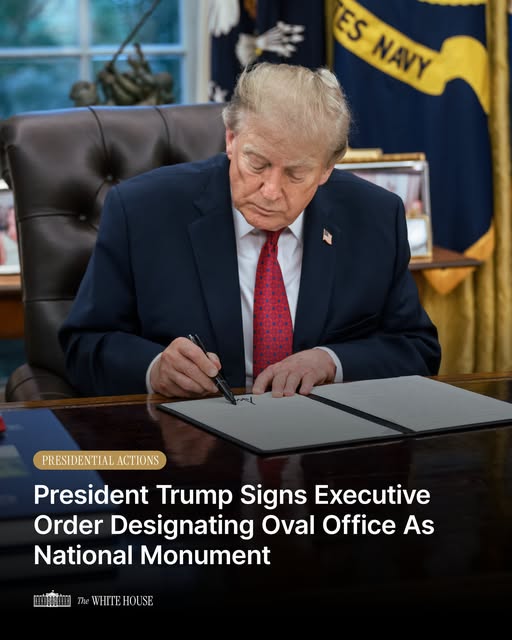
The image is designed to provoke a mixture of laughter and disbelief: Donald Trump, seated at the Resolute Desk, carefully signing a document. The caption below is as audacious as it is absurd: "President Trump Signs Executive Order Designating Oval Office As National Monument."
The post, which has circulated widely across social media, presents itself as a legitimate news update, complete with a "Presidential Actions" label and the official-looking White House seal. It plays directly into the popular caricature of Trump as a leader obsessed with his own legacy, his name on buildings, and the grandeur of his surroundings.
But here is the truth: This is not a real executive order. There is no record of President Trump designating the Oval Office as a national monument. The image is a piece of political satire—a meme that has gone viral because it feels, to many observers, like something he might actually do.
This is the story behind the viral claim, the legal reality of how national monuments are created, and why this particular joke resonates so deeply in the current political moment.
The Verdict: A Fabricated Claim Rooted in Satire
Unlike many viral political headlines, this one cannot be traced to a single, verifiable source. It is a fabricated image, likely created by a political satirist or a social media user, and it has been shared widely as a joke.
The claim is legally nonsensical. Under the Antiquities Act of 1906, the President of the United States has the authority to designate national monuments on federally owned land. This power has been used by presidents of both parties to protect millions of acres of land, from the Grand Canyon to Bears Ears. But the Oval Office is not "federally owned land" in the traditional sense—it is the working office of the President, located within the White House, which is already a designated National Historic Landmark and a unit of the National Park Service. A president cannot unilaterally designate his own workspace as a national monument, and even if he could, the move would be legally and practically absurd.
The White House itself has not issued any statement on the matter, and a search of the Federal Register—where all executive orders are officially published—returns no record of such an action.
Why the Joke Works: The "Trumpian" Logic
The viral image resonates because it taps into a very real and widely recognized aspect of Trump's political persona: his obsession with his own legacy and his tendency to turn everything he touches into a monument to himself.
Consider the evidence:
-
The Presidential Walk of Fame: In 2026, Trump installed a "Presidential Walk of Fame" in the White House Rose Garden, featuring plaques honoring himself and other presidents—a move that critics described as self-aggrandizing.
The Oval Office Renovations: Trump has extensively remodeled the Oval Office, adding gold-leaf accents, a new desk, and portraits of himself and other figures. The renovations were widely covered in the media, with critics describing them as "gaudy" and "monarchical."
The Building Names: Trump has put his name on hotels, casinos, steaks, water, and even a university. The idea that he would want to put his name on a national monument is not a stretch.
The joke works because it is a logical extension of a pattern. It is satire that is only slightly removed from reality.
The Legal Reality: How National Monuments Are Actually Created
For those who might be wondering, here is the legal framework that makes the viral claim impossible:
The Antiquities Act grants the president the power to declare "historic landmarks, historic and prehistoric structures, and other objects of historic or scientific interest" on land owned or controlled by the federal government as national monuments. The power is broad, but it is not unlimited. The monument designation must be limited to the "smallest area compatible with proper care and management of the objects to be protected."
The Oval Office is already part of the White House complex, which is a National Historic Landmark and a unit of the National Park Service. It is already protected. The idea of designating it as a separate national monument would be redundant, legally dubious, and—most importantly—unnecessary.
The Broader Context: A Presidency of Spectacle
The viral image is more than just a joke. It is a window into how the Trump presidency is perceived by a significant portion of the American public. For his critics, Trump is a leader who prioritizes spectacle over substance, who is more concerned with his legacy than with governance, and who treats the presidency as an extension of his personal brand.
The image of him signing an order to make the Oval Office a national monument is a perfect distillation of that critique. It is a joke, but it is also a commentary on the nature of his presidency—a presidency that has been defined by a relentless focus on image, symbolism, and self-promotion.
The Bottom Line
The viral graphic is not a real news story. It is a piece of political satire, and it should be treated as such. There is no executive order designating the Oval Office as a national monument, and there is no legal basis for such an order.
But the fact that the image has circulated so widely—and that so many people believed it, or at least found it plausible—tells us something important about the political moment. It tells us that the line between satire and reality has become dangerously blurred, and that the public's trust in the institutions of government has been eroded to the point where almost any absurdity seems possible.
In the end, the joke is on us. And that, perhaps, is the most telling monument of all.
📸 Suggested Images
-
The Viral Graphic: The original image featuring Trump signing the document, with the "National Monument" caption.
The Real Oval Office: A photo of the Oval Office as it actually looks today, with a caption noting that it is already a National Historic Landmark.
The Antiquities Act: A photo of the Grand Canyon or another national monument created under the Antiquities Act, illustrating the legal framework that the viral claim misrepresents.
The Walk of Fame: A photo of the "Presidential Walk of Fame" in the White House Rose Garden, illustrating the real-world context that made the joke resonate.
The Satire: A screenshot of a social media post calling out the image as satire, illustrating the blurred line between fake news and political humor.
Comments (0)
Loading comments...
May You Like

IOWA CRISIS — 150+ WITH LEAD AND MERCURY POISONING, 69 CRITICAL!

NYC EMERGENCY—MILLIONS FACE EVACUATION RISKS, MACY'S GIANT BALLOONS REMOVED FOR SAFETY!

BANGCHAK REFINERY DISASTER IN THAILAND—120,000 BARRELS A DAY SHUT DOWN, U.S. OIL PRICES SURGE 10%!

Latest Posts








Popular Posts




