
Fact Check: Some Democrats Really Are Keeping Kamala Harris at Arm’s Length in 2026 Midterm Races
Verdict: Mostly True
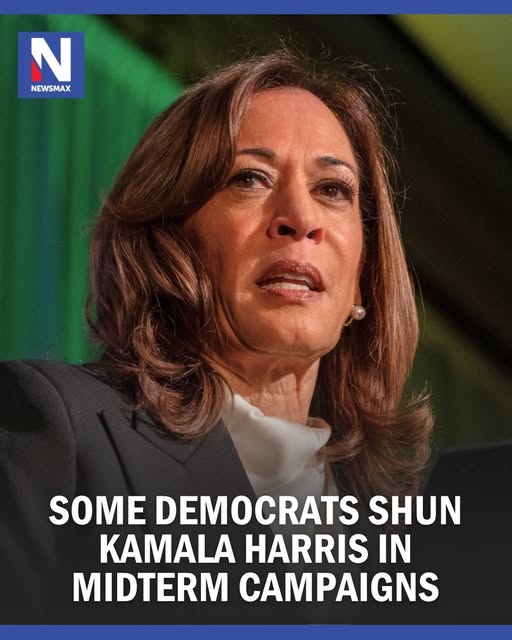
A Newsmax graphic claims: “SOME DEMOCRATS SHUN KAMALA HARRIS IN MIDTERM CAMPAIGNS.”
Unlike many viral political graphics, the central claim here is supported by recent reporting. Several Democratic candidates running in competitive or Republican-leaning states have publicly indicated that they do not want former Vice President Kamala Harris campaigning alongside them.
But the word “shun” is somewhat loaded. The Democratic Party as a whole has not rejected Harris. Other prominent Democrats are actively welcoming her endorsements and campaign assistance.
The more accurate description is that Democrats are divided over whether Harris helps or hurts them in different kinds of 2026 races.
The story behind the graphic
The issue came into sharper focus in late August and early September as Harris increased her involvement in the 2026 midterm elections.
Politico reported that some Democrats in states won by President Donald Trump in 2024 were encouraging Harris to stay away from their races. The concern is primarily electoral: candidates in conservative states and districts are trying to establish independent identities and appeal to voters who may be skeptical of national Democratic figures.
That reporting has now been acknowledged directly by Harris herself.
On September 3, MS NOW host Peter Alexander asked Harris about reports that red-state Democrats wanted her to “stay away” from their campaigns.
Harris did not deny the reports. Instead, she said candidates know what they need to do to win and that she supports them “in doing whatever they need to do to win.”
That response is important because it confirms that the controversy is not simply something invented by conservative social media.
Iowa Democrats delivered the clearest rejection
The strongest examples come from Iowa.
Rob Sand, the Democratic nominee for governor, was asked by Politico's Jonathan Martin whether he wanted Joe Biden to campaign for him.
He said no.
Then Martin asked about Harris.
Sand responded, “No thanks. Let’s move on. We need some new leadership.”
Sand went further when asked whether he thought Harris should seek the presidency again in 2028.
His answer was simply “No.”
That is considerably stronger than merely declining a campaign appearance.
Josh Turek, the Democratic nominee for U.S. Senate in Iowa, was also asked whether he wanted Harris to campaign for him.
His answer was “No.”
Iowa is a particularly difficult environment for Democrats. President Trump carried the state in 2024, meaning Democratic candidates seeking statewide office have strong incentives to distinguish themselves from the national party.
Wisconsin Democrat also says she doesn't need Harris
Rebecca Cooke, the Democratic challenger to Republican Rep. Derrick Van Orden in western Wisconsin, has similarly emphasized her own local appeal.
Cooke noted that in 2024 she received about 9,000 more votes than Harris in her district.
“I don't need anyone to come and campaign with me in my district,” Cooke said, arguing that she has built relationships across party lines herself.
That doesn't necessarily amount to hostility toward Harris.
It is better understood as a campaign-strategy calculation: Cooke believes her own political identity is more valuable to her race than association with the former Democratic presidential nominee.
Alaska provides another example
Former Rep. Mary Peltola, the Democratic Senate candidate in Alaska, also distanced herself from Harris.
In August, Harris's political organization sent a fundraising appeal on Peltola's behalf. Peltola subsequently rejected the unsolicited support.
The reason is particularly obvious in Alaska: Harris lost the state by roughly 13 percentage points in 2024.
For a Democrat trying to win a statewide race in a strongly Republican state, being closely identified with the 2024 Democratic presidential nominee may carry more risk than benefit.
But “Democrats shun Harris” is too broad
This is where the Newsmax graphic needs qualification.
Not all Democrats are avoiding Harris.
Sen. Jon Ossoff of Georgia has welcomed her support. Harris has also endorsed several Democratic candidates in competitive races.
One prominent example is Rep. Chris Pappas of New Hampshire, whom Harris endorsed on August 31 in the state's open Senate race. Pappas publicly welcomed the endorsement.
Harris has also been supporting candidates including Ossoff and other Democrats around the country.
And Nevada Attorney General Aaron Ford, the Democratic gubernatorial nominee, is planning to campaign with Harris at a canvass event in Las Vegas.
Ford has made no secret of his willingness to use the relationship. He said Harris's interest in 2028 is relevant to Nevada and famously characterized the political timetable as:
“2028 starts right now in 2026.”
So the political picture isn't “Democrats have abandoned Harris.”
It is closer to:
Blue-state, purple-state and some national Democrats are willing to use Harris, while Democrats in tougher red-state races are more cautious.
Harris is also positioning herself for 2028
There is another layer to the story.
Harris has not announced a 2028 presidential campaign, but she has continued to leave the possibility open.
In April, when Rev. Al Sharpton asked whether she might run again, Harris said she “might” and that she was thinking about it.
Her increasing involvement in the 2026 midterms therefore serves two purposes.
First, she can help Democratic candidates and build relationships within the party.
Second, appearing at rallies, issuing endorsements and raising money keeps her politically relevant if she ultimately decides to seek the presidency again.
That creates an awkward situation for candidates who are focused strictly on winning their own races.
A candidate may want Harris's fundraising network while simultaneously worrying that a high-profile appearance with her could give Republicans an opening.
Why some Democrats are distancing themselves
The calculation varies by state, but several factors are obvious.
1. Harris lost the 2024 presidential election
Harris replaced Biden as the Democratic presidential nominee in 2024 but ultimately lost to Trump.
That makes her a complicated surrogate in districts where voters remain dissatisfied with the previous Democratic administration.
2. Geography matters
A Democrat running in California has a very different electoral calculation from one running in Iowa or Alaska.
A national Democratic figure can be an asset in a heavily Democratic constituency but a liability in a district or state where a candidate needs Republicans and independents.
3. Candidates want to emphasize independence
Sand's comments about needing “new leadership” illustrate a broader argument inside the Democratic Party about whether it needs a generational change after the Biden-Harris era.
Some candidates believe the best way to win is to focus on local issues rather than relitigating the 2024 presidential campaign.
4. Harris herself may be part of the 2028 conversation
Candidates who are trying to establish their own brands may not want their 2026 campaign to become an implicit endorsement of one potential 2028 presidential candidate.
That is especially true for Democrats who could themselves become future national figures.
Harris's response is revealing
When confronted directly about Democrats who don't want her campaigning for them, Harris did not attack those candidates.
Instead, she said:
“We need to win.”
She said she looks forward to helping where she can and supports candidates doing whatever they need to do to win.
That's a politically sensible response.
It allows Harris to continue building relationships without publicly punishing Democrats who believe her presence could hurt them.
It also avoids turning a tactical disagreement into a larger party feud.
What the viral graphic gets right — and what it leaves out
What it gets right:
- Some Democratic candidates really have rejected or discouraged Harris's campaign involvement.
- Rob Sand explicitly said he did not want Harris campaigning for him.
- Josh Turek also said he did not want Harris campaigning for him.
- Mary Peltola rejected a Harris fundraising effort.
- Rebecca Cooke said she did not need Harris to campaign with her.
- Harris was directly asked about the issue on September 3 and acknowledged that candidates must decide what helps them win.
What it leaves out:
- Democrats have not collectively rejected Harris.
- Jon Ossoff has welcomed her support.
- Chris Pappas accepted her endorsement.
- Aaron Ford is planning a campaign appearance with her.
- Harris remains active in Democratic politics and is building a national network ahead of a possible 2028 campaign.
So “some Democrats shun Harris” is substantially accurate, while “Democrats shun Harris” would be misleading.
The larger Democratic dilemma
The Harris controversy is really part of a larger question facing Democrats before the November midterms:
What kind of party do they want to be after the 2024 defeat?
Some candidates are attempting to win back voters who supported Trump by emphasizing moderation, local issues and independence from Washington.
Others are embracing nationally prominent Democrats and building a broader anti-Trump coalition.
Harris sits directly at the intersection of those strategies.
She has national name recognition, a fundraising network and a potentially important role in the 2028 presidential field. But she also carries the baggage of the 2024 election and the Biden administration.
That means her usefulness as a campaign surrogate depends heavily on where the candidate is running and which voters they need to persuade.
Bottom line
The Newsmax graphic is based on a real political development, not a fabricated story.
Several Democrats running in difficult 2026 races really are keeping Kamala Harris at arm's length — and some have said so publicly.
But the graphic's wording can make the situation sound broader than it is.
Harris has not been rejected by the Democratic Party. She is actively campaigning for Democrats, has received enthusiastic support from other candidates, and remains a potential 2028 presidential contender.
The more accurate headline would be:
“Some Red-State Democrats Keep Their Distance From Kamala Harris as Others Welcome Her Support.”
Fact-check rating: MOSTLY TRUE.
Comments (0)
Loading comments...
May You Like

South Korea–Ukraine Rift Deepens Over North Korean POW Transfer as PURL Draws New Scrutiny

Obama Steps Back Into the Political Spotlight as Democrats Target Trump’s













