Federal Judge Blocks Trump’s White House Ban on CNN, MS NOW and Politico
A Trump-appointed judge ordered the administration to immediately restore journalists’ White House credentials while their constitutional challenge continues, dealing a temporary setback to the president’s escalating confrontation with major news organizations.
WASHINGTON — A federal judge temporarily blocked President Donald Trump’s ban on CNN, MS NOW and Politico early Thursday, ordering the White House to immediately restore the organizations’ press credentials.
U.S. District Judge Timothy Kelly granted emergency relief to the three news organizations while their lawsuit challenging Trump’s decision proceeds through federal court.
The ruling does not finally decide whether Trump’s policy violates the First Amendment. Instead, it restores access temporarily while the larger constitutional dispute continues.
Kelly concluded that CNN, MS NOW and Politico are likely to succeed on their argument that the administration failed to provide constitutionally adequate due process before revoking their journalists’ credentials.
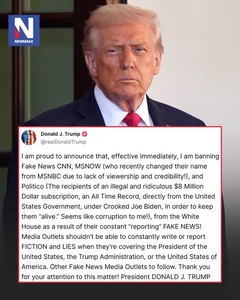
The controversy began September 18 when Trump announced on Truth Social that, “effective immediately,” he was banning the three organizations from the White House.
Trump accused CNN, MS NOW and Politico of repeatedly reporting what he called fiction and lies about his presidency and said additional news organizations could eventually face similar treatment.
Minutes later, reporters questioned Trump in the Oval Office about his decision. The president said he was tired of what he considered inaccurate reporting and described all three organizations as “fake news.”
Initially, it was unclear whether Trump’s social-media declaration would actually be enforced because journalists from the affected organizations remained on White House grounds later that Friday.
That uncertainty ended the following morning when CNN correspondent Betsy Klein, MS NOW reporter Akayla Gardner and Politico reporter Cheyenne Haslett attempted to enter the White House.
Their credentials had been deactivated. Security personnel prevented the reporters from entering, confiscating their passes and referring questions about the decision to White House officials.
The three organizations responded by announcing they would defend their access, arguing that excluding journalists because officials object to their reporting constitutes unconstitutional retaliation against the press.
CNN, MS NOW and Politico subsequently filed a joint federal lawsuit Monday seeking immediate restoration of their White House access and challenging the administration under both the First and Fifth Amendments.
Their lawyers characterized Trump’s action as viewpoint discrimination, arguing presidents cannot grant or withdraw established press access depending upon whether individual news organizations publish favorable coverage.
The administration offered a different explanation once the dispute reached court, arguing that White House access represents a privilege rather than an unrestricted constitutional right for individual journalists.
Justice Department lawyers also introduced national-security arguments, saying the outlets had allegedly failed to meet professional standards and had published sensitive or classified information.
That explanation attracted skepticism from Kelly during Wednesday’s hearing because Trump’s original public explanation had focused overwhelmingly on unfavorable and allegedly inaccurate news coverage rather than national security.
Kelly noted that nothing predating the lawsuit appeared to demonstrate that national-security concerns actually motivated the original decision to deactivate the journalists’ White House passes.
The judge also observed that some reporting subsequently cited by the administration to justify its decision appeared routine, while certain stories were already months old.
Another major problem involved procedure. The organizations received neither advance notice that their credentials were about to be revoked nor a meaningful opportunity to challenge the decision beforehand.
Kelly pointed toward two important D.C. Circuit precedents — Sherrill v. Knight and Karem v. Trump — concerning procedural protections when the government restricts journalists’ White House access.
Sherrill, decided in 1977, established that once the White House creates a system providing journalists access, decisions denying credentials must satisfy procedural requirements rather than being imposed arbitrarily.
Karem emerged from Trump’s first presidency and similarly addressed White House efforts to suspend a reporter’s credential, reinforcing due-process protections surrounding access decisions.
Kelly himself is a Trump-appointed judge, having been nominated to the federal bench during Trump’s first term, adding another noteworthy dimension to Thursday’s ruling.
He had previously handled litigation involving former CNN correspondent Jim Acosta after the first Trump administration attempted to revoke Acosta’s White House credential following a contentious presidential news conference.
In that earlier dispute, Kelly ordered Acosta’s credential restored after concluding that his Fifth Amendment due-process rights had been violated, prompting the White House to comply.
The current dispute has consequences extending beyond the three banned organizations because CNN belongs to the five-network television pool responsible for continuously documenting presidential activities.
CNN had been scheduled to provide pooled television coverage Monday as Trump traveled to New York for the United Nations General Assembly, but the White House prevented CNN from performing that role.
ABC, CBS, NBC and Fox then declined to replace CNN, joining it in temporarily suspending the presidential television pool rather than accepting the administration’s exclusion of one participating network.
The five networks said the public has a vital interest in receiving independent information about government and argued administrations should not reject news organizations simply because officials object to their reporting.
That decision produced an immediate practical consequence when Trump held a White House helipad ribbon-cutting ceremony without the usual television pool and the government feed provided little usable audio.
The press pool normally exists precisely to prevent such coverage gaps, using rotating journalists and television crews to document presidential activity in locations too small to accommodate every news organization.
Separate print and radio pool arrangements also exist, while television responsibility traditionally rotates among ABC, CBS, CNN, Fox and NBC.
The legal battle consequently reaches beyond whether three organizations can enter the White House. It could influence how much authority presidents possess over journalists covering them from government-controlled spaces.
Trump maintains that the dispute concerns dishonest journalism rather than press freedom, and he has denied that his administration is broadly attacking constitutionally protected news organizations.
The affected organizations reject that distinction, arguing government officials cannot punish journalists for reporting they dislike while continuing to grant comparable access to outlets producing more favorable coverage.
Thursday’s order does not conclusively resolve that First Amendment argument. Kelly’s immediate ruling rests substantially on the administration’s failure to provide sufficient procedural protections before revoking access.
The administration had subsequently offered the organizations until September 25 to contest their exclusion, but that opportunity arrived only after credentials had already been deactivated and litigation had begun.
The judge’s temporary order means CNN, MS NOW and Politico journalists can once again access the White House while the case proceeds, unless a higher court changes the ruling.
The broader constitutional questions — including whether the administration engaged in prohibited viewpoint discrimination — remain unresolved and could become the most consequential part of the litigation.
Comments (0)
Loading comments...
May You Like

South Korea–Ukraine Rift Deepens Over North Korean POW Transfer as PURL Draws New Scrutiny

Russian Drone Strikes Kyiv Bridge as German Chancellor Arrives in Ukraine