
Federal Judge Clears Way for Trump Administration to End Deportation Protections for Nearly 1,100 Somalis
A federal judge in Massachusetts has cleared the way for the Trump administration to terminate Temporary Protected Status (TPS) for nearly 1,100 Somali nationals, removing a major legal barrier that had prevented the government from ending their protection from deportation.
The ruling, issued Aug. 14 by U.S. District Judge Allison Burroughs, allows the Department of Homeland Security to move forward with its decision to end Somalia's TPS designation. The case remains subject to further legal proceedings, meaning the ruling does not mean that all affected Somalis will be immediately deported.
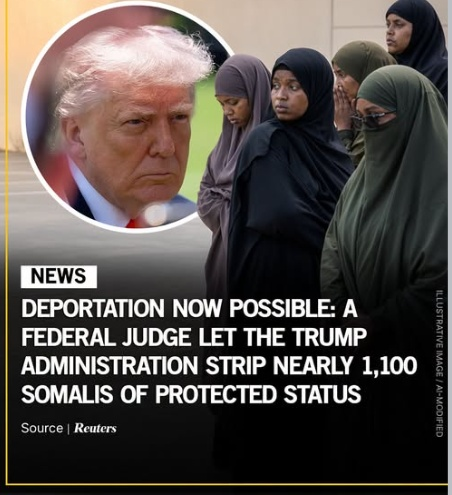
The development was highlighted in the viral news graphic provided for this report, which states that a federal judge allowed the Trump administration to strip nearly 1,100 Somalis of protected status.
What Is Temporary Protected Status?
Temporary Protected Status is a humanitarian immigration program created by Congress that allows eligible nationals of designated countries to remain legally in the United States when conditions such as armed conflict or other extraordinary circumstances make returning home unsafe.
TPS holders can generally obtain work authorization and protection from deportation for as long as the designation remains in effect.
Somalia has been covered by TPS for decades because of prolonged instability and armed conflict. The most recent extension was scheduled to run through March 17, 2026.
In January, the Trump administration announced that it would terminate Somalia's designation, arguing that conditions in the country no longer met the statutory requirements for TPS. The termination was initially scheduled to take effect March 17.
But the policy was challenged in federal court.
Judge Had Previously Blocked the Termination
In March, Judge Burroughs temporarily stopped the administration from ending Somalia's TPS protections while the lawsuit proceeded.
Her order meant Somali TPS holders continued to retain protection against deportation and detention based on their TPS status, as well as eligibility for employment authorization.
The plaintiffs — including African Communities Together and other immigrant-rights organizations and individuals — argued that the administration's decision was unlawful and discriminatory. They challenged both the government's authority to terminate TPS and the process used to reach the decision.
The litigation changed significantly after the Supreme Court issued a ruling in June concerning the administration's efforts to terminate TPS for Haitians and Syrians.
That decision narrowed the ability of federal courts to block the executive branch's TPS termination decisions, giving the Trump administration greater room to proceed with its broader immigration agenda.
August Ruling Opens the Door to Deportation
On Aug. 14, Burroughs lifted the administrative stay that had prevented the Somalia TPS termination from taking effect.
The judge concluded that the Homeland Security secretary had the legal authority to terminate Somalia's TPS designation and rejected the plaintiffs' request for emergency relief.
The court's decision means the government can now proceed with ending the protections.
However, losing TPS does not automatically mean that every Somali TPS holder will be deported immediately.
An individual may have another legal basis for remaining in the United States, such as asylum, lawful permanent residence, another immigration status, or a pending immigration case. Those circumstances must be considered separately.
The ruling therefore creates the possibility of removal for people whose only protection from deportation was TPS rather than ordering a mass deportation of all Somali immigrants.
Somali Community Faces New Uncertainty
The decision has generated concern among Somali-American organizations, particularly in Minnesota, which has the country's largest Somali community.
CAIR-Minnesota said the ruling could expose TPS holders to the loss of work authorization and potentially to detention, deportation and separation from their families. The organization emphasized that the legal challenge itself was not necessarily over.
Minnesota Attorney General Keith Ellison had previously joined a coalition of 16 state attorneys general opposing the administration's attempt to terminate TPS for Somalis. The coalition argued that ending the program could cause significant humanitarian and economic harm.
Minnesota has become a particularly important center of the debate because of its large Somali-American population, much of which is concentrated in the Minneapolis-St. Paul area.
The Broader Trump Immigration Strategy
The Somalia case is part of a much broader effort by the Trump administration to reduce or eliminate humanitarian immigration protections established under previous administrations.
The administration has pursued the termination or restriction of TPS designations covering nationals from multiple countries.
The legal battles have produced mixed results, but the Supreme Court's recent decisions have strengthened the administration's position in several of these disputes.
At the same time, other immigration policies have continued to face court challenges. Reuters reported this week, for example, that a federal appeals court found the Trump administration's IRS sharing of taxpayer information with immigration authorities unlawful, illustrating the continuing legal conflict surrounding the administration's immigration enforcement policies.
What the Viral Graphic Gets Right — and What It Leaves Out
The graphic is substantially correct about the core court ruling: a federal judge did clear the way for the Trump administration to terminate TPS protections for nearly 1,100 Somalis.
But the headline “DEPORTATION NOW POSSIBLE” needs important context.
The ruling does not order the deportation of 1,100 people. Instead, it removes a legal protection that had prevented the government from using the end of TPS as a basis for removal.
Some affected individuals may have other immigration protections or legal claims that could allow them to remain in the United States.
The legal fight also is not necessarily finished. Advocacy groups have indicated that they intend to continue challenging the termination, including through appeals.
Bottom Line
The Aug. 14 ruling represents a significant victory for the Trump administration's effort to dismantle TPS protections for Somali nationals.
For nearly 1,100 people who have relied on TPS to live and work legally in the United States, however, the decision is better understood as the opening of a new immigration and legal battle, rather than an immediate deportation order.
The case could also become an important test of how much authority the executive branch has to terminate humanitarian immigration programs — and how much protection federal courts can provide against those decisions.
Comments (0)
Loading comments...
May You Like

gfnhgmnghnmfgnbvvvvvvvvv

TRUMP HIT WITH 26 ARTICLES OF IMPEACHMENT













