
Federal Judge Rules Trump Administration’s Plan to Halve FEMA Workforce Was Unlawful
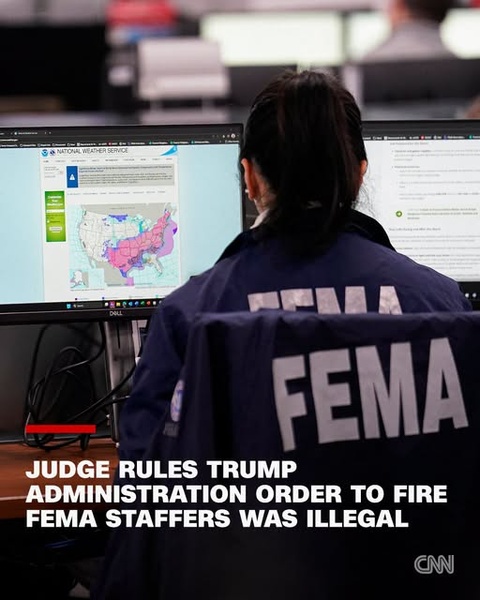
WASHINGTON — A federal judge has ruled that the Trump administration acted unlawfully when it pursued a plan to cut the Federal Emergency Management Agency workforce by roughly half.
U.S. District Judge Susan Illston issued the decision in San Francisco, siding with unions that challenged staffing reductions they said threatened FEMA’s ability to perform its disaster-response mission.
The case centers on actions by the Department of Homeland Security, which directed FEMA to reduce staffing despite objections from agency officials and restrictions imposed by federal law.
Illston found DHS improperly interfered with FEMA’s authority over personnel, particularly by preventing the agency from renewing temporary contracts for thousands of on-call disaster responders.
The ruling is significant because FEMA depends on experienced personnel and reserve responders to expand operations rapidly when hurricanes, wildfires, floods, and other emergencies overwhelm local capabilities.


Congress strengthened FEMA’s legal protections after Hurricane Katrina, requiring that the agency’s authorities, responsibilities, and functions not be substantially or significantly reduced without congressional authorization.
According to the court, the administration failed to provide a convincing rationale for the dramatic staffing target, while the proposed reduction appeared disconnected from FEMA’s operational needs.
The judge also criticized the use and deletion of Signal messages by DHS and FEMA officials discussing staffing decisions, saying the missing communications could have been relevant evidence.
The litigation was brought by federal employee unions, including the American Federation of Government Employees, which argued that the workforce reductions were unlawful and endangered the agency’s core responsibilities.
The administration has argued that FEMA has flexibility to determine appropriate staffing levels as part of a broader effort to reduce the size and cost of the federal government.
President Donald Trump has previously advocated shifting more disaster preparedness responsibilities to states and has repeatedly questioned whether FEMA should continue operating in its traditional form.
The workforce dispute follows broader changes inside FEMA during Trump’s second administration, including personnel departures, leadership turnover, and efforts to restructure how federal disaster assistance is delivered.
A Government Accountability Office report released in August found that more than 4,300 FEMA employees left during fiscal year 2025, increasing pressure on an agency already facing staffing challenges.
GAO warned that workforce reductions without strategic planning could leave FEMA without enough personnel or institutional knowledge to respond effectively to increasingly complex and frequent disasters.
The judge’s ruling does not immediately establish the final remedies or penalties. Instead, the parties are expected to submit arguments concerning what relief should follow from the decision.
That means the legal dispute is not necessarily finished, and the administration could continue challenging aspects of the ruling while negotiations over remedies move forward.
The decision also comes as federal agencies face continuing legal challenges over the Trump administration’s broader campaign to reduce staffing, reorganize agencies, and expand presidential control.
For disaster survivors, the controversy extends beyond employment policy because FEMA’s staffing capacity directly affects preparedness, coordination, recovery assistance, and the speed with which federal resources can reach communities.
Emergency management specialists have long emphasized the importance of trained personnel and coordinated information during disasters, making workforce capacity a central component of national preparedness.
The ruling therefore represents an important legal setback for the administration’s FEMA restructuring effort, while leaving unresolved questions about the agency’s future size, responsibilities, and role in national disaster response.
Sources referenced: Reuters, Associated Press, and the U.S. Government Accountability Office.
The wording above deliberately uses “plan to halve FEMA’s workforce” rather than saying the court simply ruled that every FEMA firing was illegal, because that more precisely reflects the September 2026 ruling.
Comments (0)
Loading comments...
May You Like

Shocking news from Ohio: an unexpected development ahead of Trump's rally

Russian Drone Strikes Kyiv Bridge as German Chancellor Arrives in Ukraine













