Gas Hits $4.14 a Gallon Before Labor Day — But Is Trump and the GOP to Blame?
Fact-check verdict: Mostly misleading
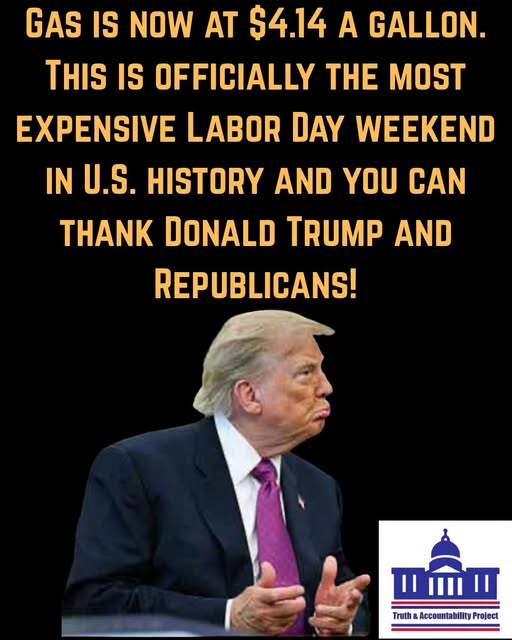
A viral graphic claims that gasoline has reached $4.14 a gallon, making this the “most expensive Labor Day weekend in U.S. history,” and tells Americans to “thank Donald Trump and Republicans.” The first part is substantially correct. The second turns a complicated global oil-price shock into a much simpler political claim.
As of September 3, 2026, the national average for regular gasoline really was $4.14 per gallon, according to AAA. More importantly, AAA says Americans are facing the highest gasoline prices ever recorded for the Labor Day period. But the primary driver of today's prices is the extraordinary disruption in global oil markets stemming from the U.S.-Iran conflict and continuing problems around the Strait of Hormuz—not simply a Republican policy decision at the gas pump.
The $4.14 figure is real
AAA reported a national average of $4.1436 per gallon on September 3, up from $4.0997 a week earlier and $3.1903 a year earlier.
That represents an increase of about 95 cents, or roughly 30%, in one year.
The historical comparison is also striking.
AAA says the previous Labor Day record was $3.82 per gallon on September 3, 2012. This is the first time the national average has been above $4 on Labor Day, according to the organization.
So the graphic is on solid ground when it says this is an unprecedentedly expensive Labor Day at the pump.
What about the $4.14 number from the government?
The Energy Information Administration's latest weekly data are slightly different because EIA measures prices on a weekly basis and uses its own methodology.
For the week ending August 31, EIA put the average price for regular gasoline at $4.071 per gallon, while its broader “all grades” measure was $4.207.
That isn't a contradiction. AAA's $4.1436 figure is a daily national average as of September 3, while EIA's figures are weekly averages.
Why are gasoline prices so high?
The biggest factor is the price of crude oil.
Gasoline prices are heavily influenced by the cost of crude, and oil markets have been badly disrupted by the continuing conflict involving the United States and Iran.
The Strait of Hormuz is particularly important. EIA reported that crude and petroleum liquids moving through the waterway averaged only about 4.9 million barrels per day in the second quarter of 2026, compared with 21.6 million barrels per day in the fourth quarter of 2025, before the conflict.
That represents an enormous reduction in one of the world's most important oil-transit routes.
The renewed fighting has kept the pressure on. Reuters reported September 4 that Brent crude was headed for a weekly gain of more than 6%, while WTI was up more than 8% for the week amid renewed U.S.-Iran fighting and continuing uncertainty around the Strait of Hormuz.
On September 1, Brent settled at about $94.65 a barrel, while WTI reached $90.22, after a new escalation in the conflict.
That is ultimately what American motorists are paying for at the pump.
Did Trump and Republicans have nothing to do with it?
That conclusion would go too far in the other direction.
President Donald Trump does bear political responsibility for the administration's decisions surrounding the Iran conflict, which has been a major catalyst for the oil-market disruption.
Reuters reported earlier this year that the war launched by the United States and Israel against Iran was responsible for a major part of the gasoline-price surge, and a Reuters/Ipsos poll found that 77% of registered voters said Trump bore at least some responsibility for rising gasoline prices.
Trump himself has also acknowledged that the conflict has consequences for fuel prices. In August, Energy Secretary Chris Wright said gasoline prices had remained elevated because of the U.S.-Israeli war with Iran. Reuters reported that Trump had defended higher fuel prices as a necessary trade-off for preventing Iran from acquiring nuclear weapons.
So there is a legitimate political argument that Trump's foreign-policy decisions contributed to the conditions producing today's expensive gasoline.
But that is different from saying that Republicans simply decided to raise gasoline prices.
Gasoline prices aren't controlled by the White House
The retail price Americans pay is determined by several factors:
- crude-oil prices;
- global supply and demand;
- refinery capacity and utilization;
- gasoline inventories;
- transportation and distribution costs;
- seasonal gasoline demand;
- state and federal taxes; and
- geopolitical disruptions.
The current episode illustrates the global nature of the market. Even though the United States produces enormous quantities of oil, American gasoline prices are still affected by international crude prices.
And the current shock isn't confined to gasoline.
U.S. diesel prices have also surged. The Associated Press reported September 4 that the national diesel average had reached a record $5.85 per gallon, with the conflict disrupting global fuel supplies.
Trump has actually been pressuring oil companies to lower prices
There is another important piece of context missing from the viral graphic.
Trump has repeatedly demanded that gasoline retailers and oil companies reduce prices.
In June, he called for gasoline retailers to lower prices immediately and targeted a price around $2.50 per gallon. He also directed the Justice Department to investigate major oil companies over whether consumers were being overcharged.
That doesn't mean his administration is responsible for none of the underlying price pressure. It does demonstrate why the claim that Republicans simply wanted Americans to pay $4.14 at the pump is an oversimplification.
The administration has also taken steps to increase fuel supply
The Trump administration has attempted to respond to the price shock through measures involving oil supplies and refinery output.
Reuters reported in August that Energy Secretary Chris Wright was working with refiners on measures to increase fuel production, even as U.S. refineries were already operating at very high utilization rates.
Earlier responses included releasing oil from the Strategic Petroleum Reserve and other measures intended to mitigate the supply shock.
But these measures cannot instantly erase a disruption affecting the global oil market.
The political problem for Republicans
Where the viral graphic has a legitimate political point is in its electoral significance.
Gasoline is one of the most visible prices Americans encounter. Drivers see it every few days, and fuel costs feed into transportation, shipping and eventually the prices of other goods.
That makes $4-plus gasoline particularly dangerous for a governing party heading into midterm elections.
Reuters reported in August that Trump's approval rating was only 33%, with dissatisfaction over the Iran war, inflation and gasoline prices weighing heavily on voters.
Republicans themselves have recognized the political danger. Earlier reporting showed GOP strategists trying to emphasize Republican economic policies while reducing the degree to which candidates are personally tied to Trump.
In other words, the price spike is unquestionably a political problem for Trump and Republicans, even if assigning every dollar of the gasoline price directly to them would be inaccurate.
What the viral graphic gets right — and what it leaves out
What it gets right:
- The national gasoline average really was about $4.14 per gallon on September 3.
- AAA says this is the highest Labor Day gasoline price on record.
- Prices were roughly 95 cents higher than a year earlier.
- The surge is occurring amid a major geopolitical oil-market disruption.
- High gas prices are a serious political liability for the Trump administration and Republicans heading into the midterms.
What it leaves out:
- $4.14 is a national average, not what every American is paying.
- EIA's weekly numbers differ because it uses a different measurement period and methodology.
- Gasoline prices depend heavily on global crude-oil markets, not simply congressional or presidential decisions.
- The current surge is closely tied to the U.S.-Iran conflict and disruptions around the Strait of Hormuz.
- Trump has simultaneously been pressuring oil companies to reduce prices and attempting to increase fuel supply.
- Other factors—including refinery operations, inventories, transportation and regional taxes—also affect what motorists pay.
Bottom line
The graphic's price claim is accurate: $4.14 gasoline is real, and AAA says Americans are experiencing the most expensive Labor Day period at the pump ever recorded.
But the political conclusion—“you can thank Donald Trump and Republicans”—is much less straightforward.
Trump's administration bears meaningful responsibility for the geopolitical decisions that helped produce the current oil shock, and the resulting gasoline prices are clearly hurting the Republican Party politically. But the pump price itself is the product of a global petroleum market, with the continuing Iran conflict and Strait of Hormuz disruption playing an unusually large role.
Verdict: Mostly misleading. The graphic accurately describes an unprecedented Labor Day gasoline price, but presents a complex global energy shock as though it were simply a price set by Trump and congressional Republicans.
Comments (0)
Loading comments...
May You Like

Shocking news from Ohio: an unexpected development ahead of Trump's rally
OBAMA STEPS BACK INTO THE POLITICAL SPOTLIGHT

Russian Drone Strikes Kyiv Bridge as German Chancellor Arrives in Ukraine