
Gavin Newsom Challenges Jared Kushner’s Role in U.S.
SACRAMENTO — California Gov. Gavin Newsom has sharply questioned why Jared Kushner, President Donald Trump’s son-in-law and a private-sector investor, is playing a prominent role in sensitive U.S. diplomatic negotiations.
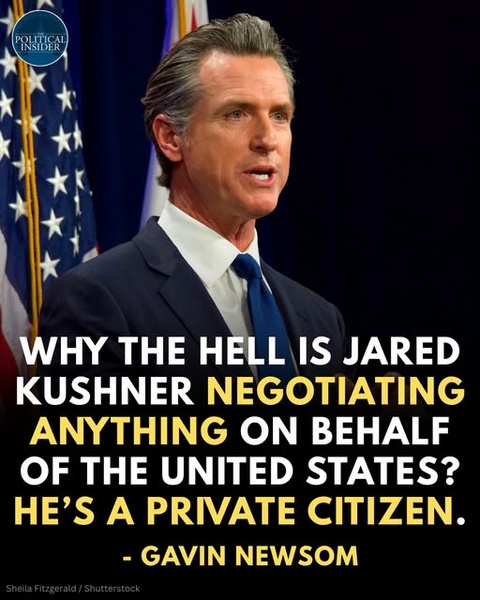
“Why the hell is Jared Kushner negotiating anything on behalf of the United States? He’s a private citizen,” Newsom’s press office posted on X.
The criticism comes as Kushner has become increasingly visible in the Trump administration’s international diplomacy, including recent efforts to revive negotiations aimed at ending Russia’s war in Ukraine.
But there is an important distinction behind the controversy: Kushner is indeed a private citizen, yet the Trump administration has publicly involved him in diplomatic efforts and treats him as part of the president’s negotiating team.
Kushner Has Become a Key Trump Diplomatic Emissary
Kushner is not serving as secretary of state or as a Senate-confirmed ambassador. He is also not a sitting government official in the traditional sense.
Nevertheless, Trump has repeatedly relied on him for high-level diplomatic missions.
In recent days, Kushner traveled alongside U.S. special envoy Steve Witkoff to Moscow, where they held roughly three hours of talks with Russian President Vladimir Putin before traveling to Kyiv to meet Ukrainian President Volodymyr Zelenskyy.
The mission was part of Trump's renewed effort to restart negotiations over the Russia-Ukraine war.
Reuters reported that Trump had sent Witkoff and Kushner abroad with the goal of advancing a peace proposal, while Zelenskyy later said the U.S. envoys had presented several potentially useful ideas.
The talks did not produce an immediate breakthrough.
The White House Has Given Kushner an Official Diplomatic Role — Without Making Him a Conventional Diplomat
Newsom's criticism focuses on Kushner's status as a private citizen.
That point is factually correct: Kushner is not a Cabinet secretary or career Foreign Service officer.
But it would be misleading to suggest that he is acting entirely on his own.
The Trump administration has repeatedly publicly identified Kushner as part of its diplomatic efforts.
The White House included him in its 2025 Ukraine peace talks alongside Secretary of State Marco Rubio and special envoy Steve Witkoff.
In January 2026, the White House also appointed Kushner to the executive board of Trump's Board of Peace, an international organization created around the administration's Gaza initiative. The White House described Kushner as one of the figures responsible for areas including governance, regional relations, reconstruction and investment.
The White House's current communications also refer to Kushner as a “Special Envoy” in connection with the Ukraine peace effort.
So while Newsom is correct that Kushner is a private citizen, the broader suggestion that he is simply freelancing foreign policy is not supported by the available evidence.
Why Newsom Is Raising the Issue Now
Newsom's criticism comes at a particularly sensitive moment for Trump's foreign policy.
The administration is simultaneously dealing with the continuing conflict with Iran and trying to revive stalled Russia-Ukraine negotiations.
Kushner has emerged as one of Trump's most trusted intermediaries in these efforts, despite having no conventional diplomatic career.
That has created an unusual situation in which a businessman and presidential relative is participating in negotiations involving major foreign powers.
For Newsom, that raises obvious questions about accountability.
His criticism echoes a broader Democratic argument that major foreign-policy decisions should be conducted through established government institutions and officials who are accountable to Congress and the American public.
Kushner’s Defenders Point to His Relationship With Trump
Trump's allies see the situation differently.
Kushner has a unique relationship with the president: he is not only Trump's son-in-law but also a former senior White House adviser who played a major role in Trump's first administration.
During Trump's first term, Kushner was deeply involved in Middle East diplomacy and was closely associated with the development of the Abraham Accords, which normalized relations between Israel and several Arab states.
The Trump administration has therefore continued to treat Kushner as a trusted channel capable of communicating directly with foreign leaders.
The White House has defended the broader diplomatic team around Witkoff and Kushner, emphasizing that Trump personally directs the negotiations.
The Ukraine Mission Shows How Unconventional the Approach Has Become
The latest Russia-Ukraine mission illustrates the administration's unconventional diplomatic structure.
Kushner and Witkoff met Putin in Moscow before traveling to Kyiv for discussions with Zelenskyy.
According to the Associated Press, the Kyiv meeting was described as encouraging, but there was no major breakthrough toward ending the war.
Reuters reported that the discussions focused on potential next steps for negotiations and that Zelenskyy expressed openness to further diplomatic engagement. A future trilateral meeting is being considered, although major disagreements remain over territory and security guarantees.
Russia and Ukraine, meanwhile, continue to exchange attacks.
That means Kushner's role is unfolding against the backdrop of an active war rather than a conventional diplomatic conference.
Is Kushner Legally Barred From Negotiating?
Newsom's statement also raises a more complicated legal question.
The United States has a longstanding federal statute known as the Logan Act, which prohibits unauthorized American citizens from negotiating with foreign governments in disputes involving the United States.
But the existence of the law does not mean that every private citizen who speaks with a foreign government is automatically violating it.
The central issue would be whether the person was acting without U.S. authority and attempting to influence a foreign government's conduct in a way prohibited by the statute.
That distinction is particularly important in Kushner's case because his diplomatic activity is occurring with the knowledge and backing of the Trump administration.
The administration is not presenting him as an independent citizen conducting a rogue foreign-policy mission. It is presenting him as part of Trump's negotiating team.
The Conflict-of-Interest Question Is Separate
There is, however, another question that cannot simply be dismissed: Kushner's private business interests.
Kushner is the founder of Affinity Partners, an investment firm that has attracted substantial capital from foreign investors, including investors in the Middle East.
That makes scrutiny of his diplomatic activities more politically sensitive.
Critics argue that whenever a private businessman with significant international financial relationships participates in government negotiations, the public deserves transparency about potential conflicts.
Supporters counter that Kushner's private-sector experience and relationships can give the administration access to people and channels that traditional diplomats may not have.
The debate therefore isn't simply about whether Kushner is legally allowed to speak with foreign officials.
It is about who should represent the United States in negotiations involving war, national security and potentially enormous geopolitical consequences.
Newsom’s Hypothetical Comparison
Newsom's broader criticism reflects a familiar Democratic argument: imagine if a Democratic president had sent a close relative — rather than a Senate-confirmed diplomat — to negotiate with a foreign government.
That argument is designed to highlight what Democrats see as a double standard surrounding Trump's use of family members and personal allies.
Republicans, however, would likely argue that presidents have broad authority to select representatives they trust for diplomatic missions and that Kushner is operating with the administration's authorization.
The disagreement is therefore as much about political norms and institutional trust as it is about formal legal authority.
What the Viral Graphic Gets Right — and Wrong
The image circulating online presents Newsom's statement as a direct challenge to Kushner's legitimacy.
Several points are worth separating:
Confirmed:
- Newsom's office publicly questioned Kushner's diplomatic role and called him a private citizen.
- Kushner is not the secretary of state or a traditional career diplomat.
- Trump has nevertheless used Kushner in high-level diplomatic missions.
- Kushner recently traveled with Witkoff to Moscow and Kyiv for Russia-Ukraine peace discussions.
- The White House has formally included Kushner in major diplomatic structures, including the Board of Peace.
Needs qualification:
- Saying Kushner is “just a private citizen” can obscure the fact that he is acting with the Trump administration's backing.
- There is no evidence that he independently seized authority to negotiate on behalf of the United States.
- Newsom's criticism is a political and institutional argument, not a judicial finding that Kushner's diplomatic activities are illegal.
A New Model of Presidential Diplomacy
The controversy ultimately reveals something larger about Trump's governing style.
Rather than relying exclusively on traditional diplomatic institutions, Trump has repeatedly turned to people he personally trusts — including business figures, political allies and family members — to pursue difficult negotiations.
Kushner has become one of the clearest examples.
Whether that approach produces breakthroughs remains uncertain. The latest Russia-Ukraine talks have generated renewed diplomatic momentum, but the fundamental disagreements between Moscow and Kyiv remain unresolved.
For Newsom and other critics, the question is whether such sensitive negotiations should be handled by people with formal public responsibilities and institutional accountability.
For Trump, the calculation appears different: if someone he trusts can get a foreign leader to the negotiating table, that may matter more than whether the negotiator fits the traditional definition of a diplomat.
That tension — between formal diplomatic institutions and presidential personal diplomacy — is likely to remain at the center of the debate as Kushner's role continues to expand.
Comments (0)
Loading comments...
May You Like
Jack Smith Defends His Integrity as Trump Investigations Face Renewed Political Firestorm

OBAMA STUNS ON INSTAGRAM: MESSAGE MARKING 34-YEAR MILESTONE SPARKS A BUZZ














