Gavin Newsom Claims Americans Were Better Off Under Biden — What the Record Shows

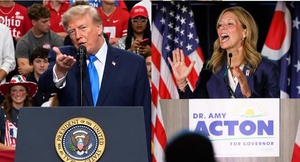
A political graphic circulating online claims that California Gov. Gavin Newsom says Americans were better off under President Joe Biden.
The claim has a factual basis, but there is an important catch: the statement is not new. Newsom made the argument during the 2024 presidential campaign, and he has continued to defend Biden's record more recently.
The bigger question — whether Americans actually were better off under Biden — depends heavily on which economic measures are used.
Newsom did argue that Americans were better off under Biden
In late October 2024, while campaigning for Biden-Harris, Newsom told voters that they were “much better off today” than before Biden and Kamala Harris took office.
The Sacramento Bee examined Newsom's economic claims at the time and found a mixture of accurate, partly accurate and incorrect statements.
For example, Newsom claimed Biden had overseen dramatically greater job creation than the previous three Republican administrations combined. The Bee found that claim was true using the comparison Newsom specified, although the picture changed when Ronald Reagan's administration was included.
Newsom also cited historically low unemployment among some demographic groups, but several of those claims required correction or context.
So the graphic is not inventing Newsom's position, but it compresses a much broader economic argument into a single sentence.
Biden left office with a strong labor market
One of the strongest arguments supporting Newsom's position is employment.
By January 2025, when Biden left office, the unemployment rate was 4.0%. The Bureau of Labor Statistics reported that nonfarm payroll employment had increased by 143,000 that month.
Newsom's broader job-creation argument also has substantial support. The Sacramento Bee calculated approximately 16.1 million jobs were added during Biden's presidency, although that number is influenced by the enormous employment collapse and subsequent recovery associated with COVID-19.
That last point matters.
Comparing presidents by total jobs added can be misleading because Biden inherited an economy still recovering from the pandemic. Millions of jobs lost during 2020 were subsequently restored.
But inflation was the major weakness of the Biden economy
This is where the “better off” argument becomes much more subjective.
Americans experienced a substantial increase in prices during Biden's presidency. Even after inflation cooled considerably from its 2022 peak, prices remained much higher than when Biden took office.
That means lower inflation in 2023-24 did not mean prices returned to their 2021 levels.
This distinction is crucial:
Inflation rate: how quickly prices are increasing.
Price level: how expensive goods and services have become.
A household can experience falling inflation while still paying considerably more for groceries, housing, gasoline and other necessities than it did several years earlier.
That helps explain why economic statistics and people's personal experiences can produce very different answers to the question “Are you better off?”
Real wages did eventually recover
The wage picture is more complicated than simply saying wages went up or down.
BLS data show that real — inflation-adjusted — average hourly earnings increased 1.0% from January 2024 to January 2025. Real average weekly earnings increased 0.7% over that period.
In other words, by the end of Biden's presidency, wages were again growing faster than inflation on a year-over-year basis.
But workers had already experienced substantial inflation earlier in the administration, particularly in 2021-22. Consequently, a worker could have received raises while still feeling financially squeezed because the cost of living had risen sharply.
Household incomes tell another part of the story
Census data provide another useful measure.
Median household income in 2024 was $83,730, compared with $82,690 in 2023. However, the Census Bureau said the difference was not statistically significant.
That doesn't establish that the typical American household was definitively better or worse off across the entire Biden presidency. It demonstrates why broad claims about household prosperity need to specify the measure being used.
Newsom's defense of Biden has continued
The claim also fits Newsom's more recent political positioning.
In June 2026, Newsom spoke very positively about Biden, describing him as one of the most successful presidents of the last century and saying he would defend Biden's legacy.
That is politically significant because Newsom is widely viewed as a potential Democratic presidential contender for 2028. Axios reported in June that Newsom had been unusually willing among prospective Democratic candidates to embrace Biden's legacy.
So the graphic's basic message is consistent with Newsom's public position, even though the particular “better off” argument dates back to the 2024 campaign.
What about Americans under Trump now?
Current public opinion provides an important counterpoint.
A Reuters/Ipsos poll conducted in late August 2026 found that 71% of Americans disapproved of Trump's handling of living costs, while Trump's overall approval rating stood at 33%. The survey also found that economic concerns were helping Democrats regain an advantage on economic issues.
A separate Financial Times poll found that more than 53% of registered voters said their financial situation had worsened since Trump returned to office, including 57% of independents.
Those numbers don't prove that Biden's economy was objectively better in every respect. They do show that a substantial share of Americans currently feel worse off under Trump, which gives Newsom's argument political traction.
There is no single “better off” statistic
This is the biggest problem with the graphic.
If “better off” means jobs and unemployment, Biden's record is relatively strong.
If it means inflation and the purchasing power of household budgets, the Biden years contain a major negative: the enormous price increases of 2021-22.
If it means real wages, the answer changes depending on the starting and ending dates.
If it means household income, the evidence is more mixed.
And if it means how Americans themselves felt about their financial situation, polling showed considerable dissatisfaction with the Biden economy heading into the 2024 election.
The Sacramento Bee's 2024 review illustrates precisely why individual Newsom statistics cannot simply be treated as proof that every American was better off. Some of his claims checked out; others were partly true or needed significant context.
Verdict on the graphic
Mostly true, but missing important context.
Newsom genuinely argued that Americans were better off under Biden, particularly during the 2024 campaign, and he has continued defending Biden's presidency.
But the graphic should not be interpreted as an objective finding that Americans universally were better off under Biden.
The economic record contains legitimate evidence for both sides: strong employment and falling unemployment, but also a major inflation shock that left prices substantially higher than when Biden entered office.
And importantly, the graphic makes an old 2024 argument look like a new statement unless the date is supplied.
Bottom line
Newsom's position is real. The question of whether Americans actually were better off under Biden is a matter that can be evaluated with economic data, but it cannot honestly be reduced to a one-line political slogan.
Comments (0)
Loading comments...
May You Like

South Korea–Ukraine Rift Deepens Over North Korean POW Transfer as PURL Draws New Scrutiny

Jack Smith Defends His Integrity as Trump Investigations Face Renewed Political Firestorm

Obama Steps Back Into the Political Spotlight as Democrats Target Trump’s