Google Maps Is Drowning in One-Star Reviews Over the ‘Lake America’ Change — But MapQuest Just Had the Last Laugh
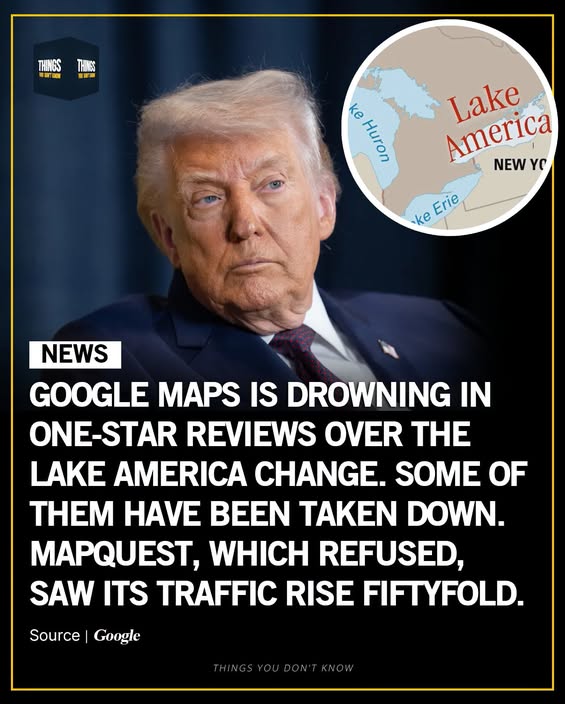
A viral image showing Google Maps being flooded with one-star reviews over its decision to rename Lake Ontario to "Lake America" has ignited a firestorm of controversy. While Google has scrambled to remove some of the backlash, rival MapQuest — which refused to make the change — has seen its traffic surge fiftyfold and climbed to the top of the App Store.
WASHINGTON — A striking image circulating online shows Google Maps drowning in negative reviews following its decision to adopt President Donald Trump's executive order renaming Lake Ontario to "Lake America." The graphic highlights the public backlash, with users flooding Trustpilot, Google Maps' review pages, and app stores with criticism .
The controversy began on August 27, 2026, when Trump signed an executive order directing the Interior Department and U.S. Board on Geographic Names to rename Lake Ontario — one of the five Great Lakes and a body of water shared with Canada — as "Lake America" . The White House framed the move as recognition of the lake's importance to U.S. commerce, defense, and energy production, arguing that the United States had contributed more than Canada to protecting the Great Lakes .
But for critics, the move was seen as a political stunt amid an escalating trade war with Canada. Canadian Prime Minister Mark Carney rejected the change outright, noting that the Lake Ontario name is more than 400 years old, predating both Canadian Confederation and the U.S. Declaration of Independence .
Google Maps' Decision Sparks Backlash
Google Maps began displaying "Lake America" for U.S. users within days of the executive order, following what the company described as its "long-standing practice" of updating maps to reflect names in official government sources . Users in Canada continue to see "Lake Ontario," while users elsewhere see both names .
The decision immediately drew fierce criticism. One U.S.-based Trustpilot reviewer, Dennis Joslyn, wrote: "Lake America does not exist. The correct name of the lake is Lake Ontario" . Another user, Susan Buchan, said on the Google Maps Help page: "I have been a Google user for a very long time and am extremely disappointed that you would follow the ridiculous change... Shame on you for caving to politics" .
Some users went further, posting one-star reviews of the Google Maps app itself on Apple's App Store, accusing the company of displaying "factually inaccurate" information . The review-bombing echoed a similar backlash when Google renamed the Gulf of Mexico to the "Gulf of America" in 2025 — a move that also prompted Google to disable new reviews and delete negative ones .
Google's Response: Deleting Reviews and Turning Off Posting
Google has responded to the backlash by removing negative reviews and disabling the ability to leave new reviews for the renamed location . This mirrors the company's approach during the "Gulf of America" controversy, when it blocked reviews and deleted policy-violating content .
Google's support page explains that "some types of places are more likely to receive posts, like reviews, that violate Google's policies. To prevent this, Google has turned off posting" . The company has defended its decision as part of a policy on "real-time abuse" and has taken similar actions in the past to prevent review-bombing .
Critics, however, see the move as an attempt to silence dissent. One user on X described the decision as "genuinely disturbing," writing: "It's just deeply sad, not even demoralizing, just pathetic" . Another blasted the move as "weak," adding: "No one is calling it that" .
MapQuest's Defiance and Viral Comeback
While Google and later Apple Maps fell in line with the administration's order , MapQuest took a dramatically different approach. The company, once a dominant navigation service in the 1990s, posted a simple social media message on August 27: "We're not changing it" — alongside a map labeled "Lake Ontario" .
The decision went viral. Users who had long thought MapQuest had ceased to exist expressed surprise and delight, and many pledged to switch to the platform . The payoff was immediate: MapQuest's downloads surged tenfold week over week, with in-app usage spiking to roughly 50 times normal levels .
By August 31, MapQuest had climbed to the #1 free app on Apple's U.S. App Store, ahead of ChatGPT at #2 . The company reported over 1.5 million installs across the U.S. and Canada combined . According to Sensor Tower data, MapQuest pulled in 184,000 global downloads during the week of August 24, a 10x jump week over week, with day-over-day growth hitting 128% .
MapQuest's resurgence even caught the attention of Eric Trump, who posted online that it was "shocking" to see the legacy brand was still alive. A MapQuest spokesperson embraced the comment, calling it "hilarious" — and true, as the platform celebrated its 30th anniversary .
Why MapQuest's Decision Resonated
MapQuest's general manager Doug Berger said the company's stance was not intended as a political statement but as a commitment to geography and familiarity . "We're using the same approach we took with the Gulf of Mexico rename: keep the names people already know" .
Derek H. Alderman, a professor of geography at the University of Tennessee, noted that many people wanted map companies to "take a moral stand" on the matter. "Maps and their name places help define the world we come to live in and know," he said. "Although map tech companies appear on the surface to be simply about delivering the latest and most accurate geographic information, they are actually deeply involved in the politics of representing the Earth" .
David R. Rain, a professor of geography at George Washington University, highlighted the challenge facing mapping companies: "One basic problem for the mapping companies is that there is no single uncontested authority to defer to" . He added that showing different names to users based on location "may seem like an elegant technical solution," but "it raises a big huge cartographic question: Is a map telling us what a government calls a place, or what the people who live there call it?" .
The Broader Context: A Digital Imperialism Debate
The dispute has also drawn objections from Indigenous leaders. Seneca Nation President J. Conrad Seneca called for the order to be rescinded, describing it as an attempt to erase the history and culture of Indigenous peoples who lived around the lake before either the United States or Canada existed .
The name "Lake Ontario" itself is derived from an Indigenous term — likely the Iroquoian word "oniatarí:io," commonly translated as "lake of shining waters" . For many, the renaming represents more than a political grievance; it is an erasure of history.
In a Globe and Mail opinion piece, Vass Bednar described Google's decision as a form of "digital imperialism," arguing that "American state power can so confidently travel through American digital infrastructure" . The piece noted that because of how web developers outsourced their digital layers, online maps on some Canadian government websites inadvertently displayed Lake Ontario as "Lake America" .
The Bottom Line
| What the Graphic Says | The Reality |
|---|---|
| Google Maps is flooded with one-star reviews | True — users review-bombed the app and location |
| Some reviews have been taken down | True — Google deleted reviews and disabled posting |
| MapQuest traffic rose fiftyfold | True — downloads surged and the app hit #1 on the App Store |
| MapQuest refused to change the name | True — the company posted "We're not changing it" |
The viral image captures a moment of digital rebellion — a public pushing back against what many see as political overreach dressed up as geography. Google's decision to follow the administration's directive, while legally defensible as a reflection of government sources, has cost the company goodwill. MapQuest, once a relic of the early internet, has found new life by standing firm.
As the debate continues, one thing is clear: in the age of digital maps, geography is no longer just about coordinates. It's about identity, history, and who gets to define reality. And for now, the people have spoken — with their downloads.
Comments (0)
Loading comments...
May You Like


Obama Steps Back Into the Political Spotlight as Democrats Target Trump’s Senate Majority

TRUMP’S OHIO WARNING UNDER THE SPOTLIGHT