
He Didn’t Win the Prize. So Is He Taking an Island Instead?
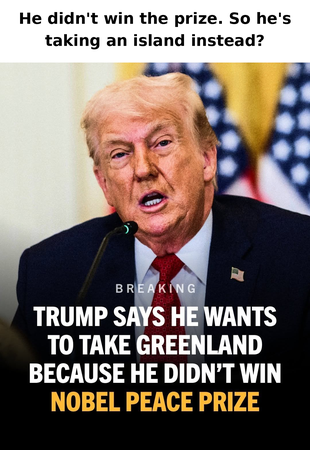
WASHINGTON — September 15, 2026 — A provocative claim linking President Donald Trump’s frustration over the Nobel Peace Prize to his long-running push for control of Greenland is resurfacing as the Arctic dispute continues to reverberate between Washington, Copenhagen and Nuuk.
The connection is not simply a social-media invention. In January, Trump explicitly linked the two issues in a message to Norwegian Prime Minister Jonas Gahr Støre, saying that because Norway had not given him the Nobel Peace Prize, he no longer felt obligated to “think purely of Peace” before reiterating his demand for “Complete and Total Control” of Greenland.
But the broader story is more complicated than the viral headline suggests.
Trump Actually Linked the Nobel Prize to Greenland
Trump's January message came during an escalating dispute over his demand that the United States gain control of Greenland, the self-governing Arctic territory within the Kingdom of Denmark.
In the message, Trump claimed he had stopped eight wars and complained that Norway had not awarded him the Nobel Peace Prize. He then argued that the world would not be secure without U.S. control of Greenland.
Norwegian officials pushed back on the premise. The Norwegian government does not select the Nobel Peace Prize winner; the award is decided by the independent Norwegian Nobel Committee.
Trump later told reporters that he did not care about the prize and said his priority was saving lives. He nevertheless continued to argue that his administration had helped end multiple conflicts.
That distinction matters: Trump clearly connected the issues in his message, but it would be an overstatement to say that he literally announced a plan to acquire Greenland because he lost the Nobel Prize.
Greenland Remains the Real Geopolitical Issue
Trump's interest in Greenland predates the Nobel controversy.
The island occupies an extraordinarily strategic position in the Arctic, between North America and Europe. Its location matters for missile warning, military operations, shipping routes and competition involving Russia and China.
Trump has repeatedly argued that Greenland is essential to U.S. national security and that Denmark cannot adequately defend it. His demands have triggered one of the most serious disputes between Washington and its NATO allies during his presidency.
Greenland itself is not simply an unclaimed piece of territory available for another country to take. It is a self-governing part of the Kingdom of Denmark, and Greenlandic and Danish leaders have repeatedly emphasized their own sovereignty and political authority.
The Dispute Has Not Gone Away
The issue has remained active even after months of diplomatic tension.
On September 2, Greenland's Foreign Minister Mute Egede said that discussions with the United States over Greenland's future were still continuing, although he did not disclose details of the talks.
Just days later, European Commission President Ursula von der Leyen visited Greenland and announced a €200 million investment package designed to strengthen ties with Greenland and Denmark. The EU has also proposed substantially increasing its longer-term support for the island.
That European response illustrates how seriously Trump's Greenland ambitions have been taken by U.S. allies.
Trump’s Latest Map Stirred Fresh Anger
The controversy received another jolt earlier this month when Trump shared a map portraying a vast area of North America and surrounding territory under the U.S. flag.
The image included Greenland and Iceland, prompting Iceland's government to summon the U.S. ambassador and describe the post as inappropriate.
The episode demonstrated that Trump's territorial rhetoric continues to generate diplomatic consequences even when no formal annexation proposal is immediately on the table.
At the same time, Danish Prime Minister Mette Frederiksen said on September 14 that she hoped for a peaceful way forward with Washington on the Arctic and Greenland issue, suggesting that diplomatic channels remain open.
So, Did Trump “Trade” the Nobel for an Island?
Not literally.
The viral headline captures a real and unusual moment in Trump's January message, but it compresses a much larger geopolitical dispute into a punchline.
What is factual: Trump complained about not receiving the Nobel Peace Prize and, in the same message, renewed his demand for complete U.S. control of Greenland.
What is misleading: There is no evidence that Trump formally decided to pursue Greenland as a substitute prize because he failed to win the Nobel.
The Greenland campaign has been driven primarily by Trump's stated national-security and strategic arguments, while the Nobel controversy became an extraordinary rhetorical element in the dispute.
The Bigger Question Is Still Greenland
Nearly a year into Trump's renewed push for greater U.S. control over the Arctic territory, the central issue remains unresolved.
Greenland's strategic importance is growing as Arctic competition intensifies, while Denmark, Greenland and European allies are seeking to reinforce their position. The EU's new investment commitments and continuing diplomatic discussions with Washington show that the dispute has evolved from Trump's initial territorial rhetoric into a much broader question about the future security architecture of the Arctic.
So the image's question — “He didn't win the prize. So he's taking an island instead?” — makes for a powerful headline.
But the reality is even more consequential: Trump really did connect his Nobel frustration with his Greenland demands, yet Greenland itself is part of a much deeper strategic confrontation over territory, sovereignty and Arctic security.
Comments (0)
Loading comments...
May You Like

FIGHT OVER OBAMA’S IRAN POLICY
Jack Smith Defends His Integrity as Trump Investigations Face Renewed Political Firestorm

South Korea–Ukraine Rift Deepens Over North Korean POW Transfer as PURL Draws New Scrutiny













