
HIGH-STAKES CAPITOL PROBE — NO WAY OUT!
Ilhan Omar’s Deleted Father’s Day Post Sparks New Controversy as Federal Investigation Draws Attention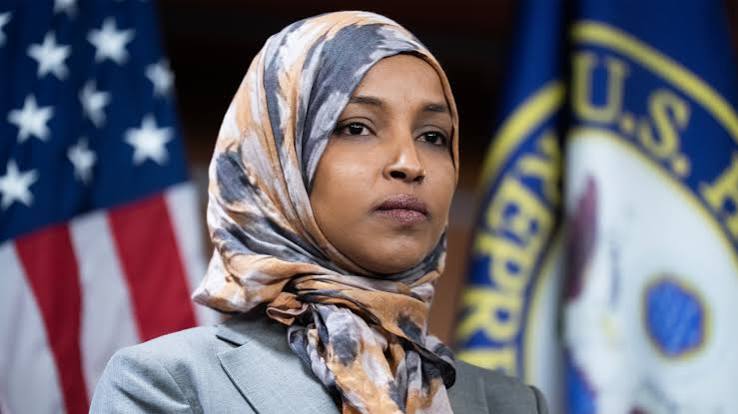
WASHINGTON — Minnesota Democratic Representative Ilhan Omar is facing renewed public scrutiny after a deleted Father’s Day message from 2013 resurfaced amid reports of a federal investigation involving questions about her identity and immigration records. The controversy has reignited debate over her family history, while Omar and her representatives continue to reject allegations of wrongdoing.
The social media message, originally published in June 2013, expressed gratitude to Omar’s father. In the post, she referred to him as “Nur Said,” a name that has attracted attention because it resembles part of the name of her former husband, Ahmed Nur Said Elmi. The post was deleted in September 2019, according to archived records cited in recent reporting.
The resurfaced message has become a focal point for critics who argue that differences between the names appearing in public records deserve further examination. Others have warned that drawing conclusions from a single social media post risks turning an unresolved dispute into an unsupported accusation.
Omar’s father has been identified in several public records as Nur Omar Mohamed. A memorial statement published by the Congressional Black Caucus following his death in 2020 used that name. The difference between this name and the name appearing in the 2013 message has prompted questions about naming practices and the circumstances surrounding the original post.
A spokesperson for Omar previously explained that “Nur Said” was a childhood nickname used by her father. The explanation also stated that the post was removed after Omar and her family received threats and disturbing online messages. The account has been challenged by critics, but the name discrepancy alone does not establish that the explanation is false.
The controversy is closely connected to longstanding allegations that Omar married her former husband, Ahmed Nur Said Elmi, who critics have claimed was her brother. Omar has repeatedly denied the allegation. Her representatives have described the claim as baseless, and no conclusion establishing that the two were siblings has been demonstrated by the resurfaced Father's Day post.
The similarities between the names have nevertheless prompted renewed attention because Somali naming traditions differ from conventional Western surname practices. Somali names commonly incorporate a person's given name followed by the given names of their father and grandfather. Additional names and variations may also appear in records. Consequently, matching names can raise questions without independently proving that two people share a particular family relationship.
Recent reports have added another dimension to the controversy. Federal agents reportedly searched Omar’s Washington, D.C., residence on October 12, 2026, as part of an investigation involving possible false statements on immigration and naturalization documents. The search has intensified political attention, although the precise scope of the investigation and the evidence being examined have not been fully established in public.
According to reporting by Fox News, court documents associated with the search warrant identify Omar using the name “Ilhan Nur Said Elmi,” alongside the name Ilhan Abdullahi Omar. The filing, as described in the reporting, does not explain why the alternative name appears or establish that Omar used a false identity on federal documents.
Omar has disputed the suggestion that the alternative name is her legal name. When questioned by Fox News Digital, she identified herself as Ilhan Abdullahi Omar. Her office has also rejected allegations that she knowingly misrepresented her identity or committed immigration-related wrongdoing.
The distinction between an investigative document and a finding of misconduct is important. Search warrants authorize investigators to examine specified evidence under legal procedures; they do not establish that a crime has occurred. Whether any alleged false statement violates federal law would depend on the relevant documents, the circumstances in which they were submitted and evidence of intent.
Omar’s personal history has long attracted attention because of her journey from Somalia to the United States. She became a prominent political figure in Minnesota before winning election to the US House of Representatives in 2018. Her career has included advocacy on immigration, foreign policy, economic inequality and the experiences of refugees and immigrant communities.
Her political prominence has also made her a frequent target of partisan attacks. Supporters argue that renewed scrutiny of her personal life is often shaped by political hostility, while critics contend that questions involving public records and official documents deserve examination regardless of a politician’s party affiliation.
The latest controversy has spread across social media, where the deleted post is being circulated as supposed evidence supporting longstanding allegations. However, a screenshot or archived message can establish what a post appeared to say without necessarily establishing the underlying facts about a family relationship or a person's legal identity.
Investigators examining questions about immigration records would need to rely on authenticated documents, relevant testimony and other evidence rather than social media speculation alone. Any potential legal issue would have to be assessed according to the applicable statutes and evidentiary standards. Public discussion, however intense, cannot substitute for that process.
The episode also illustrates the difficulty of interpreting historical records involving people who have lived across different countries and naming systems. Transliteration, alternative names, nicknames and variations in official documents can complicate comparisons. Such discrepancies can warrant clarification, but they do not automatically indicate deception or criminal conduct.
For Omar, the immediate challenge is managing renewed questions about her identity while continuing her work in Congress. The investigation may generate additional public reporting as legal proceedings develop, but the information currently available does not establish that she has been charged with an immigration-related offense connected to the reported inquiry.
For the broader political debate, the controversy raises questions about transparency, privacy and the responsibilities of public officials. Elected representatives can reasonably face scrutiny over official records, but allegations should be presented with enough context to distinguish established facts from speculation. This is particularly important when claims involve family relationships and potentially serious criminal accusations.
The role of news organizations is equally significant. Reports should explain what documents actually say, identify which claims come from interested parties and provide responses from the people involved. Repeating an allegation across multiple platforms does not independently verify it, especially when those reports rely on the same original source.
Further developments may clarify why the 2013 post used the name “Nur Said,” how that name relates to other public records and what investigators are examining. Authenticated documents and official statements could help resolve some questions, although the investigation's complete scope may remain confidential while it continues.
For now, the deleted Father's Day message remains a source of political controversy rather than conclusive proof of wrongdoing. Omar has denied the allegations against her, and the publicly reported information does not establish that she married her brother or knowingly used a false identity. Any stronger conclusion would require evidence beyond the name similarities and the existence of an investigation.
As the story develops, the central issue will be whether reliable evidence supports the claims being circulated. Until that evidence is made available and properly evaluated, the distinction between suspicion and proof remains essential to understanding the controversy surrounding Ilhan Omar.
Comments (0)
Loading comments...
May You Like

WWE BRONSON REED DEAD AT 38, STIMULANTS DETECTED, $10M INSURANCE PAYOUT FROZEN!

WWE BRONSON REED—STAR COLLAPSES AT COMPANY EVENT, FATAL DRUG REACTION SUSPECTED!

WEYMOUTH HORROR—80-MPH WIND GUSTS, FIRE TRUCK FLIPS, 3 FIREFIGHTERS CRITICAL!









Popular Posts



