
House Democrats Join Republicans to Make Trump’s National Fraud Enforcement Division Permanent
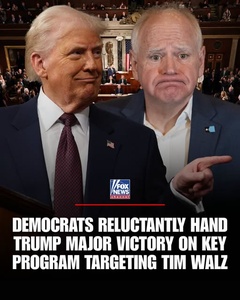
More than 140 Democrats backed legislation codifying the Trump administration’s anti-fraud unit, even as some warned that the Justice Department has used the initiative against political opponents including Minnesota Gov. Tim Walz.
WASHINGTON, Sept. 19, 2026 — President Donald Trump’s government-fraud crackdown received substantial bipartisan support this week as the House voted overwhelmingly to make his administration’s National Fraud Enforcement Division permanent.
The House approved the legislation 352–72 Wednesday, with every Republican voting for the measure alongside more than 140 Democrats, including House Minority Leader Hakeem Jeffries of New York.
All 72 lawmakers opposing the legislation were Democrats, demonstrating an unusual split inside the minority party over whether supporting stronger anti-fraud enforcement outweighs concerns about how Trump’s Justice Department could use it.
The legislation would codify the National Fraud Enforcement Division, which the Trump administration established within the Justice Department earlier this year as part of a broader federal campaign against fraud.
The administration says the division targets fraud affecting the federal government, federally funded programs and private citizens, with officials presenting it as a mechanism for recovering taxpayer money and prosecuting large-scale schemes.
The Minnesota connection explains why Tim Walz appears prominently in the viral graphic. Earlier this year, Vice President JD Vance referred Walz and Minnesota Attorney General Keith Ellison for potential investigation by the division.
That referral followed mounting scrutiny of fraud involving Minnesota social-service programs, which Republicans have repeatedly used to criticize oversight under Walz’s administration.
Walz and Ellison have acknowledged that public programs were exploited by fraudsters, while disputing Republican characterizations of their own responsibility and accusing political opponents of exaggerating the scandal for partisan purposes.
Importantly, a referral for potential investigation is not a criminal charge or finding of guilt, and the House vote this week did not determine whether Walz or Ellison committed wrongdoing.
The legislation itself also does not instruct prosecutors to investigate Walz personally. Its central purpose is broader: placing a federal anti-fraud operation currently associated with Trump’s executive branch into statute.
That distinction makes the Fox News formulation that Democrats handed Trump a victory on a program “targeting Tim Walz” attention-grabbing but narrower than the actual scope of the legislation.
Republican Rep. Jeff Van Drew of New Jersey framed the vote as an opportunity to make anti-fraud enforcement permanent rather than treating the proposal as a partisan extension of Trump’s presidency.
Van Drew argued Americans are frustrated by wasted taxpayer money and said lawmakers should establish a lasting mechanism for combating fraud rather than allowing disagreements about Trump to determine the legislation’s fate.
Democratic Rep. Jamie Raskin of Maryland took a considerably more skeptical approach but ultimately supported the bill, describing his backing as “tepid support.”
Raskin argued that the Justice Department has already maintained fraud-enforcement capabilities for decades, questioning Republican suggestions that the legislation represents a revolutionary new development in federal law enforcement.
He nevertheless said establishing a unit called the National Fraud Enforcement Division was something he could support, despite his much broader criticism of the Trump administration’s criminal-justice policies.
Raskin used the debate to accuse Trump of undermining anti-fraud enforcement through pardons and other actions benefiting people convicted of white-collar offenses, an argument Republicans rejected.
The Maryland Democrat specifically challenged Republicans over restitution and fines involving fraud cases, arguing that lawmakers should approach financial crime consistently rather than focusing primarily on cases associated with Democratic-led governments.
Republicans responded by emphasizing Minnesota. Rep. Harriet Hageman of Wyoming said the fraud exposed there was criminal in nature and argued similar problems could exist elsewhere on an even greater scale.
The Minnesota controversy has become a recurring national political issue as Republicans investigate whether state officials adequately supervised programs receiving substantial amounts of federal taxpayer money.
For Trump’s administration, the issue supports a broader argument that federal and state governments have tolerated excessive waste, fraud and abuse and require more aggressive investigation and prosecution.
For Democrats who supported Wednesday’s legislation, voting for a permanent anti-fraud division does not necessarily amount to endorsing every investigation, accusation or enforcement decision undertaken by Trump’s Justice Department.
That distinction is particularly relevant to Jeffries. His vote supported the institutional anti-fraud legislation even though House Democratic leadership remains sharply opposed to Trump across numerous other investigations and policy disputes.
The overwhelming 352–72 result consequently represents genuine bipartisan agreement on maintaining a dedicated anti-fraud operation, despite intense disagreement about Trump’s broader use of federal law-enforcement power.
It also gives Trump a legislative victory because Congress is moving toward preserving an initiative his administration created rather than allowing a future administration simply to dismantle it through executive action.
But the House vote alone does not yet make the division permanently established by statute. The legislation must complete the remaining congressional process and become law before that happens.
The political significance surrounding Walz is also narrower than some viral posts suggest. The Minnesota governor remains connected to the story because his administration became a major focus of the division’s early activities.
Nothing about Wednesday’s vote, however, establishes that Walz committed a federal crime, nor does passage itself require prosecutors to charge or investigate him.
The vote instead demonstrates that many Democrats were willing to separate two questions: whether government fraud deserves a permanent federal enforcement structure and whether they trust every decision made by Trump administration officials.
That helps explain the unusual coalition of Jeffries, Raskin, other Democrats and the entire Republican conference supporting the same legislation despite sharply different views of the administration.
For Trump, the result provides bipartisan congressional validation for one element of his anti-fraud agenda. For Walz, it ensures that an enforcement structure associated with scrutiny of Minnesota could outlast the immediate political fight
Comments (0)
Loading comments...
May You Like

Obama Steps Back Into the Political Spotlight as Democrats Target Trump’s Senate Majority

Russian Drone Strikes Kyiv Bridge as German Chancellor Arrives in Ukraine













