House GOP Bill Would Bar SNAP Benefits at Restaurants — Here's What the $524 Million Program Debate Is Really About
A freshman Republican congressman has introduced legislation that would end the decades-old Restaurant Meals Program, which allows certain SNAP beneficiaries — including elderly, disabled, and homeless individuals — to purchase hot meals at participating eateries. The bill comes as nearly $524 million in taxpayer funds flowed to restaurants across nine states in just two years, with California alone accounting for $475 million of that total .
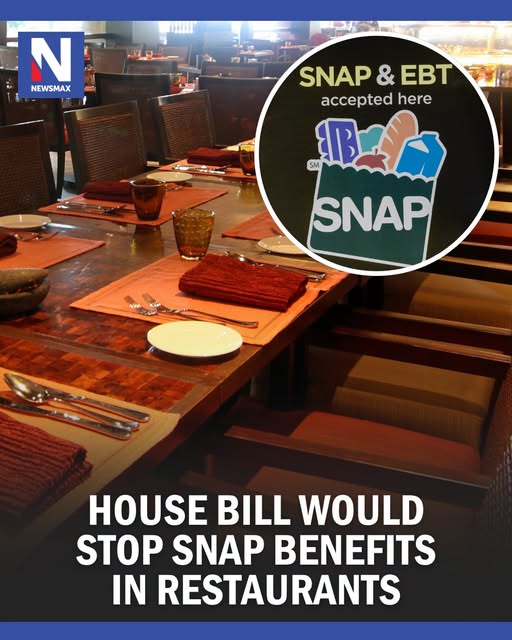
WASHINGTON — The viral image is straightforward: a SNAP/EBT sign and the headline "HOUSE BILL WOULD STOP SNAP BENEFITS IN RESTAURANTS." The graphic, shared by Newsmax, captures a proposal that has ignited a fierce debate over taxpayer dollars, nutrition, and who gets to decide what struggling Americans eat.
On September 3, 2026, Rep. Brandon Gill (R-TX) introduced the Ending Restaurant Purchases with SNAP Act — a bill that would eliminate the Supplemental Nutrition Assistance Program's Restaurant Meals Program (RMP) entirely .
What the Bill Would Do
The Restaurant Meals Program was established by the Food and Agriculture Act of 1977. It allows states to let certain SNAP recipients — specifically elderly, disabled, and homeless individuals — use their benefits to purchase hot, prepared meals at participating restaurants . Nine states currently participate: California, Arizona, New York, Michigan, Rhode Island, Massachusetts, Illinois (limited to Cook and Franklin counties), Virginia, and Maryland .
Gill's bill would:
-
Abolish RMP entirely, prohibiting restaurants from accepting SNAP benefits
Preserve meal programs run by public agencies and nonprofits, including home-delivered meals for elderly and disabled Americans
Keep the focus on groceries rather than prepared food
"SNAP is supposed to help struggling Americans put nutritious food on the table, not stick taxpayers with the bill for fast food," Gill said in a statement .
The $524 Million Question
The driving force behind the bill is money — specifically, how much is being spent at restaurants through the program.
Between June 2023 and May 2025, approximately $524 million in SNAP benefits** was spent at restaurants across the nine participating states . California dominated the spending, accounting for roughly **$475 million, followed by Arizona at $41.4 million and New York at $3.6 million .
Gill framed the spending as a "loophole" that has expanded far beyond its original intent. "What was originally intended as a narrow accommodation for individuals unable to store or prepare food, the program has grown and is now dominated by large national fast-food and quick-service chains," Gill and other Republican lawmakers wrote in a letter to USDA and HHS officials .
The Case Against — What Supporters of RMP Argue
But the program has defenders who argue it serves a critical purpose for vulnerable Americans.
According to USDA guidelines, RMP is specifically designed for SNAP recipients who:
-
Are elderly (60 or older)
Have a disability (receiving disability or blindness payments)
Are homeless
For these individuals, advocates argue, the ability to purchase prepared meals is not a luxury — it's a necessity. A 2026 study published in the Journal of Agriculture, Food Systems, and Community Development found that RMP "holds strong potential to enhance food security among some of the most high-risk SNAP participants" .
The study identified key drivers for the program, including "championing food access and food security" and "centering participants' dignity and autonomy" . Researchers noted that SNAP participants spend about 26% more time preparing meals at home compared to the general population — a burden that is especially heavy for those with disabilities or without stable housing .
The Broader Context: SNAP Under Fire
Gill's bill doesn't exist in a vacuum. It's part of a broader Republican push to tighten SNAP restrictions.
In June 2025, Gill clashed with Gina Plata-Nino, director of SNAP Policy and Advocacy at the Food Research and Action Center, over whether food stamps should be used for soft drinks. "Do the American people need Coca-Cola to survive?" Gill asked. "I think most people can rationally say that you don't need Coca-Cola to survive" .
In July 2025, Gill joined Sen. Joni Ernst (R-IA) and other GOP lawmakers in urging USDA and HHS to investigate whether RMP rules needed tightening .
The fight over SNAP is also playing out at the macro level. The House-passed Farm Bill, H.R. 7567, which passed 416-8 on April 30, 2026, locks in a $187 billion cut to SNAP — a cut that Democrats have strongly opposed . Ranking Member Angie Craig (D-MN) called the bill "a failure that does nothing to resolve high input costs, lost markets, surging food prices or provide a single penny in economic assistance to struggling family farmers" .
What's Next?
The Ending Restaurant Purchases with SNAP Act faces an uncertain future. With the broader Farm Bill still being debated in the Senate — where a 60-vote threshold requires bipartisan cooperation — the fate of Gill's standalone bill is anything but guaranteed .
Republican leadership has shown support for the concept, but the Senate's 53-47 Republican majority means any SNAP-related legislation will need Democratic buy-in to advance .
The Bottom Line
| What the graphic says | What actually happened |
|---|---|
| House bill would stop SNAP benefits in restaurants | Rep. Brandon Gill introduced the Ending Restaurant Purchases with SNAP Act on Sept. 3, 2026 |
| The program is a loophole | Supporters argue RMP serves elderly, disabled, and homeless Americans who can't cook meals themselves |
| $524 million was spent at restaurants | Yes — across nine states between June 2023 and May 2025 |
| California led the spending | Yes — $475 million of the $524 million total |
The viral graphic accurately captures the headline — a House bill does indeed seek to end SNAP benefits in restaurants. But the story behind it reveals a deeper debate: whether a program designed for the most vulnerable Americans has become a "loophole" for fast-food spending, or whether it remains a vital lifeline for those who cannot cook or store food on their own.
As the Farm Bill debate continues in the Senate, the fate of the Restaurant Meals Program — and the Americans who depend on it — hangs in the balance.
Comments (0)
Loading comments...
May You Like
TRUMP HIT WITH 26 ARTICLES OF IMPEACHMENT
Shocking news from Ohio: an unexpected development ahead of Trump's rally

Russian Drone Strikes Kyiv Bridge as German Chancellor Arrives in Ukraine