House Passes 231–186 Immigration Bill as 20 Democrats Join Republicans — But “Trump’s Trap” Goes Too Far
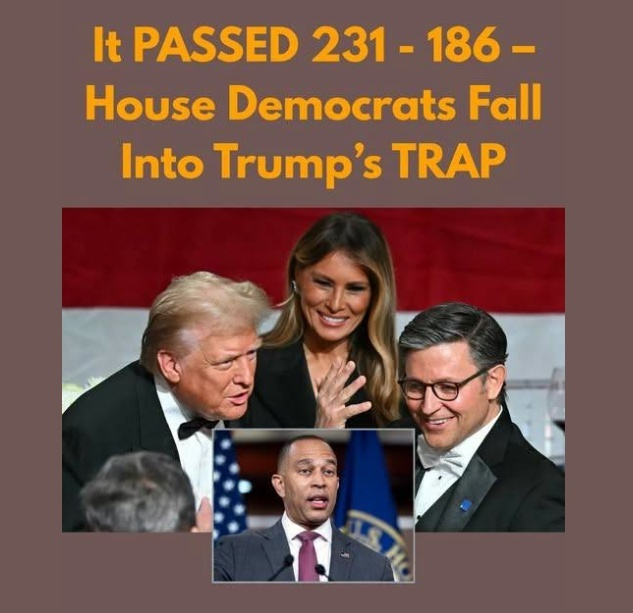
A viral graphic claims that House Democrats “fell into Trump’s trap” after a 231–186 House vote. The vote was real, and it did expose a significant Democratic split—but the graphic leaves out important context.
The measure was the Deporting Fraudsters Act of 2026 (H.R. 1958), which passed the House on March 18, 2026. Republicans backed it unanimously among those voting, while 20 Democrats joined them. All 186 votes against the bill came from Democrats.
The bill, however, has not become law. It was sent to the Senate the following day and referred to the Senate Judiciary Committee.
What the 231–186 vote was actually about
H.R. 1958 amends immigration law to make certain noncitizens inadmissible or deportable if they have been convicted of, or admit to committing, specified forms of fraud involving government programs or public benefits.
The legislation specifically addresses offenses involving programs such as:
- SNAP benefits
- Social Security
- Federal government programs
- Certain fraudulent identification documents
The Congressional Budget Office described the bill as applying when a non-U.S. national is convicted of, admits to, or admits to acts constituting specified offenses involving fraud or unlawful receipt of public benefits.
Republicans were completely united
The House Clerk's official roll call shows:
| Party | Yes | No |
|---|---|---|
| Republicans | 211 | 0 |
| Democrats | 20 | 186 |
| Independent | 0 | 0 |
| Total | 231 | 186 |
Fifteen lawmakers did not vote.
That makes the graphic's central numerical claim accurate.
Twenty Democrats crossed party lines
The most politically significant part of the vote was the 20 Democratic yes votes.
One of them was Rep. Henry Cuellar of Texas, whose own congressional voting record confirms that he voted yes on H.R. 1958.
The group was not enough to change the overall partisan character of the vote—186 Democrats opposed the measure—but it demonstrated that immigration enforcement and fraud legislation can attract Democratic support, particularly from members representing competitive or more conservative-leaning districts.
So calling the vote a political setback for Democratic leadership is reasonable.
Calling it proof that Democrats universally oppose measures targeting benefit fraud would not be.
Was it really “Trump's trap”?
This is where the graphic becomes editorial rather than factual.
The bill was sponsored by Rep. David Taylor, a Republican from Ohio, not introduced as a bill by Donald Trump. Taylor said after passage that the legislation would support the Trump administration's efforts to combat fraud and described passage as a step toward making the proposal law.
The Trump administration did explicitly support the legislation.
The White House Office of Management and Budget issued a March 18 statement saying the administration strongly supported H.R. 1958 and would recommend that Trump sign it if presented to him in its current form.
So there was a clear Trump administration policy connection.
But “Trump's trap” is political framing, not an established description of what happened.
The bill is narrower than the headline suggests
Another important detail is that the measure does not simply say that anyone who receives government benefits unlawfully can automatically be deported.
The actual statutory language specifies particular offenses and circumstances. It also concerns noncitizens, not U.S. citizens.
The CBO found that existing immigration law already makes some fraud-related crimes grounds for inadmissibility or deportation. It therefore estimated that only a few people would be removed solely because of enactment of H.R. 1958.
That is an important counterweight to highly dramatic descriptions of the bill.
The bill still has a long way to go
Despite the large House vote, 231–186 was only a House passage vote.
The bill was received by the Senate on March 19 and referred to the Senate Judiciary Committee. It had not become federal law as of the latest congressional record available in September 2026.
In other words:
House approval ≠ enactment.
The Senate would still have to act, and the measure would have to clear the legislative process before reaching the president.
What about the people shown in the graphic?
The image prominently features Donald Trump, Melania Trump, Speaker Mike Johnson and House Democratic Leader Hakeem Jeffries.
That composition makes the story look like a direct confrontation between Trump and Democratic leadership.
The actual roll call tells a more complicated story.
Johnson was the Republican House speaker during the vote, while Jeffries was the Democratic leader, but the legislation was sponsored by David Taylor, and the 20 Democratic votes came from individual members rather than from the Democratic leadership as a bloc.
There is also no evidence from the vote itself that Jeffries personally “fell into a trap.” His vote was No.
What the viral graphic gets right—and wrong
Accurate:
- The House vote was 231–186.
- The vote occurred on March 18, 2026.
- The bill was the Deporting Fraudsters Act of 2026.
- All voting Republicans supported it.
- 20 Democrats voted yes.
- The Trump administration strongly supported the measure.
Misleading or overstated:
- It was not literally a bill personally introduced by Trump.
- “Trump's trap” is political characterization, not an objective description.
- The measure did not become law with the House vote.
- The legislation applies to specified categories of noncitizens and fraud-related conduct; it does not create a blanket deportation rule for anyone accused of receiving benefits improperly.
- The CBO said only a small number of people would likely be removed solely because of the bill.
Bottom line
The 231–186 vote is real, and the Democratic defections are significant. Twenty House Democrats crossed party lines to support a Republican-backed immigration measure strongly supported by the Trump administration.
But the viral phrase “House Democrats Fall Into Trump's Trap” turns a complicated congressional vote into a political slogan.
The bigger factual story is this: the House passed H.R. 1958 by 231–186, 20 Democrats supported it, and the bill moved to the Senate—but it was not yet law.
Comments (0)
Loading comments...
May You Like
Shocking news from Ohio: an unexpected development ahead of Trump's rally
Barack Obama Draws Attention With New Literary Podcast
Obama Steps Back Into the Political Spotlight as Democrats Target Trump’s