House Passes Terrorism Insurance Bill 373–15 — But Viral Claims About Ocasio-Cortez Tell a Very Different Story
WASHINGTON — The U.S. House of Representatives overwhelmingly approved legislation to extend the federal government’s terrorism insurance backstop through 2034, passing the measure by a striking 373–15 vote.
The vote was bipartisan and far less politically divisive than the dramatic online reaction surrounding it might suggest.
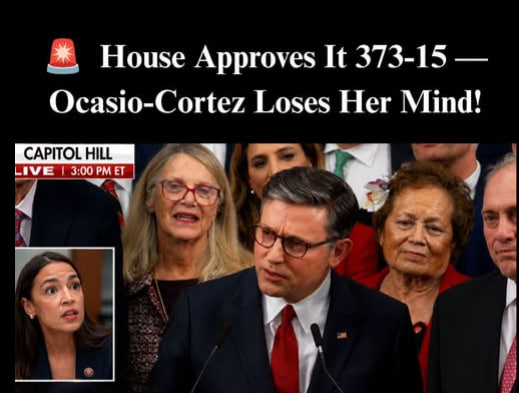
A viral graphic circulating online features House Speaker Mike Johnson at the podium and Rep. Alexandria Ocasio-Cortez in an inset, accompanied by the headline: “House Approves It 373-15 — Ocasio-Cortez Loses Her Mind!”
But the official congressional record tells a very different story.
Ocasio-Cortez actually voted YES on the bill. The House Clerk’s official roll-call record lists her among the members voting in favor of H.R. 7128. In total, 191 Democrats, 181 Republicans and one Independent voted for the legislation, while 15 Republicans voted against it.
The bill itself — the TRIA Program Reauthorization Act of 2026 — is aimed at preserving a federal backstop for terrorism-related insurance losses, an obscure but important mechanism supporting commercial property, construction and other major investments across the United States.
The vote therefore raises a bigger question about political content spreading online: what actually happened on the House floor, and what has been added to the story afterward?
A 373–15 Vote Sends a Strong Bipartisan Signal
The House approved H.R. 7128 on June 29, 2026, under an expedited procedure requiring a two-thirds majority for passage.
The final tally was overwhelming:
- 373 members voted yes
- 15 voted no
- 43 did not vote
- 0 voted present
The breakdown was particularly striking.
Democrats voted 191–0 in favor of the measure, while Republicans voted 181–15 in favor. One Independent also supported it.
That makes the legislation unusual in today's deeply polarized Congress.
Rather than producing a party-line confrontation, the bill attracted support from lawmakers across the political spectrum.
And despite the image's suggestion that Ocasio-Cortez was furious about the legislation, the official record shows the opposite: she voted to pass it.
So What Exactly Did Congress Approve?
At the center of the controversy is a program most Americans rarely think about: the Terrorism Risk Insurance Program, commonly known as TRIA.
Congress created the program after the September 11, 2001 terrorist attacks, when private insurers faced enormous uncertainty over how to cover terrorism-related losses.
The federal government subsequently established a system in which private insurers provide terrorism coverage while the federal government serves as a financial backstop under specified circumstances.
The program has become an important component of the U.S. commercial insurance market.
H.R. 7128 would reauthorize the program for seven additional years, through 2034.
The House Financial Services Committee described the legislation as providing continued stability and certainty for insurers and businesses.
Supporters argue that maintaining the program is important because terrorism coverage can be difficult or expensive for private insurers to provide without some form of federal backstop.
Why Terrorism Insurance Matters to the U.S. Economy
The legislation may sound highly technical, but its potential consequences reach far beyond the insurance industry.
Commercial property owners, developers, lenders and businesses can depend on terrorism coverage when financing major projects.
Industry groups have argued that uncertainty over terrorism insurance could affect commercial real estate transactions and financing.
The National Association of Realtors, for example, supported the seven-year extension and said predictable terrorism coverage helps maintain stability in commercial real estate financing.
The American Bankers Association similarly argued that the program helps commercial building owners obtain insurance coverage and gives lenders greater certainty when financing projects.
That means the debate is not simply about what happens after a terrorist attack.
It is also about what happens before an attack ever occurs — when companies decide whether to build, invest, lend or insure major projects.
The Program Was Created After 9/11
TRIA's origins go back to the economic shock following the September 11 attacks.
After the attacks, insurers became much more cautious about terrorism-related risks. The federal program was designed to prevent the withdrawal of terrorism coverage from the market by creating a public-private system for sharing catastrophic losses.
According to the House Financial Services Committee, the program was established in the aftermath of the 2001 attacks and has never had a TRIA claim paid under the program.
That creates an unusual political argument.
Supporters say the absence of claims does not mean the program is unnecessary. Instead, they argue that the existence of a federal backstop helps keep terrorism coverage available in the first place.
In other words, the program is designed to be there if the worst happens.
The Bill Also Changes the Certification Threshold
H.R. 7128 is not simply a straight extension.
One significant change concerns the threshold for certifying an event as a terrorism-related event under the program.
Beginning in 2029, the legislation would increase the property and casualty insurance losses required for certification from $5 million to $10 million.
The legislation also introduces changes to the federal government's certification process.
The bill requires the Treasury Department to publish notice of a certification review and establishes timelines for completing the process, with additional flexibility when more information is needed.
Supporters say these changes would make the system more predictable and transparent.
Why Mike Johnson Appears in the Viral Image
The image prominently features House Speaker Mike Johnson, who presides over the House and is one of the most visible Republican figures in Congress.
Johnson's presence in the graphic is understandable from a political-content perspective: he represents the Republican leadership of the chamber that approved the legislation.
But the vote itself was not a narrowly Republican victory.
In fact, the overwhelming Democratic support was one of the most notable aspects of the vote.
191 Democrats voted for H.R. 7128.
That includes Alexandria Ocasio-Cortez.
Consequently, framing the vote as a major confrontation between Johnson and Ocasio-Cortez would be misleading.
Ocasio-Cortez Did Not Vote Against the Bill
This is the most important correction to the viral graphic.
The image strongly implies that Ocasio-Cortez was outraged by the legislation and opposed the House vote.
The congressional record says otherwise.
The House Clerk's official roll-call record lists:
Ocasio-Cortez, Alexandria — Yea
She was one of the 373 members who voted to approve H.R. 7128.
This does not mean Ocasio-Cortez necessarily supported every aspect of the legislation or agreed with every Republican argument surrounding it.
But it does mean that the statement implied by the image — that she opposed the bill or “lost her mind” over its passage — cannot be supported by her recorded vote.
That distinction matters when turning a viral political image into a factual news report.
The Bill Had Already Won Bipartisan Support Before Reaching the House Floor
The broad support was not entirely unexpected.
H.R. 7128 had previously moved through the House Financial Services Committee, where the measure was reported with bipartisan backing.
The committee approved the legislation by a wide margin before it reached the House floor.
The bill was sponsored by Republican Rep. Mike Flood of Nebraska and had Democratic and Republican cosponsors, including Andrew Garbarino, Emanuel Cleaver, Nydia Velázquez and Ayanna Pressley.
That bipartisan foundation helps explain why the final House vote was so lopsided.
The Real Battle Now Moves to the Senate
Despite the overwhelming House vote, H.R. 7128 did not immediately become law.
After passing the House, the legislation was sent to the Senate.
On July 13, 2026, the Senate received the bill, read it twice and referred it to the Senate Committee on Banking, Housing, and Urban Affairs.
That means the legislation still faces another stage before it could reach the president.
A related Senate measure, S. 4395, also seeks to reauthorize the terrorism insurance program.
The Senate's consideration could therefore determine whether the House's overwhelming vote ultimately translates into a new seven-year extension.
Why the Vote Matters Beyond Washington
At first glance, terrorism insurance may seem like a niche financial issue.
But the system touches some of the largest parts of the American economy.
Commercial buildings, factories, stadiums, infrastructure projects and other major developments can involve enormous financial commitments. Insurance availability can influence whether banks are willing to lend and whether developers are willing to move forward.
Industry organizations have therefore warned that allowing the program to expire could create uncertainty throughout the commercial insurance and lending markets.
The current program is scheduled to expire at the end of 2027, making an early reauthorization particularly important for insurers and businesses planning years ahead.
The Viral Headline Tells One Story. The Vote Tells Another.
The dramatic graphic makes the House vote look like another explosive clash between Republicans and one of the Democratic Party's most recognizable progressive lawmakers.
But the actual congressional record paints a much less sensational — and arguably more interesting — picture.
The House passed the terrorism insurance bill 373–15.
Democrats overwhelmingly supported it.
Republicans overwhelmingly supported it.
And Alexandria Ocasio-Cortez voted yes.
The real story is therefore not that Ocasio-Cortez supposedly “lost her mind.”
The real story is that Congress reached an unusually broad bipartisan agreement on an obscure but economically significant federal insurance program created after one of the most devastating attacks in American history.
The legislation now sits with the Senate.
And with the current TRIA program scheduled to expire in 2027, lawmakers have a relatively narrow window to determine whether the federal terrorism insurance backstop will continue through 2034.
For now, the House has spoken — overwhelmingly. The next question is whether the Senate will do the same.
Comments (0)
Loading comments...
May You Like

Russian Drone Strikes Kyiv Bridge as German Chancellor Arrives in Ukraine