House Votes to Pull Taxpayer Funds for Anti-Israel Universities
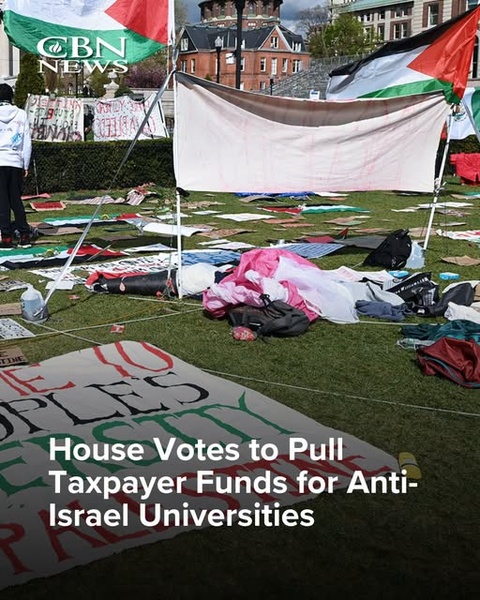
The U.S. House of Representatives has passed legislation that would strip federal funding from colleges and universities that participate in commercial boycotts of Israel, delivering a significant victory to the Trump administration and pro-Israel advocates. The bill, which passed with bipartisan support, now heads to the Senate, where its fate remains uncertain.
WASHINGTON – The image circulating online is accurate: the House of Representatives has passed a bill that would pull taxpayer funds from universities that boycott Israel.
The Protect Economic and Academic Freedom Act (H.R. 4795) passed the House on September 3, 2026, by a vote of 237 to 169 . The measure was co-sponsored by North Carolina Republican Rep. Virginia Foxx and New Jersey Democratic Rep. Josh Gottheimer .
The legislation would amend the Higher Education Act of 1965 to require universities to refrain from "participating in a nonexpressive commercial boycott of Israel" in order to remain eligible for certain federal funds .
If enacted, the bill would also require institutions receiving such funds to certify that "students are not unreasonably obstructed from participating in academic programs in Israel" .
The Coalition: Bipartisan Support with First Amendment Concerns
The vote saw 203 Republicans, 33 Democrats and one Independent voting in favor, while 167 Democrats and two Republicans voted against .
The bill garnered support from prominent Jewish lawmakers across the aisle, including Reps. Debbie Wasserman Schultz, Lois Frankel and Jared Moskowitz of Florida; Greg Landsman of Ohio; Brad Schneider of Illinois; Eugene Vindman of Virginia and Kim Schrier of Washington .
However, not all Jewish representatives backed the measure. Rep. Jerry Nadler (D-NY), who describes himself as a "deeply committed Zionist," voted against it, arguing that the bill "violates the First Amendment" .
"No matter how much I may disagree with BDS, and find it strategically stupid and morally repugnant, I will always fight to protect Americans' right to speech with which I disagree," Nadler said in a statement. "It is the only way to ensure speech I do agree with is equally protected" .
The two Republicans to vote against the bill were Kentucky's Thomas Massie and Ohio's Warren Davidson .
What the Bill Would Do
| Provision | Details |
|---|---|
| Commercial boycott ban | Prohibits universities from "participating in a nonexpressive commercial boycott of Israel" |
| Federal funding restriction | Amends the Higher Education Act of 1965 to condition federal funds on compliance |
| Certification requirement | Institutions must certify that students have equal access to academic programs in Israel |
| Strategic partners provision | Penalizes discriminatory boycotts of major U.S. strategic partners, including Israel |
The bill specifically targets "nonexpressive commercial" boycotts, distinguishing them from symbolic speech protected by the First Amendment. A 2022 U.S. Court of Appeals ruling deemed economic boycotts nonexpressive commercial conduct, not independent expression .
Why the Bill Matters
The legislation comes amid a profound shift in American attitudes toward Israel, particularly within the Democratic Party. A Gallup poll released in February 2026 found that 65 percent of Democrats sympathized more with Palestinians and 17 percent with Israelis . Overall, Americans were statistically divided, with 41 percent favoring Palestinians and 36 percent Israelis .
The bill's sponsors framed it as a necessary response to what they describe as a discriminatory anti-Israel movement on college campuses.
"This bill is an important step forward in ensuring academic freedom for all students," Gottheimer said. "I will push the Senate to take up the bill shortly so it can become law" .
Foxx stressed that the act "takes a strong stand against the BDS movement on college campuses across the nation" .
The Anti-Defamation League welcomed the bill's passage, deriding BDS activities as a tool used "to delegitimize Israel and demonize Jews and other students for their connection to the Jewish state" .
The Opposition: Free Speech and Academic Freedom
Opponents argue that the legislation would infringe on constitutionally protected speech and academic freedom.
"The Supreme Court has made clear that the government cannot condition its funding on suppression of First Amendment-protected activity," said Jenin Younes, president of the American-Arab Anti-Discrimination Committee. "Courts also recognize that boycotts constitute such activity" .
J Street, the liberal pro-Israel lobby, offered similar opposition, arguing that the bill would mean "infringing on constitutionally protected free speech and academic freedom" .
Rep. Bobby Scott (D-VA), ranking member of the House Education and Workforce Committee, called the bill "a solution in search of a problem," noting that "there is not an institution of higher education in this country that has joined the global BDS movement" .
He also raised constitutional concerns about the bill's application to Israeli institutions in the occupied West Bank, arguing that penalizing universities for opposing "activities that further annexation sets a dangerous precedent" .
What Happens Next
The bill now heads to the Senate, where it faces an uncertain future. Whether Democrats will grant sufficient support to pass the legislation in the Republican-controlled Senate remains unclear .
Senate Majority Leader Chuck Schumer (D-NY) has not given any indication as to if or when the bill will be considered .
If the Protect Economic and Academic Freedom Act becomes law, it would represent a major victory for the Trump administration's efforts to combat the BDS movement on college campuses.
What the Viral Graphic Gets Right
| What the Image Suggests | What Actually Happened |
|---|---|
| The House voted to pull taxpayer funds from anti-Israel universities | Yes — the bill passed 237-169 on Sept. 3, 2026 |
| The bill targets universities that boycott Israel | Yes — it prohibits participation in commercial boycotts of Israel |
| The bill has bipartisan support | Yes — 33 Democrats joined Republicans in voting yes |
The Bottom Line
The House passage of the Protect Economic and Academic Freedom Act represents a significant moment in the ongoing debate over Israel, academic freedom, and federal funding. The bill's sponsors argue it is a necessary step to combat antisemitism and protect American students and scholars. Opponents warn it infringes on constitutional rights and sets a dangerous precedent for government interference in academic institutions.
With the bill now before the Senate, the debate is far from over. As the former Israeli prime minister Naftali Bennett recently conceded in an interview, among American youth, "Israel is synonymous with genocide" . That sentiment — and the political divisions it reflects — will continue to shape the fight over this legislation and the broader relationship between the United States and Israel.
Comments (0)
Loading comments...
May You Like
OBAMA STEPS BACK INTO THE POLITICAL SPOTLIGHT