Humanoid robots are transitioning toward commercial deployment. Risks...
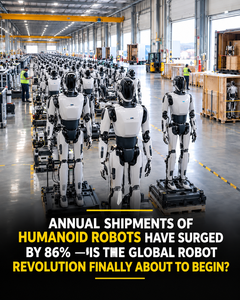
NEW YORK — Humanoid robots are moving from laboratory demonstrations toward commercial deployment, with Bank of America Global Research forecasting annual shipments could reach 1.2 million units by 2030.
From Experiment to Emerging Industry
The projection marks a dramatic increase from today’s market, but recent industry data show the technology remains at an early stage, with commercial adoption still limited.
According to the International Federation of Robotics, roughly 7,000 humanoid robots were sold worldwide in 2025 for industrial and professional service applications, excluding consumer and military machines.
That figure is tiny compared with established robotics markets. About 542,000 conventional industrial robots were installed globally in 2024, alongside an estimated 199,000 professional service robots.


Bank of America expects humanoid shipments to rise from an estimated 90,000 units in 2026 to 290,000 in 2027, before reaching 500,000 units in 2028.
The forecast then rises to roughly 800,000 shipments in 2029 and 1.2 million in 2030, implying manufacturers would need to scale production at extraordinary speed.
Such growth would depend heavily on falling component costs, improved artificial intelligence and the ability of robots to perform useful physical tasks reliably outside controlled demonstrations.
Why Humanoids Are Attracting Attention
Humanoid robots are designed to operate in environments built for people, potentially allowing them to use existing factories, warehouses, tools and infrastructure without requiring completely redesigned workplaces.
That flexibility is one reason manufacturers are testing humanoids for repetitive activities such as moving materials, handling components, sorting products and performing selected assembly operations.
Automakers have become important early adopters, but the International Federation of Robotics says current factory pilots generally involve only single-digit or sometimes double-digit numbers of machines.
Research institutions and technology companies also purchase humanoids to collect physical-world data, which can be used to train artificial intelligence systems and improve robotic decision-making.


China Takes a Leading Role
China is emerging as a major center of humanoid development, with more than 150 companies reportedly pursuing the technology and local governments supporting manufacturing capacity and research.
Yet demonstrations do not necessarily translate into productive factory work. Reuters reporting found that some Chinese humanoids remain too slow and error-prone for widespread commercial deployment.
One major technical challenge is generalization: a robot trained to perform a task in one workplace may struggle when lighting, objects, equipment, surfaces or operating conditions change.
Humanoid systems therefore require more than language intelligence. They must combine visual perception, physical control and decision-making, often using specialized vision-language-action models to interact with surroundings.
The Economic Question
Labor economics are another factor. Companies could deploy humanoids for dangerous, repetitive or physically demanding jobs, particularly where labor shortages make automation financially attractive.
However, robots must become affordable enough to justify purchasing and maintaining them. Reliability, safety, battery life, maintenance requirements and software performance will influence whether businesses expand deployments.
The technology could also affect employment patterns if humanoids eventually become capable of performing broader categories of routine physical work, although the scale and timing of such changes remain uncertain.
Other analysts are also forecasting rapid growth, although estimates differ substantially. Goldman Sachs previously projected more than 250,000 humanoid shipments in 2030 under its base-case scenario.
A Forecast, Not a Certainty
Ultimately, the 1.2 million figure should be treated as a forecast rather than an established outcome. The coming years will show whether humanoid robotics can move from spectacular demonstrations to dependable mass deployment.
Comments (0)
Loading comments...
May You Like

OBAMA STUNS ON INSTAGRAM: MESSAGE MARKING 34-YEAR MILESTONE SPARKS A BUZZ

Obama Steps Back Into the Political Spotlight as Democrats Target Trump’s