
Hundreds Protest in Portsmouth After Migrant Boat Carrying 140 Reaches UK Coast
PORTSMOUTH, England — Hundreds of protesters gathered in Portsmouth after a boat carrying about 140 migrants reached the UK coast on Sunday, triggering a major police response and a tense standoff over the transportation of the group to an immigration processing centre.
The incident, which took place near Eastney in Portsmouth on Sept. 6, came just one day after a separate anti-migrant demonstration disrupted traffic around the Port of Dover. The two events have intensified concerns about growing tensions over irregular migration and the possibility of further protests across Britain.
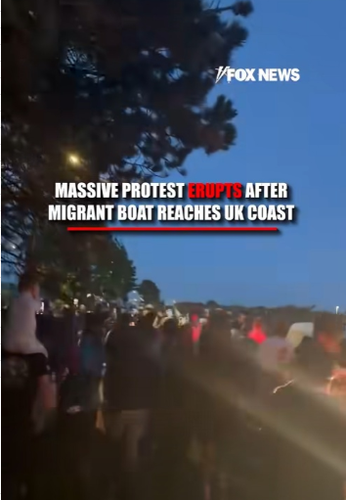
A Fox News-branded graphic circulating online describes the Portsmouth demonstration as a “massive protest” following the arrival of a migrant boat. The underlying event is genuine, although the image provides little context about what happened before and after the protest.
Boat carrying about 140 people reaches Portsmouth
French authorities reported a small boat carrying approximately 140 people travelling toward the UK on Sunday.
The vessel had reportedly departed from the Normandy coast rather than the more familiar launch areas around Calais and travelled for roughly 10 hours across the English Channel.
French rescue vessels monitored the boat, while UK authorities dispatched lifeboats, aircraft, a helicopter and emergency personnel after it approached the Hampshire coast. The passengers were eventually brought ashore near Eastney in Portsmouth.
The journey was unusually long for a Channel crossing, reflecting what authorities and migration specialists say are changing tactics by people-smuggling networks.
The migrants were expected to be taken to Manston in Kent, where people arriving by small boat are routinely processed.
Protesters block roads and confront police
News of the arrival quickly spread online, prompting hundreds of protesters to gather near the landing site.
Some demonstrators attempted to prevent coaches carrying the migrants from leaving the area. Roads were blocked for hours, while police formed lines to keep protesters away from the vehicles and the migrants.
ITV reported that hundreds gathered on Sunday evening, with some protesters wearing black clothing similar to demonstrators who had taken part in the Dover protest the previous day.
The situation later became more confrontational.
Police faced protesters near Eastney Marina, while reports said officers and police vehicles were targeted during the disorder. The Independent reported that police officers were injured and vehicles damaged as demonstrators attempted to stop the migrants from being transported away.
The British government condemned the behavior.
A government spokesperson said the right to peaceful protest is fundamental but that demonstrations must not cross into disorder. Treasury Minister Emma Reynolds described the behavior in Portsmouth as “thuggish and intimidating” and said the demonstration had gone beyond legitimate peaceful protest.
Portsmouth protest follows disruption in Dover
The Portsmouth demonstration was the second major anti-migrant protest in southern England in a matter of days.
On Saturday, masked demonstrators dressed largely in black gathered around Dover and blocked roads leading to the ferry port.
CBS reported that the Dover protest brought traffic to a standstill and created a backup stretching several miles, disrupting ferry passengers and freight traffic.
The protests in Dover and Portsmouth have been linked by British media to activist Daniel Thomas, also known as Danny Tommo, who encouraged supporters to travel to Portsmouth following the migrant boat's arrival.
Authorities are now watching for signs that the demonstrations could develop into a broader campaign against the government's migration policies.
Why did the boat arrive so far from Dover?
The Portsmouth crossing is significant because the traditional arrival point for many small boats has been the Kent coast, particularly around Dover.
The vessel that reached Portsmouth appears to have taken a considerably longer route from Normandy. The National reported that the journey began in the Bay of the Seine, roughly 273 kilometres southwest of Calais.
The change in route has raised concerns that smugglers are adapting to increased French enforcement.
British authorities say cooperation with France has helped reduce the number of people successfully crossing the Channel, but officials acknowledge that people-smuggling gangs continue to change their methods.
The Home Office says joint efforts have prevented more than 48,000 crossing attempts and resulted in the seizure of more than 1,100 boats and engines since the current government took office.
Small-boat crossings remain a major political issue
Despite the dramatic scenes in Portsmouth, the overall number of small-boat arrivals is lower than it was at the same point last year.
BBC reporting said 17,138 people had crossed the English Channel by small boat between Jan. 1 and Sept. 6, 2026, about 43% fewer than during the same period a year earlier.
The Home Office maintains a live statistical series tracking small-boat arrivals and says the figures are provisional and subject to revision. The government updated the data again on Sept. 8.
At the same time, the average number of people aboard individual boats has increased substantially in recent years. That has created a particularly visible problem for authorities because increasingly crowded boats can make individual crossings more dangerous.
Government faces pressure from both sides
The Labour government is under pressure to reduce small-boat arrivals while also preventing demonstrations from turning violent.
The government has promoted its agreement with France, including additional French enforcement on beaches, as part of its strategy to disrupt smuggling operations. Officials argue that the decline in crossings this year indicates that the policy is having an effect.
Opposition politicians and anti-migration campaigners, however, argue that any continued arrivals demonstrate that the government's measures are insufficient.
At the same time, ministers have warned protesters that frustration over immigration does not justify attacks on police, blocking emergency services or preventing people from being transported for lawful processing.
That tension was on full display in Portsmouth.
What the viral Fox News graphic gets right — and what it leaves out
What is accurate:
- A boat carrying roughly 140 migrants reached the Portsmouth area on Sept. 6.
- Hundreds of anti-migrant protesters gathered after the arrival.
- Protesters attempted to block roads and prevent coaches from leaving.
- Police were deployed in large numbers.
- The demonstration became confrontational, with reports of injuries to officers and damage to vehicles.
- The Portsmouth protest followed a major anti-migrant demonstration in Dover the previous day.
What the graphic does not explain:
- The boat was not simply allowed to arrive without a government response. UK and French authorities deployed multiple emergency and maritime resources.
- The people aboard were taken ashore and were expected to undergo the normal immigration processing procedure.
- The number of small-boat arrivals in 2026 is currently below last year's level.
- The Portsmouth demonstration was part of a broader weekend of protests rather than an isolated spontaneous event.
A new flashpoint in Britain's migration debate
The Portsmouth confrontation illustrates how Britain's Channel migration issue has moved beyond Westminster and immigration policy debates and into local communities.
For residents in coastal towns, the arrival of increasingly crowded boats can create concerns about policing, accommodation and public services. For migrants and asylum seekers, the crossings often represent the final stage of extremely dangerous journeys.
For the government, the challenge is now twofold: reducing the number of people making the crossing while ensuring that public anger does not escalate into violence or disruption.
The scenes in Portsmouth — coming immediately after the disruption in Dover — suggest that Britain's migration debate is entering another volatile phase.
With small boats continuing to cross the Channel despite a year-on-year decline, and with organized demonstrations attracting hundreds of people, both the migration issue and the political reaction to it are likely to remain major sources of tension across the UK.
Comments (0)
Loading comments...
May You Like

FIGHT OVER OBAMA’S IRAN POLICY

Shocking news from Ohio: an unexpected development ahead of Trump's rally

Jack Smith Defends His Integrity as Trump Investigations Face Renewed Political Firestorm













