
“I Guess I’ll Become Mr. Veto”: Inside Trump’s Plan to Govern Without Congress If Democrats Win the Midterms
“I Guess I’ll Become Mr. Veto”: Inside Trump’s Plan to Govern Without Congress If Democrats Win the Midterms
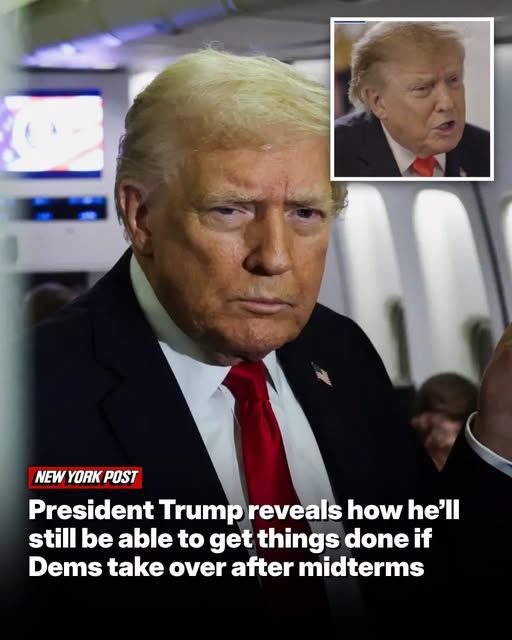
The image captures a moment of characteristic defiance: Donald Trump, mid-stride on Air Force One, his expression set in a familiar scowl. The headline from the New York Post is blunt and revealing: “President Trump reveals how he’ll still be able to get things done if Dems take over after midterms.”
The post, shared widely on the eve of the November 3 midterm elections, offers a rare glimpse into the contingency planning of a president who is publicly projecting confidence but privately bracing for a political earthquake. In an interview on the New York Post’s “Pod Force One” podcast, Trump laid out a strategy that is part constitutional theory, part negotiating tactic, and part warning to his opponents: if Democrats win, he will simply veto everything they send him—and then wait for them to come to the table.
But the story is bigger than a single interview. It is a story about a White House that has spent months preparing for a Democratic takeover, a president who is willing to govern through executive authority, and a looming constitutional showdown over the limits of presidential power.
The Verdict: A Real Strategy, A Real Threat
Unlike many viral political headlines, this one is grounded in verifiable reporting and direct quotes. Trump did, in fact, say he would become “Mr. Veto.” He did, in fact, outline a strategy of repeated vetoes followed by negotiations. And the White House did, in fact, spend months developing plans to advance Trump’s agenda through executive action if Democrats win control of Congress.
The interview excerpt, released on Sunday, November 1, 2026, was unambiguous. “I guess I’ll become Mr. Veto,” Trump told host Miranda Devine. “I’m not going to let them ruin it” .
He then explained the logic of his strategy: “They’ll be sending stuff up. You veto it. And eventually, after a month or two of getting all vetoed, they’re just wasting [time], they come over, and you make a deal. I think that probably would happen, but hopefully we don’t have to worry about that” .
In a later interview, he was even more direct: “I think we’re going to do great. But if we didn’t win, I veto everything. I’ll be vetoing, vetoing” .
The “Mr. Veto” Strategy: A Constitutional Staring Contest
The strategy is simple in theory but fraught with risk in practice. If Democrats win control of Congress, they will be able to pass legislation—but they will need a two-thirds majority in both chambers to override a presidential veto. Given the current partisan composition of Congress, that is an almost impossible threshold. Trump, therefore, holds a powerful check on the Democratic agenda.
The numbers tell the story. Democrats need a net gain of four seats in the House and four seats in the Senate to overturn the Republican majorities of 218–214 and 53–47 . Forecasters widely favor Democrats to win the House, while the Senate remains too close to call .
Trump’s calculation is that after a month or two of gridlock, Democrats will be forced to negotiate. It is a high-stakes game of legislative chicken, and Trump is betting that he can outlast his opponents.
The Secret Plan: Governing Through Executive Action
The “Mr. Veto” strategy is only one part of the administration’s preparation. According to a report from Reuters, the White House has spent months developing plans to keep advancing Trump’s agenda through executive power while bracing for investigations of his administration .
Senior officials, including deputy chief of staff Stephen Miller and budget director Russell Vought, have been working with the White House Counsel’s Office since April to identify executive actions on immigration, tariffs, housing costs, and federal spending that Trump could pursue without congressional approval . White House counsel Will Scharf and his team have also been examining “what Trump can legally do on his own, where he could push the limits of his authority and how to defend those decisions in court” .
Among the executive actions under consideration are new tariffs on imports of critical minerals and wind turbines, tighter rules on visas for international students and temporary foreign workers, and measures aimed at lowering housing and construction costs . Vought is also examining which priorities can move forward using money already appropriated by Congress, and he is pushing to change federal grant rules to give political appointees more say in which programs receive taxpayer money—potentially giving the White House more influence over federal spending without seeking congressional approval .
When asked how comfortable Trump would be governing through executive authority under a Democratic Congress, one person familiar with the plans said, “very comfortable” .
The Coming Investigations: Preparing for Subpoenas
The White House is also preparing for a flood of Democratic investigations. If Democrats win control of either chamber, they have promised to open a flurry of inquiries into Trump, his administration, and many allies . To prepare, White House lawyers have begun briefing appointees on how to handle subpoenas and document requests, according to one source .
Trump’s response to this threat has been characteristically aggressive. Asked whether he would protect family members, White House staff, and billionaire Elon Musk from potential congressional subpoenas, Trump said he would issue pardons without hesitation . He cited his previous clemency decisions involving defendants charged in connection with the January 6, 2021, Capitol riots, and he made clear he would use the pardon power again if necessary.
The Warnings: “Maybe Forever Destroyed”
Trump’s interview was not just a strategy session. It was also a warning to voters. He agreed with Elon Musk’s recent warning that if Democrats sweep the elections, the country will be “maybe forever destroyed” .
He claimed that Democrats plan to add Puerto Rico and Washington, D.C., as states—which would add Democratic seats to Congress—while expanding the size of the Supreme Court and eliminating the filibuster in the Senate to shut Republicans out of power . He warned that a complete Democratic victory in both chambers, followed by a Democratic presidential win in 2028, would leave the country “finished” .
These claims are, to put it mildly, contested. But they serve a political purpose: to motivate Republican voters to turn out on Tuesday and prevent the scenario Trump is describing.
The Bottom Line
The viral graphic is right about one thing: Donald Trump has a plan if Democrats take over after the midterms. But the story is not just about a single interview. It is about a White House that has spent months preparing for a political landscape in which the president is stripped of his legislative majority, forced to rely on executive authority and the veto pen, and besieged by investigations.
Trump’s “Mr. Veto” strategy is a bet—a bet that he can outlast Democratic pressure, that his executive actions will survive legal challenges, and that voters will blame Democrats for the gridlock that follows. Whether that bet pays off will depend on the results of Tuesday’s elections, the courts, and the American people.
For now, the president is projecting confidence. “They want to get rid of your Second Amendment, have transgender for everyone,” he said of the Democrats. “Look, if we didn’t win—I think we’re going to do great—but if we didn’t win, I’d veto everything. I’ll be vetoing, vetoing” .
It is a strategy born of defiance, and it may be the defining political battle of the final two years of Trump’s presidency.
📸 Suggested Images
-
The Interview: A screenshot of the New York Post headline, with a quote overlay of “I guess I’ll become Mr. Veto.”
The Veto Pen: A photo of Trump holding a veto pen or signing a document, with a caption noting his veto strategy.
The White House Team: A photo of Stephen Miller and Russell Vought, with a caption identifying them as the architects of the executive action plan.
The Capitol: A photo of the U.S. Capitol, with a caption noting the narrow Republican majorities and the stakes of the midterm elections.
The Investigations: A photo of Democratic committee chairs or a congressional hearing room, illustrating the investigations that the White House is preparing for.
Comments (0)
Loading comments...
May You Like

BANGCHAK REFINERY DISASTER IN THAILAND—120,000 BARRELS A DAY SHUT DOWN, U.S. OIL PRICES SURGE 10%!


IOWA EMERGENCY: TOXIC AIR, POLLUTED WATER, 3,000 FAMILIES FORCED OUT AFTER 5-TON WASTE BLAST!

Latest Posts









Popular Posts



