ICE at Polling Stations: DHS Threatens Deployments — Security or Intimidation?
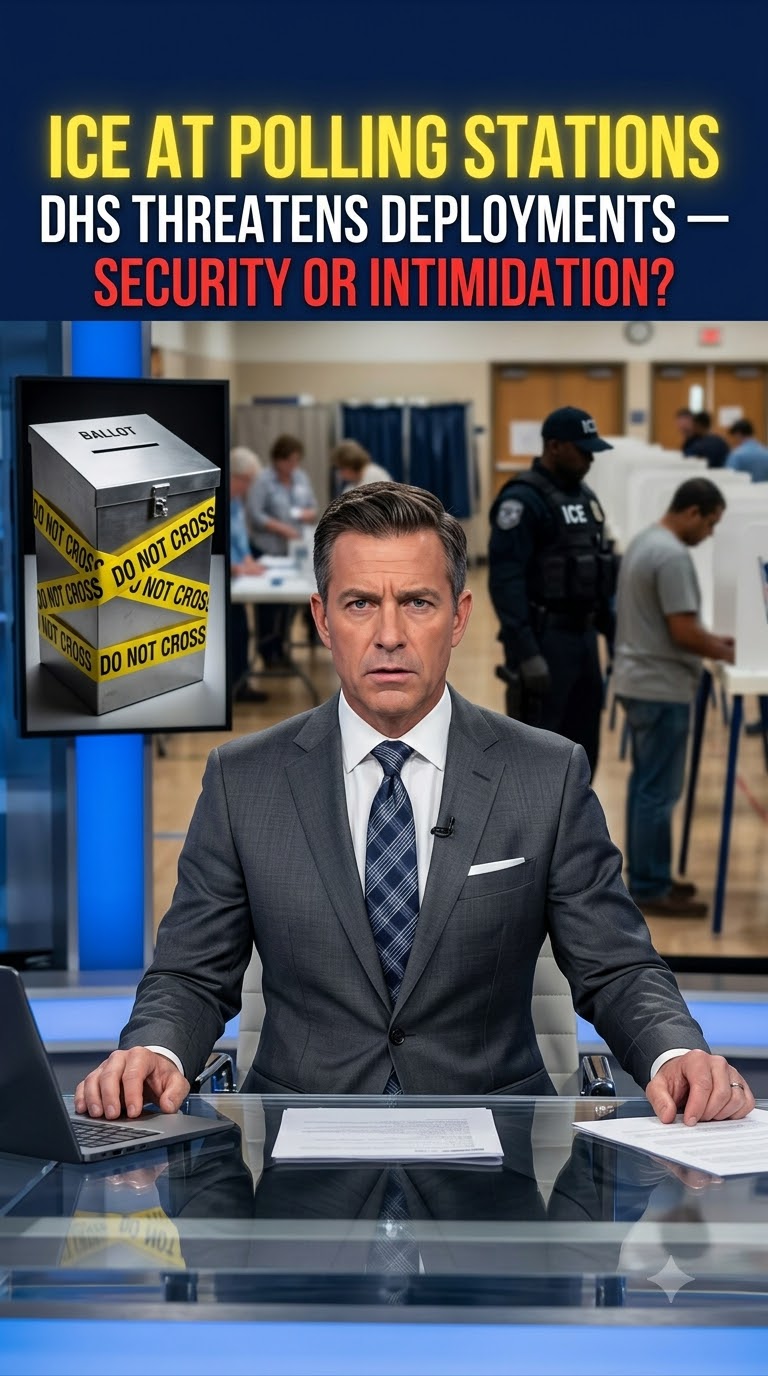
The Department of Homeland Security has sparked a firestorm of controversy by refusing to rule out deploying Immigration and Customs Enforcement agents near polling stations in November, as the military confirms it will not send troops to vote centers. The conflicting signals have left voters — particularly in Latino communities — fearing that federal law enforcement presence could be used to suppress turnout.
WASHINGTON — The debate over election integrity has taken a sharp turn: will federal immigration agents show up at polling places? The question has become a central flashpoint ahead of the November midterms, with voting rights advocates warning that even the threat of ICE presence could intimidate millions of eligible voters.
While the military has issued a clear pledge to stay out of polling stations, DHS has remained conspicuously silent on the role of ICE, leaving a legal and political vacuum that critics say is designed to sow fear.
Military Promises: No Troops at Polls
On September 4, 2026, Chairman of the Joint Chiefs of Staff Gen. Dan Caine provided written assurances to Senator Elissa Slotkin that the U.S. military has no plans to deploy federal troops or federalized National Guard personnel to polling places during the election.
Caine further stated that the military will not seize ballot boxes, counting equipment, or related documents, affirming that election administration remains the responsibility of state and local governments.
This commitment appeared to ease concerns about military involvement — but it left an equally pressing question unanswered: what about ICE?
ICE's Ambiguous Role: A Tool for Intimidation?
According to a Chinese media report summarizing the situation, the key issue is that while the Pentagon has addressed military involvement, DHS has refused to clarify ICE's role near polling locations.
Patrick Eddington, a senior fellow at the Cato Institute, warned that if DHS attempted to deploy immigration enforcement near polling sites, "the legal challenge to it would be straightforward and multipronged by the attorney general of any state so affected." However, he noted that the real danger is "not so much legal as political and psychological".
DHS Secretary Markwayne Mullin has previously stated that ICE would only be deployed to specific sites where "concrete threats" exist, rather than to generate fear. But critics argue that "concrete threats" is a vague standard that could be abused to justify widespread enforcement actions, especially given that the administration has conducted large-scale operations in public spaces before.
Latino Voters: A Community on Edge
For many Latino voters, the specter of ICE near polling stations is deeply unsettling. The community has become a critical voting bloc in key swing states including Texas, Florida, Arizona, Nevada, and Georgia. Any perception of federal presence — even if framed as "security" — could alter turnout, particularly among mixed-status families.
The unease has been fueled by recent aggressive immigration enforcement. In August 2026, ICE apprehended a parent at a Connecticut school bus stop, prompting outrage and accusations of using children as bait. Trump administration border chief Tom Homan denied that the agency operates through "intimidation of children," but acknowledged that some arrests involve parents.
In March 2026, President Trump threatened to deploy ICE agents to airports nationwide unless Congress funded DHS programs, warning that agents would carry out "unprecedented security work" and "immediately arrest all illegal immigrants arriving". Democrats at the time described the plan as an intimidation tactic.
What Voter Intimidation Law Says
Legal experts note that deploying armed federal agents near polling stations without a clear security justification could violate federal laws prohibiting voter intimidation. Under U.S. law, anyone who "intimidates, threatens, or coerces" voters can face prosecution. However, the standard for proving intimidation is subjective — it is enough that a voter feels threatened, not that a threat was overtly issued.
As one analysis notes, intimidation can succeed even without an arrest or a single vote being discarded: "Elections don't usually fail all at once. They fail when enough people decide voting isn't worth the risk".
Calls for Legislation — and Growing Concern
Senator Slotkin has introduced legislation that would restrict the president's ability to deploy federal troops or armed personnel to voting sites without congressional approval. However, the bill remains under review and has not yet advanced.
Meanwhile, the administration continues to frame its stance as a necessary response to election security concerns. Trump has repeatedly argued that "stronger supervision" is needed to prevent fraud. Opponents argue that the deployment of federal law enforcement is political overreach intended to suppress Democratic-leaning constituencies.
| Key Detail | Information |
|---|---|
| Military commitment | No federal troops or National Guard at polling stations |
| ICE role | Unclear — DHS says deployments possible only when "concrete threats" exist |
| Legal threat | Legal challenges would be "straightforward," but intimidation is "political and psychological" |
| Community affected | Latino voters in key states (Texas, Florida, Nevada, Arizona, Georgia) |
| Recent context | ICE arrested parent at CT school bus stop; Trump threatened airport ICE deployments |
| Legislative response | Slotkin bill pending — would restrict presidential deployment of armed personnel |
With the election less than two months away, the question of whether ICE will show up at polling places remains unresolved. What is clear is that the threat — even if unfulfilled — is already shaping perceptions, and in a deeply divided nation, that may be enough.
Comments (0)
Loading comments...
May You Like


OBAMA STUNS ON INSTAGRAM: MESSAGE MARKING 34-YEAR MILESTONE SPARKS A BUZZ