
"If People Ever Got Tired of Me... I'll Move to Israel and Become Prime Minister": Inside Trump's Bizarre Election-Day Joke—and the $4 Billion Announcement That Came With It
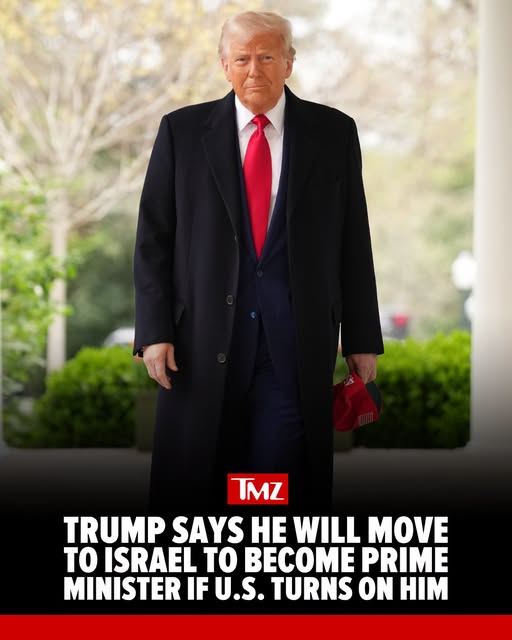
"If People Ever Got Tired of Me... I'll Move to Israel and Become Prime Minister": Inside Trump's Bizarre Election-Day Joke—and the $4 Billion Announcement That Came With It
The image is designed to be both provocative and puzzling: Donald Trump in a long dark coat, standing on what appears to be the White House grounds, the TMZ chyron cutting to the heart of a surreal political moment: "TRUMP SAYS HE WILL MOVE TO ISRAEL TO BECOME PRIME MINISTER IF U.S. TURNS ON HIM."
On the surface, it sounds like a throwaway line—a characteristic Trump quip, delivered with a smirk, designed to provoke a reaction and dominate the news cycle. But this was not a random aside. It was a carefully timed remark, delivered in a Fox News interview on the morning of Election Day 2026, and it came bundled with a far more consequential announcement that has profound implications for the Middle East and for America's role in the world.
This is the story behind the joke, the 99% approval rating he claimed, and the $4 billion decision that could reshape the U.S.-Israel relationship.
The Verdict: A Real Quote, a Real Announcement, a Real Political Moment
Unlike many viral political headlines, this one is grounded in verifiable reporting and direct quotes. On Tuesday, November 3, 2026—as Americans headed to the polls to vote in the midterm elections—Trump called into "Fox & Friends" to boost Republican candidates. During the interview, the conversation turned to Israel, and the President made the remark that would go viral.
"I'm at 99% approval rating in Israel. Can you believe it?" Trump said. "In fact, if people ever got tired of me in the US, I'll move to Israel and become prime minister".
He repeated the line in subsequent interviews and at rallies, and it was quickly picked up by outlets across the political spectrum, from TMZ to TASS to the Times of India. It was a joke, yes, but it was also a signal—a signal about his relationship with Israel, his view of his own popularity, and the announcement he was about to make.
The 99% Claim: A Familiar Boast
Trump's claim of a 99% approval rating in Israel is not new. He made a similar remark in May 2026, and he has repeated it several times since. He has also claimed to have the "highest approval rating of anybody in history"—a claim he did not support with any polling data.
The 99% figure is almost certainly an exaggeration. No credible poll has ever shown Trump with 99% approval in Israel, a country with a diverse and fractious political landscape. But the claim serves a political purpose. It reinforces his narrative that he is uniquely beloved by the Israeli public, that he has been the most pro-Israel president in American history, and that his support for Israel is unwavering.
He linked his popularity in Israel directly to his actions against Iran. "They've been a great partner, but what we did, we stopped Iran. Iran was an unstoppable force. We knocked the hell out of them," he said. It was a reference to the ongoing U.S.-Iran conflict, which had entered its ninth month and which Trump had repeatedly framed as a necessary act of strength.
The $4 Billion Announcement: A Policy Shift Disguised as a Joke
The most consequential part of the Fox News interview was not the joke about becoming prime minister. It was the announcement that came alongside it: the United States would end its 10-year security assistance agreement with Israel, which provides approximately $3.8 billion to $4 billion in annual military aid through 2028.
Trump said Israel no longer needed the assistance. "Israel's our number one; we give them more than anybody else, and they no longer need it... If they did need it, I would say keep it going," he said. He claimed he had discussed the decision with Israeli Prime Minister Benjamin Netanyahu, and that the two leaders had talked about it for years.
The announcement was significant for several reasons. It marked a dramatic shift in the U.S.-Israel relationship, which had been anchored for decades by the memorandum of understanding signed under President Obama in 2016. It came without congressional approval, raising questions about the president's authority to unilaterally alter a security agreement. And it was announced on Election Day, in a Fox News interview, with almost no advance warning to the Israeli government or to Congress.
The existing aid agreement runs through September 2028, and any change to the funding arrangement would require congressional approval, according to Reuters. The announcement was met with immediate criticism from Israeli opposition figures, who questioned the way the change in the security relationship had been handled.
The Reactions: "Threatening Us With a Good Time"
The response to Trump's remarks was swift and, in many quarters, mocking. Critics seized on the absurdity of the scenario he described—a sitting American president, rejected by his own people, relocating to Israel to run for prime minister—and turned it into a punchline.
"Trump threatens us with a good time," wrote The Tennessee Holler, a progressive social media account. George Conway, a prominent Trump critic and conservative lawyer, offered a sharper quip: "Much as this offer is tempting, to wish this upon Israel would be the height of anti-Semitism, which we must reject in all forms. Fortunately, there are many other countries in the world (who knew?!), including many s--- house countries, to which he can go".
Mehdi Hasan, the former MSNBC anchor, was more direct: "I can't believe he actually said this out loud. On Fox. The 2026 midterms summed up in one moment".
The joke also drew attention to the tension between Trump's rhetoric and the reality of his policy. He was claiming, on the one hand, to be so beloved in Israel that he could become its prime minister, while on the other hand, announcing that he was cutting off the military aid that had helped sustain Israel's security for decades. It was a contradiction that even his supporters struggled to reconcile.
The Political Context: A Closing Argument on Election Day
The timing of the interview was not accidental. Trump was calling into "Fox & Friends" on the morning of the midterm elections to make a final pitch to voters. The elections would determine control of Congress, with Democrats needing to gain just a handful of seats to seize the House and Senate. The results would shape the remainder of Trump's presidency, determining his ability to pass legislation and his exposure to investigations.
The joke about Israel was, in part, a distraction—a way to change the subject from the war with Iran, the economy, and the unpopularity of his administration. But it was also a reflection of his political instincts. Trump has always understood the power of a memorable line, even if it is not entirely true, and he has always been willing to say things that others would consider inappropriate or undignified.
The 99% approval claim, the joke about becoming prime minister, and the $4 billion aid cut were all part of the same message: that Trump is a singular figure, uniquely beloved by some and uniquely powerful to act on his convictions. It was a message designed to energize his base and to project strength, even as the political ground shifted beneath him.
The Bottom Line
The viral graphic is right about one thing: Donald Trump did say he would move to Israel and become prime minister if Americans turned on him. He said it as a joke, on Election Day, in a Fox News interview, and it was picked up by outlets around the world.
But the story is not just about a single quip. It is a story about a president who has made his relationship with Israel a central pillar of his foreign policy, who claims a level of popularity abroad that defies the available evidence, and who is willing to make far-reaching policy changes—like ending a $4 billion annual aid package—in the same breath as a joke. It is a story about the line between entertainment and governance, and what happens when that line disappears.
For now, the joke has faded, but the policy remains. The aid cut is real. The questions about the U.S.-Israel relationship are real. And the man who said he would move to Israel to become prime minister is still in the White House, waiting to see what the voters decide.
📸 Suggested Images
-
The Interview: A screenshot of Trump during the Fox News interview, with a quote overlay of "I'll move to Israel and become prime minister."
The Announcement: A photo of Trump and Israeli Prime Minister Benjamin Netanyahu, with a caption noting the $4 billion aid cut announcement.
The Reaction: A screenshot of George Conway's tweet about "wishing this upon Israel," illustrating the mocking response.
The Stakes: A photo of the U.S. Capitol on Election Day, with a caption noting the midterm elections and the narrow Republican majorities.
The Relationship: A photo of the U.S. and Israeli flags side by side, with a caption noting the long-standing security assistance agreement that Trump announced he would end.
Comments (0)
Loading comments...
May You Like

CAIRO INFERNO — CAR CARRYING SENIOR U.S. OFFICIAL SLAMS INTO FUEL TANKER, 31 DEAD, 21 INJURED!

TRUMP CALLS GDP FIGURE “FAKE” AFTER GOVERNMENT’S SCHEDULED REVISION

STORM WARNING: MILLIONS FACE EVACUATION, MACY'S GIANT BALLOONS GROUNDED!
Latest Posts








Popular Posts




