
Ilhan Omar Accuses Trump of Political Intimidation: What Is Verified About the Alleged Raid and Her Comparison With Obama?
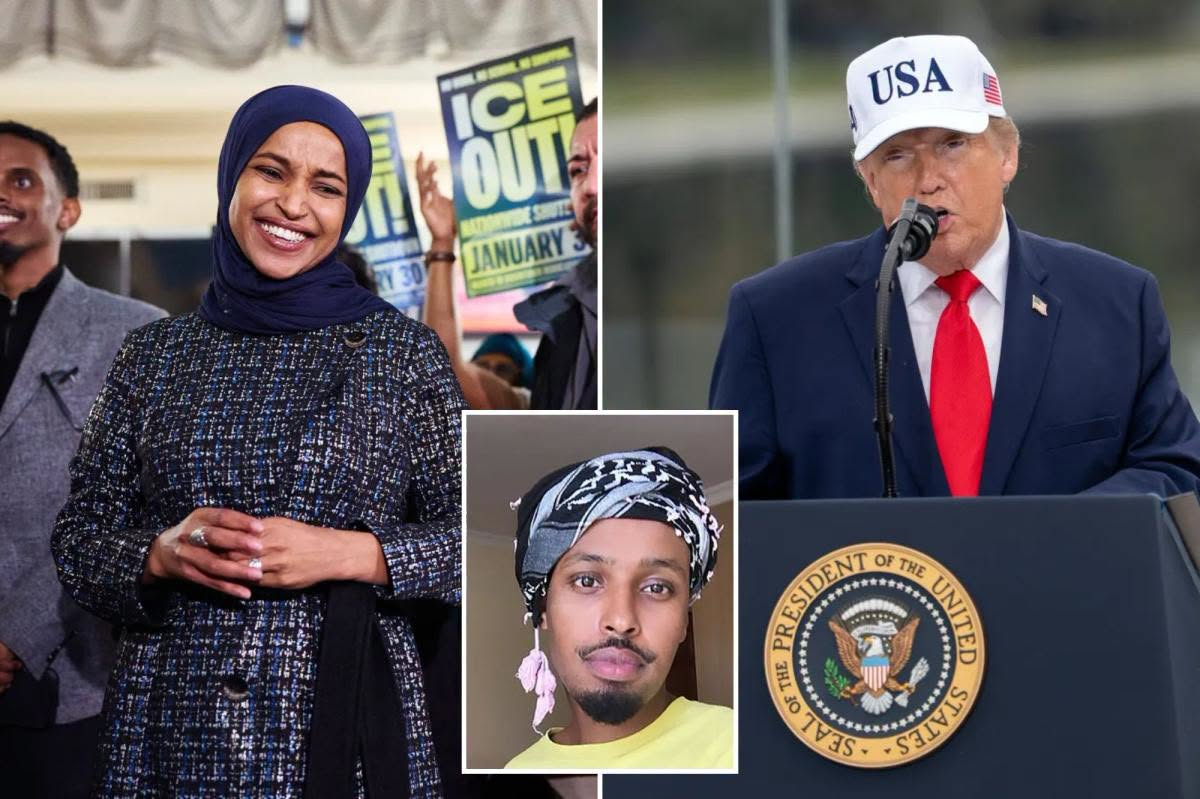
The viral image links Representative Ilhan Omar, Donald Trump and an alleged pre-dawn federal raid on her Washington residence. The central question is whether the incident actually happened—and whether there is evidence connecting it to the White House.
A dramatic political claim is circulating online alleging that Democratic Representative Ilhan Omar has accused President Donald Trump of an “unhealthy and creepy obsession” with her after federal agents allegedly carried out a pre-dawn raid at her Washington, D.C., residence. The post says Omar compared the episode with Trump's years-long campaign questioning Barack Obama's birthplace and citizenship.
The allegation, if substantiated, would raise serious questions about the use of federal law-enforcement powers and the treatment of elected officials who criticize the administration. But several separate claims need to be established before the story can responsibly be presented as fact: whether a raid took place, which agency conducted it, what legal authority was cited, what Omar actually said, and whether any evidence connects the operation to Trump or the White House.
The October 12 search: What happened at Omar’s home
The search itself is confirmed by multiple news organizations. On October 12, agents from Homeland Security Investigations (HSI), the investigative arm of the Department of Homeland Security, searched Omar’s Washington residence under a judicially authorized warrant. The operation took place before dawn, less than a month before the November midterm elections.
In her October 21 interview with MS NOW host Chris Hayes, Omar described waking to agents pounding on the front and back doors. She said she initially thought there was a fire. According to her account, between 15 and 25 agents entered the home, searched it for four to five hours and took 17 items, including phones, a camera, a Somali phrase book and notebooks belonging to her husband.
The Justice Department said officers followed the protocol established by the warrant and declined to discuss the ongoing investigation. Omar’s lawyers alleged that agents ignored restrictions imposed by the judge; the department disputed that claim. The warrant itself and the precise scope of the investigation have not been fully made public in the reporting reviewed here.
The investigation reportedly concerns possible irregularities in immigration paperwork submitted when Omar and her family came to the United States in the 1990s. Omar has denied wrongdoing. No criminal charge against her had been announced in the reporting available by November 4.
The new interview: Omar makes the Obama comparison explicit
The most recent development came in an interview with The Nation, published November 2. In the conversation with journalist John Nichols, Omar said Trump had an “unhealthy and creepy obsession” with her. She argued that attacks on her identity and background were being used to shift public attention away from problems facing the administration.
Omar's comparison with Obama was not simply a passing reference. When Nichols asked about former President Barack Obama's public support for her and the parallels between their experiences with conspiracy theories, she said that Obama understood the world of right-wing conspiracies because he had been a central target of it.
“In many ways, the conspiracy world I find myself in was created around him,” Omar told The Nation. She argued that, just as the birther movement continued questioning Obama's citizenship despite the release of his birth certificate, some accusations about her background persisted despite denials and the absence of publicly established proof.
The comparison concerns the political dynamics of the accusations, not an assertion that the two cases are legally identical. Obama was born in Hawaii in 1961, and his birth certificate documented his U.S. birthplace. The birther movement nevertheless continued to question his eligibility for the presidency. Omar, meanwhile, is a naturalized U.S. citizen whose immigration history is now the subject of a federal investigation.
The distinction between a conspiracy theory and a legitimate investigation is important. The existence of a federal inquiry does not establish that the allegations are true; equally, a politician's denial does not automatically settle the factual questions investigators are examining.
Why the timing of the raid has become a constitutional controversy
One of the strongest objections from Democrats concerns the timing. The October 12 search occurred roughly three weeks before the November 3 midterm elections, when Omar was campaigning for reelection. The Justice Department has historically sought to avoid overt investigative actions involving candidates during the 60 days before an election, although that practice is guidance rather than an absolute statutory prohibition.
The search also involved a sitting member of Congress, raising questions about the constitutional protections afforded to lawmakers. CNN reported on October 14 that the federal magistrate judge who approved the warrant imposed restrictions on how investigators could access Omar's records because of her congressional role and the protections associated with the Speech or Debate Clause.
Omar's attorneys subsequently accused the Justice Department of violating safeguards imposed by the judge. They asked the government to return property and preserve recordings of the search. The department denied that agents had violated the warrant's requirements. These competing accounts have not been resolved in a final public judicial finding.
The dispute has also moved into court over access to the warrant itself. On October 28, The Washington Post reported that the Justice Department was asking a federal judge to keep the warrant application sealed while the investigation continued. Prosecutors argued that releasing the documents could compromise the inquiry and expose suspected wrongdoing before decisions about charges had been made. A coalition of news organizations sought disclosure, arguing that the public interest in understanding the search was substantial.
That leaves an important transparency question: the public knows a judge authorized the search, but does not yet have the full affidavit explaining the evidence investigators presented to obtain that authorization.
Trump's response and the question of White House involvement
Trump has denied involvement in the operation. On October 12, he told reporters that the investigation had “nothing to do” with him and that the matter was up to the Justice Department. At the same time, he criticized Omar personally and questioned whether she could be deported or imprisoned.
The president's subsequent comments intensified the controversy. In the October 21 interview with Chris Hayes, Omar rejected Trump's denial and said, “He's got everything to do with it,” pointing to his longstanding public attacks against her and the earlier scrutiny of her immigration history. That is Omar's allegation about political responsibility; it is not independent proof that Trump ordered the search or directed investigators.
The Associated Press reported that Trump and senior administration officials had referred to an ongoing inquiry into Omar in the months before the search. Homeland Security Secretary Markwayne Mullin had publicly suggested that action could follow an investigation into possible irregularities in family immigration paperwork.
The central issue is therefore not whether Trump has criticized Omar—his public remarks are extensively documented. It is whether the investigation was initiated and pursued independently on the basis of evidence, or whether political considerations influenced its timing, scope or direction. The public record available so far does not conclusively answer that question.
What is the investigation actually examining?
The reported inquiry concerns immigration and citizenship paperwork from the 1990s, when Omar and her family arrived in the United States after fleeing Somalia. Omar has said that her late father handled the relevant paperwork when she was a child and that she did nothing wrong.
The Washington Post reported that Trump administration officials examined similar questions in 2019 and did not identify citizenship problems at that time. That earlier review is relevant context, but it does not automatically prevent authorities from examining new evidence or pursuing a new investigation.
The current investigation has also generated renewed discussion of allegations about Omar's previous marriage. She has repeatedly denied the claim that she married her brother to facilitate immigration benefits. The allegation has circulated in conservative media for years, but its repetition does not establish that it is true. Reporting on the earlier scrutiny has noted that a prior investigation did not result in a prosecution, with limitations on prosecution cited in connection with the alleged offense.
As of November 4, the key facts remain:
-
Federal agents searched Omar's Washington residence on October 12 under a judicially authorized warrant.
The investigation reportedly concerns historical immigration paperwork.
Omar denies wrongdoing and says the operation was politically motivated.
Trump says he had nothing to do with the search, while continuing to criticize Omar publicly.
The warrant application remains sealed, and no criminal charge against Omar had been announced in the reporting reviewed for this article.
These points should not be collapsed into either a declaration that Omar is guilty or a conclusion that the investigation has definitively been proven to be a political operation.
The broader political stakes
For Omar, the search is part of a much longer period of political hostility. She has said that Trump's rhetoric has contributed to threats against her and her family. In her December 2025 interview with The Guardian, she described the president's focus on her as an “unhealthy and creepy obsession” and discussed the security consequences she associated with his attacks.
The issue has particular resonance because Omar is one of the first two Muslim American women elected to Congress and the first Somali American member of the House. Trump has repeatedly criticized her Somali background, her political positions and her comments about U.S. foreign policy. The debate over her treatment has consequently become part of a wider national argument about immigration, religious identity, political speech and the use of federal law enforcement.
The political stakes are not limited to Omar's individual case. If the government can conduct highly visible searches involving political candidates close to an election, the public needs confidence that such decisions are grounded in evidence and applied consistently. At the same time, elected officials are not automatically exempt from legitimate criminal investigations.
That balance is particularly important when the subject is a member of Congress. The Constitution protects legislative independence, but it does not place lawmakers above the law. A credible investigation must respect both principles.
What comes next?
The immediate questions concern the sealed search-warrant materials, the evidence seized from Omar's residence and the restrictions imposed by the judge. Their eventual release—or the court's explanation for keeping them sealed—could clarify the government's justification for the operation.
Congressional oversight may also become important. Omar has called on lawmakers to defend the independence of the legislative branch and investigate whether federal agencies were used to intimidate a political opponent. The administration, for its part, has maintained that the search was part of a legitimate criminal investigation.
The Obama comparison adds another layer to the dispute. Omar sees a familiar pattern in the persistence of accusations about a politician's origins and citizenship, even when those claims have been repeatedly challenged. Her critics argue that the current investigation should be allowed to proceed on its evidence rather than dismissed as a conspiracy.
The most consequential fact is that the raid really happened. The political motivation Omar alleges remains contested, and the underlying immigration investigation has not reached a publicly established conclusion. Until the warrant evidence and investigative findings become clearer, the story is best understood as a serious dispute over law enforcement, congressional independence and the boundary between legitimate scrutiny and political pressure—not as proof that either side's entire account has been established.
Comments (0)
Loading comments...
May You Like

STORM WARNING: MILLIONS FACE EVACUATION, MACY'S GIANT BALLOONS GROUNDED!

TOLEDO I-75 TRUCK CRASH — POTENTIAL BRIDGE COLLAPSE AND MILLIONS IN DAMAGE!

THANKSGIVING NIGHTMARE: OVER 1M BLACKOUTS, NEARLY 2M WATER ALERTS!

Latest Posts










Popular Posts


