
Indian Green Card Backlog Could Mean a 179-Year Wait for Some EB-2 Applicants
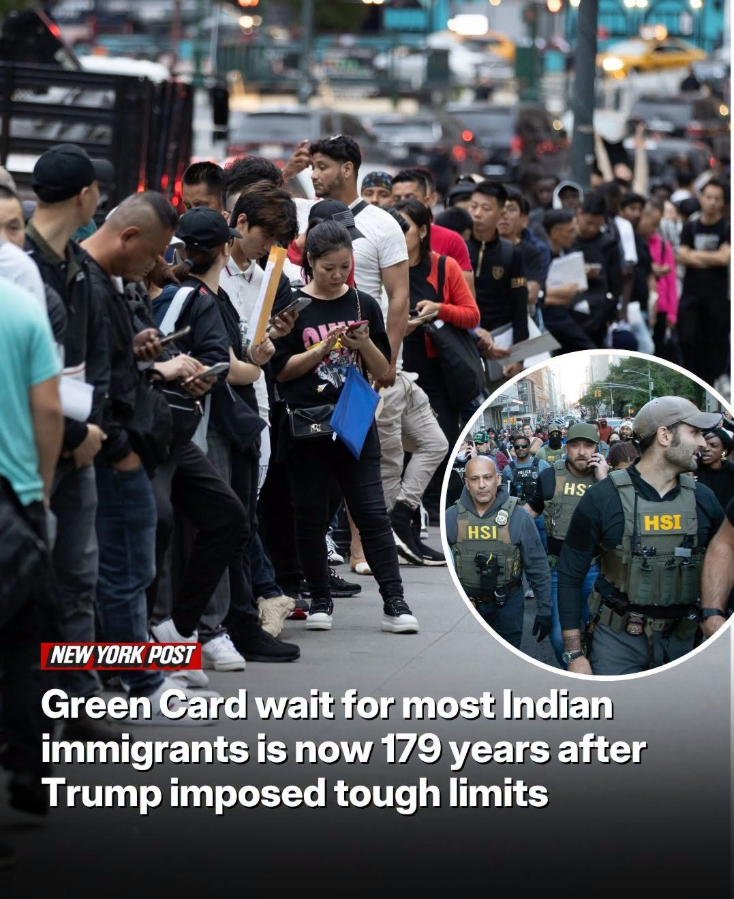
WASHINGTON — September 4, 2026 — A new analysis of the U.S. employment-based immigration backlog has produced a staggering figure: an Indian professional entering the EB-2 green card queue in 2026 could face a potential wait of 179 years if current immigration rules, demand and backlog conditions persist.
The estimate comes from the National Foundation for American Policy (NFAP), a nonpartisan immigration-policy research organization. It has drawn widespread attention in Indian and U.S. media, including the New York Post, Indian Express and Times of India.
But the viral graphic needs an important qualification: 179 years is not the guaranteed waiting time for every Indian immigrant seeking a green card. It is a projection for a new applicant in the employment-based EB-2 category under current conditions.
Nearly 1 Million Indians Are Already in the Employment-Based Backlog
NFAP estimates that 996,599 Indians were waiting in the EB-1, EB-2 and EB-3 employment-based immigration categories at the end of 2025.
That represented roughly 79% of the entire estimated employment-based backlog, which stood at about 1.26 million people across those three categories.
The concentration is particularly severe in EB-2.
NFAP estimated that approximately 731,566 Indians were in the EB-2 backlog at the end of 2025, compared with about 213,414 in EB-3.
EB-2 generally covers professionals with advanced degrees or individuals with exceptional ability in the sciences, arts or business.
Where Does the 179-Year Figure Come From?
The figure is essentially a backlog projection, not an appointment date assigned by U.S. immigration authorities.
NFAP's analysis estimates that an Indian whose employment-based petition or labor-certification process entered the queue in January 2026 or later could face a potential:
- 179-year wait in EB-2
- 38-year wait in EB-3
if existing conditions remain unchanged.
In other words, the calculation illustrates what happens when the number of people waiting vastly exceeds the number of green cards available to them.
The Congressional Research Service has likewise described the employment-based backlog as a problem that has accumulated over decades, noting that many Indian applicants can face waits measured in decades and, for some, potentially longer than a lifetime.
The U.S. Has a 140,000 Annual Employment-Based Limit
One of the central reasons for the backlog is embedded in U.S. immigration law.
The Immigration and Nationality Act establishes a worldwide annual limit of 140,000 employment-based immigrant visas. The limit applies across employment-based categories and includes eligible family members accompanying the principal immigrant.
The law also generally applies a 7% per-country ceiling to employment-based immigrant visas, although unused numbers can sometimes be redistributed.
That structure creates a particularly difficult situation for India.
India produces a very large number of highly skilled workers seeking permanent residence in the United States, but the number of employment-based green cards available to applicants from any single country is constrained by the statutory framework.
As a result, a large number of Indian applicants can remain in the queue even while applicants from countries with much smaller employment-based demand may face dramatically shorter waits.
September's Visa Bulletin Shows How Severe the Problem Has Become
The U.S. State Department's September 2026 Visa Bulletin provides a snapshot of the current situation.
For India, the employment-based EB-2 final action date is listed as “U” — unavailable for September. The EB-3 final action date is January 1, 2014, meaning only applicants with qualifying priority dates earlier than that date can receive immigrant visas in that category during the month.
India's EB-1 category is also heavily backlogged, with a September 2026 final action date of October 15, 2022.
The State Department itself warns that visa availability can change and that retrogression may become necessary as additional demand emerges.
Is Trump Responsible for the 179-Year Backlog?
This is where the headline in the viral graphic requires the most caution.
The image says the wait is 179 years “after Trump imposed tough limits.”
Trump's administration has unquestionably introduced major restrictions affecting legal immigration and high-skilled foreign workers.
In September 2025, Trump issued a proclamation requiring a $100,000 payment for certain new H-1B visa petitions involving workers outside the United States. The administration argued that the H-1B program had been abused and that the measure was intended to protect American workers.
The administration has also pursued stricter immigration vetting and additional restrictions affecting foreign workers. Reuters reported in July 2026 that expanded background checks and other measures had contributed to processing delays and uncertainty for legal immigrants.
More recently, the administration proposed making the $100,000 H-1B fee permanent at $103,265, although that proposal remains subject to legal and administrative developments.
But the 179-year green-card projection cannot accurately be attributed solely to Trump's policies.
The underlying employment-based numerical limits are longstanding provisions of U.S. immigration law. The 140,000 annual employment-based limit dates to legislation enacted in 1990, while the 7% per-country ceiling is also part of the statutory system. The Congressional Research Service describes the backlog as a problem that has been growing for decades.
Trump's policies may affect the broader environment for high-skilled immigrants, including H-1B workers who often pursue employment-based permanent residence, but the fundamental green-card queue predates the current administration.
A Bigger Problem Than One Presidential Administration
The scale of the backlog has been building for years.
NFAP estimates that the total EB-1, EB-2 and EB-3 backlog increased from about 1.05 million in April 2020 to 1.26 million in December 2025, an increase of approximately 20.6%.
The Congressional Research Service similarly says the backlog has been growing for decades because the number of workers entering the employment-based immigration pipeline has regularly exceeded the number of green cards available under the statutory limits.
NFAP projects that, without legislative changes, the employment-based backlog could exceed 2 million by 2040.
That means the problem is fundamentally structural: immigration demand has outgrown a system whose numerical limits have changed little relative to the size of the modern high-skilled workforce.
What the Viral Graphic Gets Right — and Wrong
The core number is real.
NFAP did estimate a potential 179-year wait for an Indian entrant to the EB-2 backlog under current conditions. Multiple news organizations have independently reported the finding.
But three parts of the graphic are easy to misunderstand:
1. It does not apply to all Indian immigrants.
The estimate concerns employment-based immigration, particularly the EB-2 category.
2. It is a projection, not a guaranteed individual waiting time.
A 179-year figure assumes the current backlog, demand, visa availability and legal framework continue in a way that produces the modeled result. Immigration legislation, visa-number changes, changes in demand or administrative policies could significantly alter the calculation.
3. The backlog was not created by Trump alone.
The principal numerical restrictions are decades old, although the Trump administration has introduced additional policies that affect high-skilled immigration and the broader legal-immigration environment.
The Human Cost of an Immigration Queue Measured in Decades
For many Indian professionals already living in the United States, the problem is not simply the inconvenience of waiting for a document.
Many are in the country on temporary employment visas while their employers pursue permanent residence on their behalf. A prolonged green-card backlog can affect job mobility, family planning, international travel and long-term financial decisions.
The CRS has noted that workers stuck in the employment-based backlog can face restrictions on changing jobs and other practical hardships while they wait for permanent-resident status.
For a new Indian professional entering the EB-2 queue today, the NFAP estimate therefore serves less as a literal prediction of life in the year 2205 than as a dramatic measure of how badly the current system is mismatched with demand.
Bottom Line
The 179-year figure is credible as an NFAP projection, but the viral headline overstates the role of Trump and the scope of those affected. The United States is facing a severe employment-based green-card backlog dominated by Indian professionals, and the September 2026 Visa Bulletin confirms that India's EB-2 category is currently unavailable.
The deeper issue, however, is not simply a new Trump restriction. It is a decades-old statutory system of annual and per-country limits that has failed to keep pace with demand for employment-based permanent residence.
Comments (0)
Loading comments...
May You Like

OBAMA STUNS ON INSTAGRAM: MESSAGE MARKING 34-YEAR MILESTONE SPARKS A BUZZ

gfnhgmnghnmfgnbvvvvvvvvv

Shocking news from Ohio: an unexpected development ahead of Trump's rally












