
Insurrection Act Showdown: Federal Troops Deployed to Border as Governors Threaten Resistance
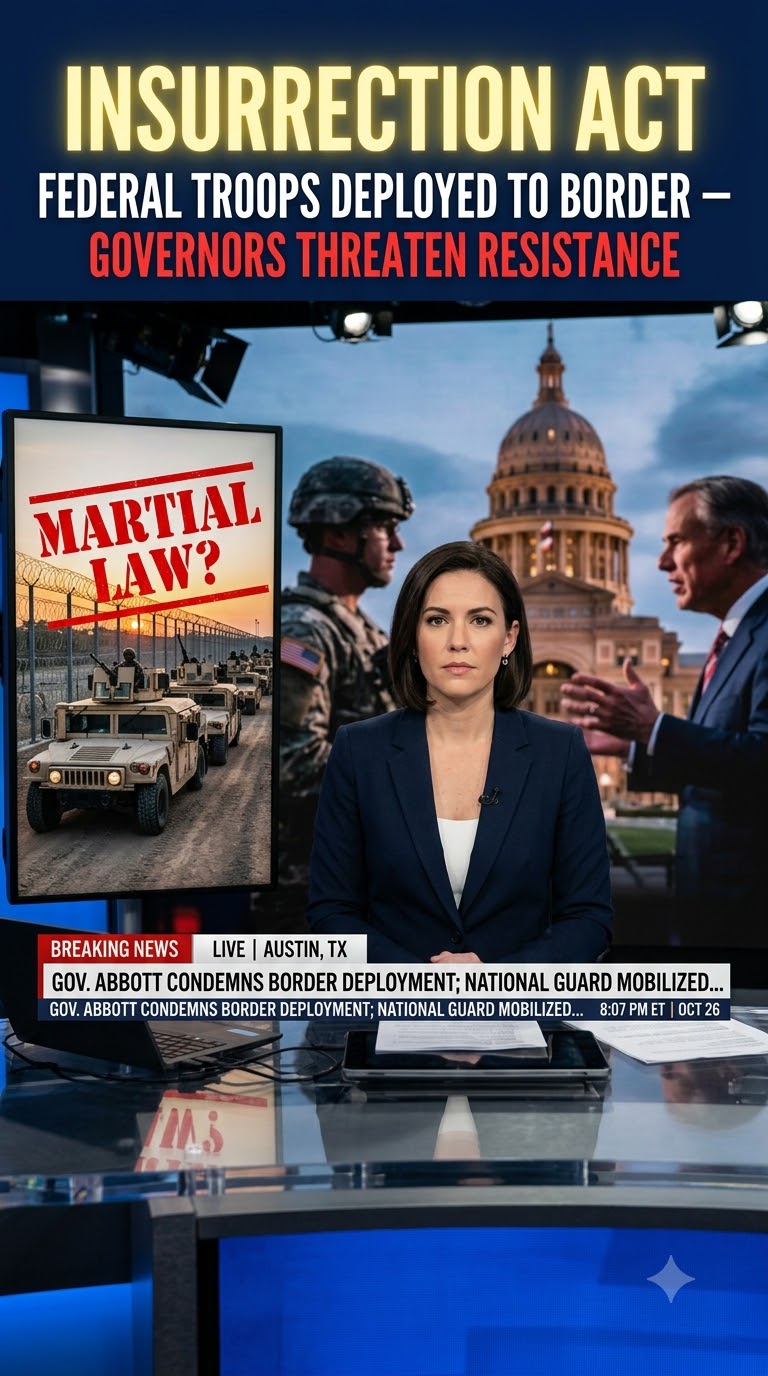
President Donald Trump has invoked the Insurrection Act of 1807 to deploy federal troops to the southern border, bypassing state governors who have refused to cooperate with mass deportation efforts. Texas Governor Greg Abbott has condemned the move and mobilized the state's National Guard, setting up a constitutional crisis that legal experts warn could be the most significant test of executive power since the Civil War.
AUSTIN, Texas – A dramatic confrontation is unfolding along the U.S.-Mexico border as President Donald Trump has ordered the deployment of active-duty federal troops to support immigration enforcement, using the Insurrection Act to override the authority of state governors who have refused to comply with the administration's deportation agenda .
Texas Governor Greg Abbott has condemned the federal deployment and mobilized the Texas National Guard, declaring that the state will not stand by while federal forces operate within its borders without consent. "This is a violation of state sovereignty," Abbott said in a statement. "Texas has the right and the duty to protect its citizens from federal overreach" .
What Is the Insurrection Act?
The Insurrection Act of 1807 is a federal law that authorizes the president to deploy U.S. military forces within the United States to suppress civil disorder, insurrection, or rebellion . The law provides an exception to the Posse Comitatus Act of 1878, which generally prohibits the use of the military for domestic law enforcement .
The Act grants the president sweeping authority to use troops when state authorities are unable to enforce federal law, without requiring congressional approval. It has been invoked approximately 30 times in U.S. history, most recently in 1992 when President George H.W. Bush deployed troops to Los Angeles to quell the riots following the Rodney King verdict .
Legal scholars warn that the law's language is dangerously broad. "There are no checks on what constitutes an 'insurrection' or 'obstruction' — Congress and the courts have no role in determining whether the conditions have been met," according to experts cited in recent analyses . Once invoked, the military can carry out arrests, searches, and other law enforcement functions — opening the door to military involvement in immigration enforcement .
Why Now?
The deployment comes amid escalating tensions over immigration enforcement. In January 2026, President Trump threatened to use the Insurrection Act to suppress protests against ICE operations in Minneapolis, where federal agents had been deployed to enforce immigration laws . At the time, Trump posted on Truth Social: "If the corrupt politicians of Minnesota do not follow the law and do not stop the extremists and professional rioters from attacking ICE patriots, I will use the Insurrection Act... to quickly end this game" .
Legal experts note that Trump's repeated references to the Insurrection Act represent an escalation of executive power. Since the Supreme Court blocked his earlier attempts to federalize National Guard units in 2025, the administration has increasingly turned to the Insurrection Act as a legal workaround to bypass state and judicial resistance .
Supreme Court Precedent
The Supreme Court has historically granted the president broad discretion in determining whether conditions warrant invoking the Insurrection Act. In an 1827 ruling, the Court held that the president has sole authority to decide when the Act should be applied .
However, recent legal challenges have emerged. In 2025, federal appeals courts blocked the administration's attempts to federalize National Guard troops without governors' consent, citing violations of the Posse Comitatus Act and constitutional limits on federal power .
Legal and Political Response
Governor Abbott's decision to mobilize the Texas National Guard sets up a direct confrontation between state and federal authority. The Texas governor has framed the issue as a matter of constitutional principle, arguing that the federal government cannot unilaterally deploy troops within a state without the governor's consent .
Democratic governors in other border states, including California's Gavin Newsom, have also condemned the deployment. Newsom previously described similar federal interventions as "a violation of state sovereignty" .
Republican lawmakers have expressed mixed reactions. Senate Majority Leader John Thune (R-SD) has expressed hope that local authorities can "work things out" without federal intervention . Senate Armed Services Committee Chairman Roger Wicker (R-MS) has called the use of the Insurrection Act "inappropriate" .
The Brennan Center for Justice has warned that the administration's use of the Insurrection Act sets a dangerous precedent, arguing that the law's ambiguity leaves it vulnerable to abuse .
The Broader Context
The border deployment comes amid a broader crackdown on immigration. In March 2025, Trump had threatened to deploy ICE agents to airports nationwide unless Congress funded DHS programs. The threat of federal military involvement in immigration enforcement has alarmed civil rights groups, who warn that it could lead to widespread violations of due process and constitutional rights .
The use of active-duty troops to enforce immigration law also raises questions about military readiness. Defense officials have previously expressed concerns that domestic deployments could strain military resources and training cycles.
What Happens Next?
The legal battle is expected to escalate quickly. Civil rights groups have already announced plans to challenge the deployment in federal court. Legal experts predict that the Supreme Court may ultimately need to intervene to resolve the constitutional questions raised by the invocation of the Insurrection Act.
The Texas National Guard remains mobilized, creating the potential for a direct confrontation between state and federal forces along the border — a scenario that has not occurred in modern American history.
| Key Detail | Information |
|---|---|
| Authority Invoked | Insurrection Act of 1807 |
| Deployment | Federal troops to southern border |
| State Opposition | Texas Gov. Abbott has mobilized Texas National Guard |
| Legal Basis | President has sole authority to invoke, per 1827 Supreme Court ruling |
| Recent Precedent | Last used in 1992 (LA riots) |
| Key Concern | Military could perform law enforcement functions (arrests, searches) |
| Legal Challenge | Planned by civil rights groups; likely to reach Supreme Court |
This is a developing story. The White House has not issued a detailed response to Abbott's mobilization of the Texas National Guard.
Comments (0)
Loading comments...
May You Like

Shocking news from Ohio: an unexpected development ahead of Trump's rally

South Korea–Ukraine Rift Deepens Over North Korean POW Transfer as PURL Draws New Scrutiny

FIGHT OVER OBAMA’S IRAN POLICY












