
Iran Caves: Trump Pulls Off Massive Victory as Ceasefire Deal Takes Shape After Weeks of Military Pressure
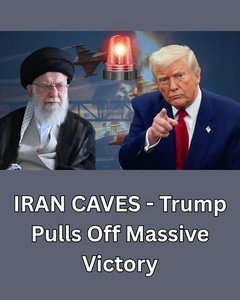
After a series of devastating joint U.S.-Israeli airstrikes and the dramatic assassination of Supreme Leader Ali Khamenei, Iran appears to be backing down. A viral graphic declaring "IRAN CAVES — TRUMP PULLS OFF MASSIVE VICTORY" is capturing the mood, but the full story is more complex — and more consequential — than one headline can capture.
WASHINGTON – A striking image circulating across social media features President Donald Trump pointing directly at the camera, with Iran's Supreme Leader Ali Khamenei seated beside him — and the words "IRAN CAVES - TRUMP PULLS OFF MASSIVE VICTORY" emblazoned across the bottom.
The graphic captures a dramatic shift in the geopolitical landscape: after months of escalating tensions, targeted strikes, and a stunning decapitation of Iran's leadership, the Islamic Republic appears to be signaling a willingness to negotiate.
But what exactly happened — and is "caving" the right word?
The Road to This Moment: A Timeline of Escalation
The path to Iran's apparent capitulation began with a dramatic escalation in early 2026.
On January 14, 2026, Iranian state television aired footage featuring an image of President Trump from the July 2024 assassination attempt at a campaign rally in Pennsylvania, along with a chilling message: "This time, it won't miss" . The threat came as Trump was weighing a possible military strike against Iran over its nuclear ambitions.
Trump responded with characteristic bluntness, warning that the United States was "fully prepared to use its Air Force against Iran" if Tehran refused to come to the negotiating table. He made clear that while Washington preferred diplomacy, it would be "backed by military power" if Iran did not comply .
Then came the strikes.
On February 28, 2026, a joint U.S.-Israeli operation carried out a series of precision airstrikes targeting high-ranking Iranian officials. The primary target: Supreme Leader Ali Khamenei .
According to Wikipedia's detailed account of the operation, Khamenei was assassinated on the first day of what would become known as the 2026 Iran War. The operation, which used strategic intelligence from the CIA to determine Khamenei's whereabouts, involved Israeli Air Force jets striking his compound with thirty precision munitions and Sparrow ALBMs .
Khamenei's death was confirmed by the Iranian government on March 1. The strikes also killed his daughter, granddaughter, son-in-law, and daughter-in-law, according to Fars News Agency .
The Iranian government announced 40 days of mourning and seven days of public holiday .
Iran Signals It's Ready to Deal
In the weeks following the assassination, Iran's position appears to have shifted dramatically.
According to reports, Iran has proposed reopening the Strait of Hormuz in exchange for a ceasefire — a significant concession from a regime that had previously threatened to close the critical oil chokepoint .
Speaking from West Palm Beach on Saturday, Trump acknowledged seeing a new **"concept" for a deal but labeled the current terms "unacceptable" . The president's willingness to entertain negotiations — while maintaining military pressure — has been a hallmark of his approach to the crisis.
Earlier reports indicated that Trump had received a seven-day offer to reopen the Strait of Hormuz, but with a "catch" that the president wasn't buying .
A "Massive Victory" — But at What Cost?
The graphic's claim of a "massive victory" is not without basis. The assassination of Khamenei represents one of the most audacious military operations in modern history — a decapitation strike against the supreme leader of a nation that has been a U.S. adversary for over four decades.
A previous plan to assassinate Khamenei during the Twelve-Day War in June 2025 was vetoed by Trump, according to unnamed U.S. officials . This time, the president gave the green light.
The operation was made possible by months of CIA tracking of Khamenei's movements. The Iranian leader had become increasingly reclusive after the Twelve-Day War, spending much of his time in a bunker so deep that its elevator took more than five minutes to reach, making opportunities to strike extremely rare .
The CIA learned that a meeting of senior officials was to take place with Khamenei in attendance, and the strikes were planned to coincide with that gathering .
Reactions inside Iran have been mixed. While many civilians went out to celebrate in the streets, thousands of others gathered in mourning . Iranian diaspora members around the world participated in joyful gatherings .
What Comes Next?
If Iran follows through on reopening the Strait of Hormuz and negotiating a broader deal, it would represent a stunning geopolitical realignment in the Middle East.
The Strait of Hormuz is the world's most important oil transit chokepoint, with approximately 20% of global oil consumption passing through it daily. Its closure would have sent global energy markets into chaos.
But significant questions remain:
-
Will Iran's new leadership honor any deal? With Khamenei gone, the power structure in Tehran is in flux.
What are Trump's actual terms? The president has said the current offer is unacceptable — but what would he accept?
Can a lasting peace be achieved? The 2026 Iran War has fundamentally altered the balance of power in the region.
Comments (0)
Loading comments...
May You Like


OBAMA STUNS ON INSTAGRAM: MESSAGE MARKING 34-YEAR MILESTONE SPARKS A BUZZ

Obama Steps Back Into the Political Spotlight as Democrats Target Trump’s Senate Majority












