
Iran wants to end the war; will Trump respond to Tehran
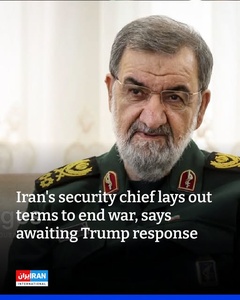
Iran’s top security official says Tehran has sent Washington conditions for ending the war, using Qatar as a mediator, while awaiting President Donald Trump’s response amid renewed regional tensions.
Supreme National Security Council Secretary Mohsen Rezaei made the remarks in an interview with Al Jazeera on September 19, outlining Tehran’s position as diplomatic contacts remain stalled.
Rezaei said Qatar had conveyed Iran’s conditions to Washington, while consultations with Qatari and Pakistani mediators were continuing as Tehran waits for an official response from Trump.
The Iranian official identified three central demands: an end to fighting on all fronts, the release of frozen Iranian funds, and termination of the American naval blockade.
Rezaei also described a broader seven-point framework for reopening negotiations, although he did not publicly detail every condition during the interview with Al Jazeera.
Iran’s demands come after a June memorandum of understanding brokered with help from Qatar and Pakistan established a temporary framework for reducing hostilities and pursuing further negotiations.
That agreement included provisions concerning the Strait of Hormuz, Iranian oil exports, sanctions relief and reconstruction, but the arrangement later expired after renewed disputes and military exchanges.
According to Al Jazeera, the memorandum expired last month, leaving both governments without a functioning framework for sustained negotiations despite continuing mediation efforts by regional governments.
The Strait of Hormuz remains central to the dispute because it is a major route for global energy shipments, while restrictions on maritime traffic have disrupted regional commerce.
Reuters reported that Iran reiterated its position that the waterway would remain effectively blocked until terms associated with the earlier agreement, as Tehran interprets them, are addressed.
The latest diplomatic initiative comes as regional tensions have intensified, with Yemen’s Houthi movement carrying out attacks around Saudi Arabia and threatening additional pressure on important shipping routes.
Reuters reported that Saudi Arabia said it intercepted a missile aimed at Riyadh on September 19, while the Houthis claimed attacks on sensitive sites and an Aramco facility.
The developments have expanded the conflict’s regional consequences, particularly for Gulf states, commercial shipping and energy markets, adding pressure to diplomatic efforts seeking a broader de-escalation.
Washington has continued to signal that military and economic pressure remain options, while Trump has also indicated openness to meeting Iranian President Masoud Pezeshkian during the United Nations General Assembly.
Reuters reported on September 20 that Trump warned Iran could face severe economic consequences or further escalation if Tehran does not reach a deal with Washington.
At the same time, Iranian military officials have warned that any new American attack could trigger retaliation against United States forces and interests across the region.
Rezaei said Iran was prepared to continue fighting if necessary, while arguing that negotiations could still provide a route toward ending the conflict under Tehran’s stated conditions.
The diplomatic uncertainty comes as the United States has approved visas for senior Iranian officials, including Pezeshkian, to attend the United Nations General Assembly in New York.
Whether those diplomatic contacts produce direct negotiations remains unclear, particularly because Tehran has insisted that Washington first meet its conditions before a renewed negotiating process can begin.
For now, Iran says the proposal has reached Washington through Qatar, leaving the next public response to the Trump administration as regional tensions continue to affect security, shipping and energy markets.
Comments (0)
Loading comments...
May You Like

TRUMP’S OHIO WARNING UNDER THE SPOTLIGHT

Russian Drone Strikes Kyiv Bridge as German Chancellor Arrives in Ukraine

OBAMA STUNS ON INSTAGRAM: MESSAGE MARKING 34-YEAR MILESTONE SPARKS A BUZZ












