
Trump Says Iran War Will End ‘Whenever I Want It to End'
Trump Says Iran War Will End ‘Whenever I Want It to End,’ Raising Questions About Presidential Power and Military Strategy
October 31, 2026 | Washington, D.C. | U.S. Politics & Middle East
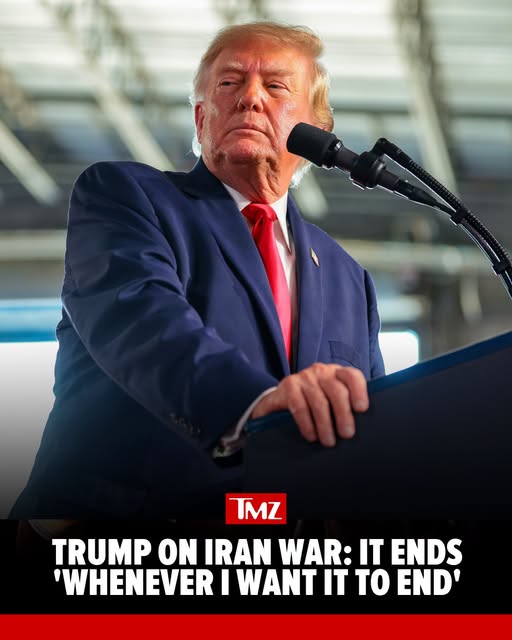
A widely circulated news graphic attributes a striking statement to President Donald Trump, suggesting that the duration of the Iran conflict ultimately depends on his personal decision to bring military operations to an end.
The headline features Trump standing at a podium alongside the declaration that the war will conclude whenever he wants, highlighting his assertive approach to presidential authority and military decision-making.
The statement raises important questions about executive power, the limits of presidential control over armed conflict, and the practical challenges involved in achieving a sustainable diplomatic settlement.
It also reflects Trump's longstanding preference for presenting himself as a decisive negotiator capable of applying military pressure while retaining the option of ending hostilities through an agreement.
Verification note: The image provides a quotation but no interview date or full transcript. Its exact wording and context must be independently established before it can be presented as a newly confirmed presidential statement.
Trump's Approach to the Iran Conflict
Trump's approach toward Iran has consistently combined economic pressure, military deterrence, and demands for restrictions on Tehran's nuclear activities and regional influence.
During his first administration, he withdrew the United States from the 2015 Iran nuclear agreement, arguing that its restrictions were insufficient to address long-term security concerns.
His administration subsequently reinstated extensive economic sanctions, seeking to pressure Iranian leaders into accepting a more comprehensive agreement covering nuclear development and other security issues.
The relationship deteriorated further following the January 2020 American drone strike that killed Iranian military commander Qassem Soleimani, triggering retaliatory Iranian missile attacks against American forces in Iraq.
These developments established a confrontational relationship between Washington and Tehran that continued to influence American policy after Trump returned to the White House in January 2025.
October 27 Rally Confirms Trump's Statement
The central claim in the viral graphic is authentic. During an October 27 campaign rally in Lubbock, Texas, Trump explicitly stated that he could determine when the conflict would conclude.
His remarks were recorded and subsequently reported by multiple news organizations, confirming that the headline reflects a genuine presidential statement rather than a fabricated social media quotation.
Trump also explained that he wanted the conflict resolved on terms preventing Iran from acquiring nuclear weapons, adding an important qualification to his declaration of personal control.
Trump Insists the Conflict Must End on American Terms
The president maintained that military operations could conclude quickly but emphasized that Washington needed an outcome addressing its central national security demands.
He portrayed the conflict as a necessary response to Iran's nuclear ambitions and accused previous American administrations of failing to adequately confront threats originating from Tehran.
His remarks suggested that negotiations remained possible, although he continued to present additional military pressure as an option should diplomatic efforts fail to achieve an acceptable agreement.
War Costs Reach Approximately $47 Billion
The latest reported military expenditure has added urgency to the debate, with estimates placing the American cost of the conflict at approximately $47.1 billion.
That figure includes spending on replacement munitions, lost military equipment, and additional operations, illustrating the substantial financial burden associated with prolonged military engagement.
The conflict has also contributed to higher energy prices, placing additional pressure on American households already concerned about gasoline costs, transportation expenses, and everyday affordability.
Congressional Critics Question Presidential Authority
Republican Representative Thomas Massie publicly challenged Trump's remarks on October 28, arguing that the Constitution does not permit the executive branch to wage an unauthorized war indefinitely.
His response highlighted longstanding disagreements over the division of military authority between Congress, which possesses the power to declare war, and the president as commander in chief.
Although presidents exercise substantial operational control over American armed forces, that authority does not automatically grant them unilateral control over every legal and diplomatic dimension of warfare.
Regional Allies Prepare for Possible Renewed Strikes
New reporting indicates that American officials have privately warned several Middle Eastern governments to prepare for possible renewed military operations against Iran following the November 3 elections.
Two diplomats familiar with those discussions said regional allies were also advised to consider potential Iranian retaliation against energy infrastructure and other strategically important facilities.
The officials emphasized that Trump had not made a final decision, leaving uncertainty over whether Washington would pursue additional strikes, renewed negotiations, or another diplomatic arrangement.
Can Trump Actually End the War Whenever He Wants?
Trump can order American military operations to stop, but ending a broader international conflict requires more than a unilateral announcement from Washington.
Iranian decisions, regional security arrangements, negotiations, and the possibility of continued retaliation could all influence whether a suspension of American attacks produces a lasting settlement.
The distinction is particularly important because military disengagement, a temporary ceasefire, and a comprehensive peace agreement represent different outcomes with significantly different long-term consequences.
What Happens Next?
The administration faces growing pressure to clarify its military objectives as voters prepare for the midterm elections and regional governments assess the possibility of further escalation.
Trump continues to insist that he can conclude the conflict quickly, but no publicly confirmed agreement guarantees that Iran would accept Washington's proposed conditions.
Final fact-check verdict: The quotation is genuine and was repeated during Trump's October 27 Texas campaign appearance. His assertion of control, however, should not be confused with proof that he can unilaterally secure lasting peace.
Comments (0)
Loading comments...
May You Like

STORM WARNING: MILLIONS FACE EVACUATION, MACY'S GIANT BALLOONS GROUNDED!

BLACK FRIDAY TENSIONS IN NYC — DID PROTESTERS CROSS THE LINE AT A DISNEY STORE?

CAIRO INFERNO — CAR CARRYING SENIOR U.S. OFFICIAL SLAMS INTO FUEL TANKER, 31 DEAD, 21 INJURED!













