
Iran's IRGC Navy Strikes 6 Vessels in Retaliation for U.S. Attacks on Oil Tankers
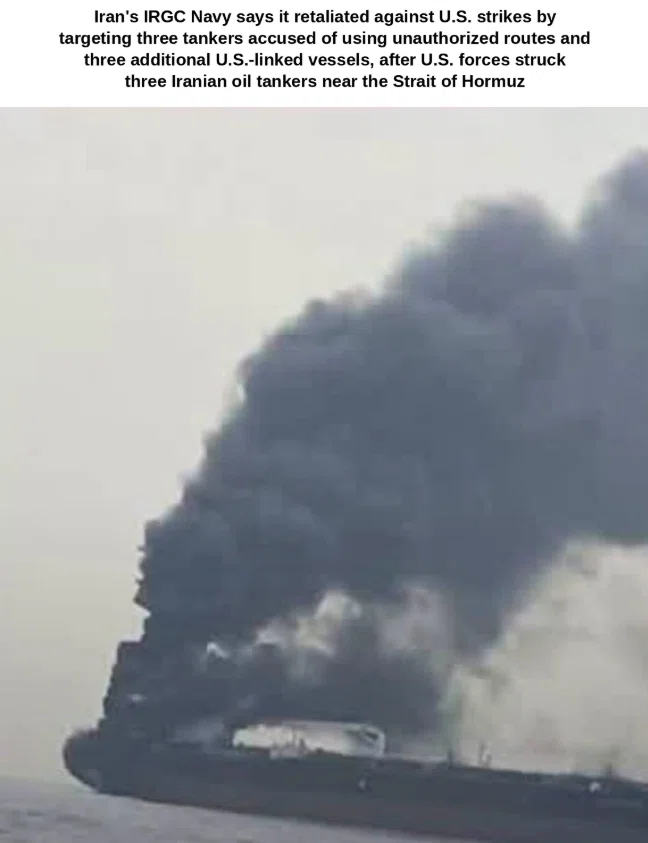
Iran's Islamic Revolutionary Guard Corps (IRGC) Navy announced on September 5 that it had struck three oil tankers in the Strait of Hormuz and three U.S.-affiliated vessels in other locations, in retaliation for U.S. military strikes against Iranian oil tankers earlier the same day .
TEHRAN/WASHINGTON – The tit-for-tat escalation marks a dramatic resurgence of hostilities after a month of relative calm in the ongoing U.S.-Iran conflict. The exchange began when the U.S. military struck three Iranian crude oil carriers, warning it would "if necessary, destroy Iran's limited and exposed oil fleet" .
The U.S. Strikes That Sparked the Retaliation
On September 5, U.S. Central Command (CENTCOM) announced that its forces had struck three Iranian oil tankers after the IRGC launched ballistic missiles toward two U.S. Navy warships patrolling in the region . According to CENTCOM, an American aircraft carrier and a guided-missile destroyer successfully evaded "multiple unprovoked Iranian attacks" with no U.S. personnel harmed .
The U.S. military said it permanently disabled two Iranian oil carriers and completely destroyed a third, unladen one . The targeted vessels were identified as:
| Vessel | Location | Status |
|---|---|---|
| M/T Downy | Off Kharg Island | Permanently disabled |
| M/T Stark 1 | Near Jask, east of Strait of Hormuz | Permanently disabled |
| M/T Kylo (aka "Noxen") | Gulf of Oman | Completely destroyed |
CENTCOM described the tankers as part of a multibillion-dollar "shadow network" that generates revenue for the IRGC and its regional proxies .
Adm. Brad Cooper, head of CENTCOM, issued a stark warning: "Let the message to the IRGC be clear: If you shoot at two of our ships, we will impose an even higher economic cost – taking out three of yours. We will not hesitate to defend American forces, and if necessary, destroy Iran's limited and exposed oil fleet" .
Iran's Retaliatory Strikes
In response, the IRGC Navy said it targeted three oil tankers crossing the Strait of Hormuz through what it described as "unauthorized" routes, as well as three vessels affiliated with the United States in other regions .
The IRGC cited a verse from the Quran in its statement: "And if you attack us, then attack us in the same way as we attacked you" . Iran's state broadcaster, IRIB, reported the strikes, though CENTCOM has not independently confirmed them .
Iran's Warning to Commercial Shipping
The IRGC Navy also issued a warning to all vessels operating in the Gulf and near the Strait of Hormuz, urging them to refrain from being "deceived" by the U.S. military and to avoid any "suspicious movement" to transit through "unauthorized" waterways, "otherwise they will be targeted" .
The Strait of Hormuz has become a critical flashpoint in the conflict. Since the war began on February 28 with U.S. and Israeli strikes on Iran, Tehran has restricted passage through the waterway, barring vessels linked to the United States or Israel, while U.S. forces have imposed a naval blockade targeting vessels traveling to or from Iranian ports and coastal areas .
A Dangerous Escalation
The exchange comes after six months of an on-again, off-again war that has seen both sides inflict military and economic pain . The resumption of attacks followed a month of relative calm, with at least five people killed earlier in the week during a U.S. bombardment of southern Iran — one strike reportedly hit a wedding .
Ebrahim Zolfaghari, spokesman for Iran's main military command, warned that if the U.S. continues its attacks on Iranian ships and the naval blockade, "the strikes by the armed forces of the Islamic Republic of Iran against U.S. military vessels in the region will be more severe than before, and there is a possibility of their expansion" .
Iran's Foreign Ministry condemned the U.S. attacks as "illegal and irresponsible actions" and "a war crime," warning that "the consequences arising from the continuation of such adventurist actions and U.S. interference in the region will rest squarely with the United States and its allies" .
The Bottom Line
| What Happened | The Details |
|---|---|
| U.S. strikes | Three Iranian oil tankers hit; two "permanently disabled," one "completely destroyed" |
| U.S. justification | Response to IRGC ballistic missile attacks on two U.S. Navy warships |
| Iran's retaliation | Three oil tankers in Strait of Hormuz + three U.S.-affiliated vessels targeted |
| Iran's warning | Ships using "unauthorized" routes will be targeted; U.S. attacks will be met with "more severe" strikes |
| Broader context | Conflict began Feb. 28; negotiations have collapsed; both sides targeting economic infrastructure |
Comments (0)
Loading comments...
May You Like

OBAMA STUNS ON INSTAGRAM: MESSAGE MARKING 34-YEAR MILESTONE SPARKS A BUZZ

Obama Steps Back Into the Political Spotlight as Democrats Target Trump’s Senate Majority

Russian Drone Strikes Kyiv Bridge as German Chancellor Arrives in Ukraine












