
Jack Smith Defends His Integrity as Trump Investigations Face Renewed Political Firestorm
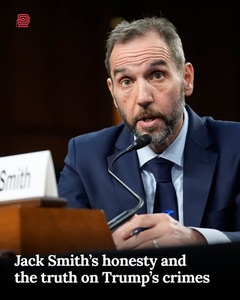
WASHINGTON — Former Special Counsel Jack Smith has returned to the center of the political and legal battle over Donald Trump, forcefully defending the investigations that produced two federal criminal cases against the former president.
Appearing before the Senate Judiciary Committee in late September, Smith rejected accusations that his prosecutions were politically motivated and said he stands by his decision to bring charges against Trump. The hearing came nearly two years after Trump’s federal cases were ultimately dismissed following his victory in the 2024 presidential election.
The confrontation has revived a fundamental question: Were the charges against Trump the product of partisan politics, or were they the result of evidence that prosecutors believed supported criminal prosecution?
The answer remains fiercely contested along political lines.
Jack Smith: “I Stand by My Decisions”
Smith told senators that his decisions were based on the evidence developed by his investigative teams rather than Trump’s political identity.
In testimony summarized from the hearing, Smith said that if presented with the same evidence today, he would prosecute the case regardless of whether the defendant were a Republican or Democrat.
His central argument is straightforward: the charges did not originate with Smith personally deciding that Trump should be punished. Federal grand juries in separate jurisdictions returned indictments based on evidence presented by prosecutors.
Smith therefore rejected the characterization of the investigations as simply an effort by Democrats or the Biden administration to eliminate Trump's political future.
Republican senators, however, sharply challenged that interpretation.
What Were the Charges Against Trump?
Smith's office pursued two major federal investigations.
The first concerned Trump's efforts to overturn his defeat in the 2020 presidential election and interfere with the peaceful transfer of presidential power.
In August 2023, Trump was indicted on four felony counts alleging conspiracy to defraud the United States, conspiracy to obstruct the certification of the Electoral College vote, obstruction of the certification process, and conspiracy against Americans' constitutional rights.
The second case concerned Trump's alleged retention of classified documents at Mar-a-Lago after leaving the White House, as well as alleged efforts to obstruct the government's attempt to recover those materials.
Trump pleaded not guilty and repeatedly characterized the investigations as politically motivated.
Smith's Final Report Made a Strong Claim
The most detailed defense of Smith's work came in his final report on the 2020 election investigation, released by the Justice Department in January 2025.
Smith wrote that his investigation had uncovered substantial evidence that Trump engaged in what prosecutors characterized as an unprecedented effort to overturn the legitimate election result and remain in power.
But there is an important distinction.
The report was a prosecutor's assessment, not a judicial verdict.
Trump never went to trial on those federal charges. Consequently, no jury ultimately determined whether he was guilty beyond a reasonable doubt.
Smith nevertheless argued that his team had enough admissible evidence to obtain and sustain a conviction if the prosecution had been allowed to proceed.
Why the Trump Cases Disappeared
The dismissal of the cases does not mean a court found Trump innocent of the allegations.
Instead, Trump's return to the presidency fundamentally changed the legal situation.
The Justice Department has long maintained that a sitting president cannot be federally prosecuted. After Trump won the 2024 election, Smith's office moved to dismiss the election case and the classified-documents prosecution against him.
Smith's final report explicitly argued that the decision to abandon the case was driven by the constitutional and Justice Department constraints surrounding a sitting president—not by a conclusion that the underlying allegations were false.
That distinction is at the heart of today's political argument.
Republicans Question Smith's Conduct
At the Senate hearing, Republican senators accused Smith and his team of abusing prosecutorial authority.
One of the most contentious issues involved the investigation's collection of phone records belonging to Republican lawmakers and other political figures.
Smith defended the investigative steps, saying they were connected to evidence prosecutors were pursuing concerning efforts to influence senators and the congressional certification process following the 2020 election.
Republicans argued that such actions demonstrated the investigation had gone too far.
Democrats countered that the Republican attacks were an attempt to discredit the investigation rather than address the evidence described in Smith's prosecution.
A Dramatic “Perjury” Allegation Collapsed
One particularly striking moment involved Republican Senator Eric Schmitt's questioning of Smith about where Smith had been on February 3, 2024.
Schmitt appeared to suggest that Smith had attended an NBA game in Atlanta, potentially raising questions about whether Smith had been involved in matters surrounding Fulton County District Attorney Fani Willis.
Smith denied that account.
The dispute ultimately turned out to involve a confusion between “Hawks” and “Hawkeyes.”
Smith had attended an Iowa women's basketball game in Maryland. Iowa's team is known as the Hawkeyes—not the Atlanta Hawks. Senator Amy Klobuchar highlighted the apparent mix-up during the hearing.
The episode became one of the most dramatic examples of how intensely partisan the questioning had become.
The Integrity Question Is Still Open to Political Debate
Smith's defenders point to his long career as a prosecutor and his insistence that the evidence—not Trump's political affiliation—drove the indictments.
Comments (0)
Loading comments...
May You Like

FIGHT OVER OBAMA’S IRAN POLICY

gfnhgmnghnmfgnbvvvvvvvvv

Obama Steps Back Into the Political Spotlight as Democrats Target Trump’s Senate Majority












