J.D. Vance 2028: Trump’s Vice President Becomes the Man to Watch in the Next Republican Power Struggle
WASHINGTON — The 2028 presidential election is still more than two years away, but the battle to determine who will inherit Donald Trump’s political movement is already beginning to take shape — and Vice President J.D. Vance is increasingly at the center of it.
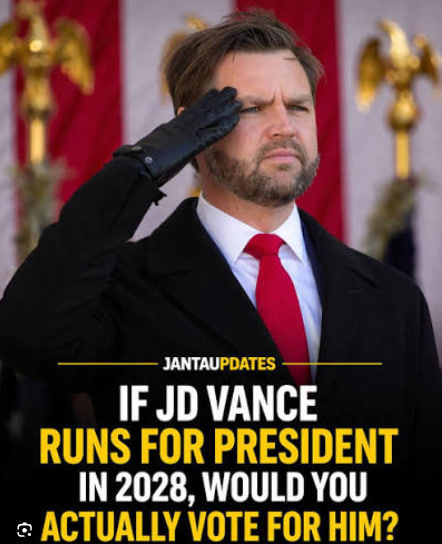
A viral image asking, “If J.D. Vance runs for president in 2028, would you actually vote for him?”, reflects a question that is rapidly becoming more serious inside Republican politics.
Vance has not announced a presidential campaign, and he has repeatedly signaled that his immediate focus remains on the Trump administration and the 2026 midterm elections. Yet his growing national profile, increasingly prominent role in the White House and strong support among conservative activists have made him one of the most closely watched potential Republican candidates for 2028.
The question facing Republicans is no longer simply whether Vance could run.
It is whether he could become the man who carries the Trump movement into the post-Trump era.
Vance Has Become Trump’s Most Visible Potential Successor
Vance's political rise has been extraordinarily fast.
The Ohio Republican went from being a relatively new senator to Trump's running mate and, ultimately, vice president. That trajectory has placed him in an unusually powerful position ahead of the next presidential election.
With Trump constitutionally barred from seeking a third elected term under the 22nd Amendment, Republicans will eventually have to choose a new presidential standard-bearer.
That makes Vance's position particularly important.
The vice president already has something many potential candidates will spend years trying to build: direct access to Trump's political base.
Vance has consistently defended the administration's agenda while presenting himself as one of the strongest voices of the movement Trump built. His appearances at political events have increasingly resembled the early stages of a national campaign, even though no formal campaign exists.
And Republicans are paying attention.
The Numbers Are Putting Vance in the Spotlight
One of the clearest signs of Vance's strength came at the 2026 Conservative Political Action Conference.
In the Republican presidential straw poll, Vance received 53% of more than 1,600 votes, placing him ahead of Secretary of State Marco Rubio, who received 35%.
No other potential candidate received more than 2%.
The result does not predict the 2028 Republican nomination — CPAC attendees represent a particularly conservative segment of the Republican electorate — but it demonstrates the level of enthusiasm Vance can generate among the party's activist base.
For Vance, that support matters.
A successful Republican presidential candidate will need more than Trump's endorsement. The candidate will need an organization, donors, activists and voters willing to campaign for them.
Vance is already beginning to accumulate some of those ingredients.
Trump Has Made the Succession Question Even More Complicated
The biggest wildcard remains Trump himself.
Trump has repeatedly discussed the possibility of Vance and Rubio becoming the Republican Party's future leaders. In June, Trump went even further, saying that he could not see how a Vance-Rubio ticket could be beaten if the two men ran together in 2028.
But Trump has also resisted definitively closing the succession debate.
That uncertainty has created an unusual situation inside the Republican Party.
Potential candidates are preparing for a race that Trump himself can still influence enormously, while trying not to appear as though they are campaigning against the president.
Vance faces an especially delicate balancing act.
He must remain loyal enough to Trump to retain the support of the MAGA base — while simultaneously proving that he can become a political force independent of Trump.
That may ultimately be one of the greatest challenges of his potential campaign.
The Vance-Rubio Rivalry Could Define the Republican Race
If Vance eventually enters the 2028 race, one of his most significant potential rivals could be Marco Rubio.
The two men occupy very different positions within the Republican Party.
Vance represents a younger, more populist generation of Republicans and has become closely associated with Trump's America First movement.
Rubio, meanwhile, brings years of experience in the Senate and a prominent role in foreign policy as secretary of state.
Both have been mentioned repeatedly as possible successors to Trump.
Both have appeared in high-profile political settings.
And both have been careful not to formally declare their intentions.
The competition became particularly visible when Vance and Rubio separately took turns at the White House press briefing room podium. Their appearances gave the public an unusually clear view of two politicians who may eventually compete for the same prize.
What makes the situation even more interesting is that Trump has suggested they could potentially run together.
That raises another enormous question:
Who would lead the ticket?
Vance Is Already Being Tested on the National Stage
The vice presidency can be both a launching pad and a political trap.
Every major decision Vance makes now is being watched not only for its impact on the current administration, but also for what it could mean for his political future.
His handling of foreign policy is one example.
Vance has emerged as a prominent voice on the administration's approach to Iran and the broader Middle East. His position has at times differed in emphasis from Rubio's, particularly over diplomacy and the use of military power.
That could become increasingly important if Vance runs for president.
Republican voters will eventually have to decide what kind of foreign policy they want after Trump.
Should America continue Trump's more interventionist approach in certain circumstances?
Should Republicans embrace Vance's skepticism toward prolonged foreign wars?
Or will voters prefer Rubio's more traditional national-security outlook?
Those questions could turn a Republican primary into a major ideological confrontation.
Democrats Are Already Treating Vance as a Serious Threat
The Democratic Party is not waiting for Vance to officially announce a campaign.
Democratic politicians and strategists have increasingly begun targeting him directly, suggesting that they already view him as one of the Republican Party's most important potential candidates for 2028.
That is significant.
Political parties rarely spend substantial resources attacking a politician they believe is irrelevant to the next presidential race.
Instead, Democrats are attempting to define Vance before he has the opportunity to define himself as a presidential candidate.
His opponents have attacked his economic policies, his relationship with Trump and his political transformation from a former Trump critic into one of the administration's strongest defenders.
For Vance, this creates another challenge.
The longer he remains nationally visible, the more time his opponents have to build a political narrative around him.
The Biggest Question: Can Vance Win Beyond MAGA?
Vance's strongest asset could also become his biggest vulnerability.
His close relationship with Trump gives him credibility with the Republican base.
But a presidential election is not decided solely by the most enthusiastic activists.
Vance would eventually need to appeal to a much broader electorate.
That means convincing suburban Republicans, independents and voters who may support some Trump policies but remain uncomfortable with the most controversial elements of the MAGA movement.
His age could also become a defining feature.
If Vance ran in 2028, he would be only 44 years old, making him one of the youngest serious contenders in modern Republican presidential politics.
For supporters, that could represent a generational change.
For critics, it could raise questions about his experience.
Either way, his age would make him difficult to ignore.
Iowa Could Offer an Early Test
One of the clearest signs that Vance is taking his national political future seriously came in Iowa.
In May, he traveled to Des Moines and appeared alongside Republican Rep. Zach Nunn, speaking to voters in a state that traditionally plays an important role in the Republican nomination process.
Vance promoted Trump's economic policies, attacked Democrats and emphasized themes aimed at working-class voters.
He did not announce a presidential campaign.
But politically, the trip mattered.
Iowa is not just another state for a potential Republican presidential candidate. Its caucuses are traditionally the first major test of a candidate's ability to organize activists and attract grassroots support.
Vance's appearance therefore attracted attention as a potential early test of his appeal among Republican voters.
The 2026 Midterms Could Change Everything
For now, Vance is expected to remain focused on helping Republicans during the 2026 midterm elections.
That timing could be crucial.
A strong Republican performance could strengthen the administration and potentially improve Vance's standing inside the party.
A disappointing result, however, could create opportunities for rivals.
Republicans are already preparing for a major political battle in November, while Trump remains deeply involved in the party's campaign strategy.
Vance's own comments suggest that the midterms may be an important dividing line.
Rather than immediately jumping into the 2028 conversation, he has indicated that he wants to concentrate on the elections ahead before making major decisions about his future.
That means the most important phase of the Vance story may still be ahead.
The Republican Party Could Soon Face a Generational Showdown
The Republican Party that emerges after Trump could look very different from the party that existed before him.
Vance represents one possible future: younger, populist, nationalist and deeply connected to Trump's political coalition.
Rubio represents another: experienced, internationally focused and capable of appealing to a broader range of Republican voters.
Ted Cruz and other Republicans are also beginning to position themselves for a potential campaign, meaning Vance cannot assume that Trump's support will automatically translate into the nomination.
And there is always the possibility of another candidate emerging from outside the current shortlist.
That is why the 2028 race remains unpredictable.
So, Would Americans Actually Vote for J.D. Vance?
That is the question behind the viral image.
And right now, there is no definitive answer.
Vance has not declared his candidacy. The Republican primary is still years away. Voter preferences can change dramatically, and major political events between now and 2028 could completely reshape the race.
But one fact is increasingly difficult to dispute:
J.D. Vance is no longer simply being discussed as Donald Trump's vice president.
He is being discussed as a potential successor.
He has won major support in conservative straw polls, built a national political profile, traveled to early-primary states and become one of the most visible figures in the Trump administration.
At the same time, potential rivals are beginning to test the waters, Democrats are already attacking him and Trump continues to keep the succession question alive.
The 2028 presidential campaign has not officially begun.
But inside the Republican Party, the battle to decide what comes after Trump may already be underway.
And if J.D. Vance eventually decides to run, the question will no longer be whether he is ready to enter the race.
It will be whether America is ready to make him the next president.
Comments (0)
Loading comments...
May You Like

South Korea–Ukraine Rift Deepens Over North Korean POW Transfer as PURL Draws New Scrutiny

FIGHT OVER OBAMA’S IRAN POLICY